The Illinois Health Care Services Lien Act applies to both medical providers and injured plaintiffs after an accident. It allows healthcare professionals and providers to claim a portion of a lawsuit settlement for the services they provided, while also capping how much they can take. Understanding the Illinois medical lien act is important for anyone involved in personal injury claim cases in Illinois.
The Chicago personal injury lawyers at The Kryder Law Group, LLC Accident and Injury Lawyers—with their deep experience and in-depth knowledge of the act—provide guidance and representation to help injured parties navigate these legal challenges.
What Is the Illinois Medical Lien Act?
¿Ha recibido un derecho de retención médica después de su accidente?
If you were injured in a car crash or other accident caused by someone else’s negligence, you likely needed hospital care and follow-ups with your doctor or physical therapist, leading to medical bills. You may receive a notice about an unpaid bill and a lien placed on your case by the healthcare provider. This may leave you with questions: What does this mean? What are my healthcare providers asking for? Why didn’t my health insurance company cover my medical bill? What should I do now?
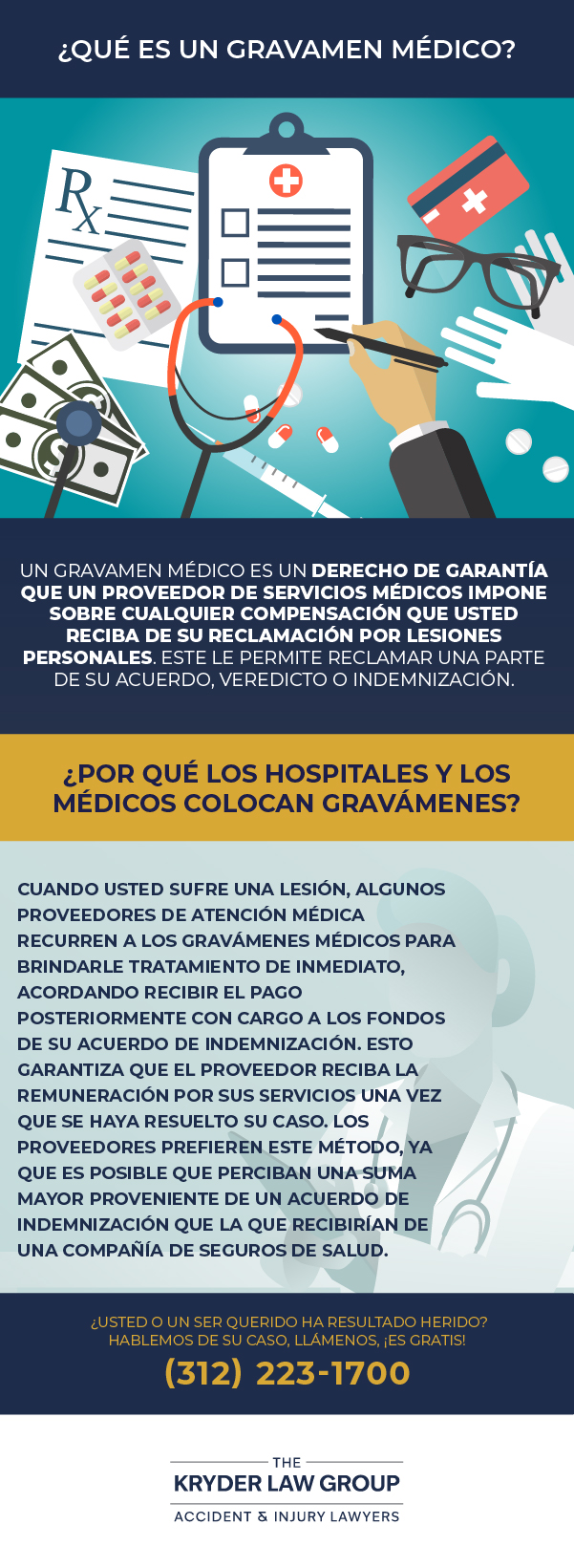
A medical lien is a security interest that medical providers place on any compensation a victim may receive from his or her claim. It allows them to claim a portion of the settlement, verdict, award, or any other recovery that was won.
¿Por qué embargan los hospitales y los médicos?
Medical providers use liens on personal injury claims to ensure they get paid as part of the settlement or award. They offer medical treatment first, deferring payment until the personal injury case ends. A healthcare professional prefers liens for services rendered because they typically get more money from settlements than from the patient’s health insurance.
¿Me han embargado?
According to the Illinois Health Care Services Lien Act (770 ILCS 23/10(b), the written notice of lien must contain:
The name and address of the injured person
The date of the injury or when the injury was sustained
The name and address of the healthcare professionals or healthcare providers
The name of the party that was allegedly negligent and would be liable to make compensation to the injured person
The lien notice must be served on both the allegedly negligent party and the injured party. It can be delivered by registered or certified mail or in person.
Cómo funciona la Ley de Embargo
Under the Illinois Lien Act, a common fund is created from 40% of the case proceeds, which is split equally among professionals and providers. Healthcare professionals include physicians and therapists, while providers are hospitals, emergency rooms, or emergency medical services personnel. Each share is based on the billed amounts within the fund’s limits.
Ejemplos de embargos médicos
For example, let’s say that an injured person was awarded $25,000 at arbitration. The amount in medical liens total $19,000 and is as follows:
Health Care Providers: $8,000
Emergency Room Lien: $8,000
Health Care Professionals: $11,000
Chiropractor Lien: $8,500
Diagnostic Imaging Lien: $2,500
Here, the common fund is $10,000 (40% of the $25,000 arbitration award). Since the total liens exceed the 40% statutory limit, they must be reduced to the $10,000 lien limit. Following the Illinois Lien Act, the final lien amounts will be adjusted accordingly:
Fondo Común: 10.000 dólares
Proveedores de asistencia sanitaria: 5.000 dólares
Gravamen de la sala de urgencias: 5.000 $.
Health Care Professionals: $5,000
Chiropractor Lien: $3,863.64
Diagnostic Imaging Lien: $1,136.36
¿Y si hay un gran embargo hospitalario?
If there’s a large hospital lien, it may be possible to negotiate with the provider or facility to reduce it. This is especially helpful if the settlement or verdict doesn’t cover all expenses, leaving the injured party with little or no compensation for pain and suffering.
What Is MedPay?
MedPay is an optional auto insurance benefit that covers medical expenses for you or your passengers after an accident, no matter who’s at fault. It helps with deductibles, copays, hospital visits, and other treatments.
When MedPay is paid, a lien is placed on any personal injury settlement from the accident. Sometimes, insurers communicate, and the at-fault carrier pays the MedPay lien. This removes the lien on the injury claim, but the at-fault carrier gets a setoff.
Un ejemplo de MedPay en una demanda por lesiones personales:
El demandante tiene un seguro con la compañía A, que paga 10.000 dólares en concepto de MedPay.
Defendant’s insurer, Company B, reimburses Company A for the $10,000.
When the plaintiff claims bodily injury against the defendant and Company B, valuing the case at $100,000, Company B agrees to pay only $90,000—citing the $10,000 it already paid.
¿Cuánto puede tomar Medicaid de un acuerdo en Illinois?
Like MedPay, Medicaid and Medicare aren’t covered by the Illinois Health Care Services Lien Act and don’t require interested parties to be notified. They have priority over other healthcare liens.
The biggest challenge with Medicaid and Medicare liens is how long they take to resolve, even though they’re usually lower than hospital or doctor bills. When attorneys review a Medicaid or Medicare benefits ledger, they see both charges and payments. Since Medicaid has contracted rates with providers, any remaining balances are often written off.
The Illinois Workers’ Compensation Act generally does not allow for medical liens against an injured employee’s claim or any settlement proceeds.
I Still Don’t Understand Medical Liens—Who Can Help Me?
If you have any questions about medical liens—or if you were injured due to someone’s negligence—do not hesitate to call The Kryder Law Group, LLC Accident and Injury Lawyers, for a free consultation with an experienced personal injury lawyer to discuss your injuries.
Entender la ley de derecho de retención médica de Illinois es importante para cualquier persona involucrada en casos de demandas por lesiones personales en Illinois.


 March 22nd, 2026








 (312) 223-1700