Es posible que muchos conductores se pregunten:«¿Cuánto se puede superar el límite de velocidad?». La legislación de Illinois es clara: cualquier exceso —incluso solo 5 mph por encima del límite de velocidad indicado— es ilegal. El exceso de velocidad es una de las principales causas de accidentes de tráfico en todo el país. Si tú o un ser querido habéis sufrido lesiones graves a causa de un conductor que circulaba a exceso de velocidad, un abogado de nuestro bufete especializado en lesiones personales puede ayudarte a conocer tus derechos y a reclamar la indemnización que te corresponde.
En este artículo
Illinois tiene leyes contra el exceso de velocidad
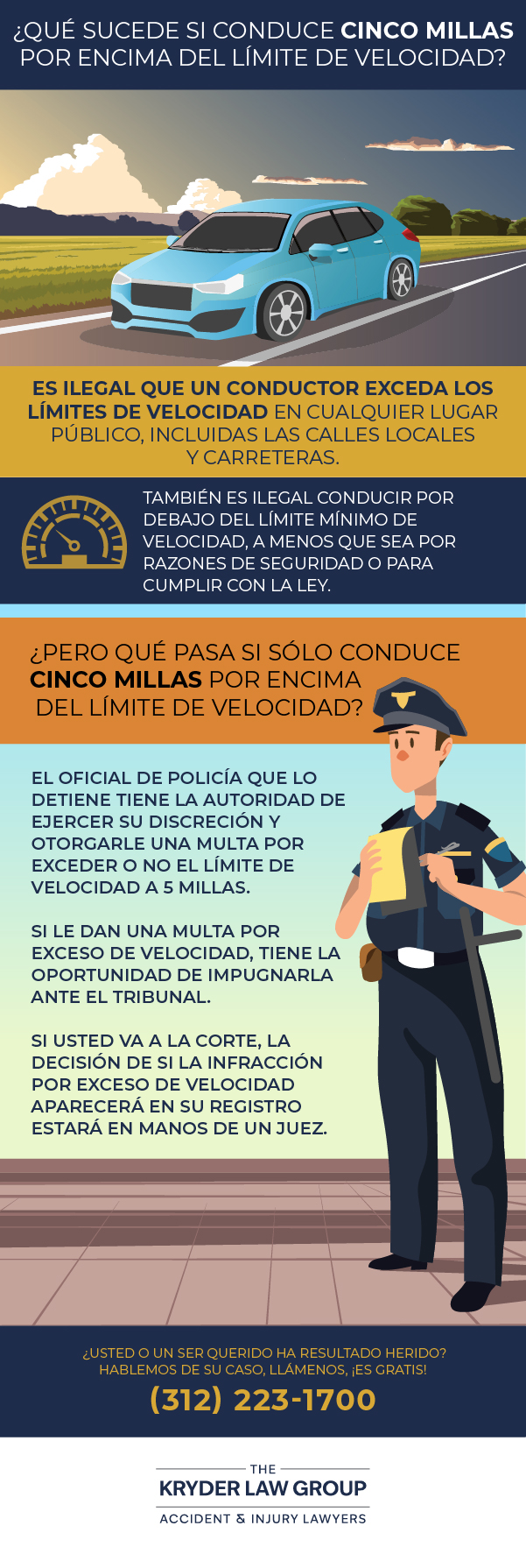
En Illinois, es ilegal superar el límite de velocidad en cualquier vía pública, incluidas las calles de los barrios residenciales, los barrios urbanos y la red de carreteras estatales. Conducir a más de 26 millas por hora por encima del límite de velocidad puede dar lugar a una acusación por delito menor de clase B.
Pero, ¿qué pasa si solo superas el límite de velocidad en cinco millas?
En este caso, el agente de policía que acuda al lugar tiene la facultad de actuar según su criterio a la hora de hacer cumplir los límites de velocidad. Puede optar por detenerte y ponerte una multa. Si un agente de policía te pone una multa por exceso de velocidad, siempre tienes la posibilidad de recurrirla ante un tribunal. En última instancia, un juez analizará los hechos y decidirá si la infracción por exceso de velocidad quedará registrada en tu historial de conducción.
¿Existe un límite de velocidad mínimo?
Sí, lo hay. Según la legislación de Illinois (625 ILCS 5/), nadie debe conducir tan despacio que obstaculice el flujo normal y razonable del tráfico. Las únicas excepciones son cuando es necesario conducir despacio por motivos de seguridad —como en caso de tráfico denso— o para cumplir con la ley. En la mayoría de las carreteras principales y autopistas hay un límite de velocidad mínimo señalizado. Los conductores que decidan circular por debajo de este límite mínimo de velocidad también pueden ser objeto de multas de tráfico y sanciones económicas.
Presta atención a los límites de velocidad locales y en zonas residenciales
A menudo, los distintos pueblos y aldeas tienen límites de velocidad en zonas residenciales diferentes a los de las calles de la ciudad. No se puede dar por sentado que todos los barrios tengan las mismas normas. Por lo tanto, es importante estar atento a los límites de velocidad más bajos y respetar las señales indicadas cada vez que se entre en un nuevo municipio.
Por ejemplo, Skokie (Illinois) ha modificado recientemente el límite de velocidad máximo en sus calles residenciales a 25 mph. Las administraciones locales suelen introducir estos cambios para proteger a los peatones, a los ciclistas y a los niños que juegan cerca de la calle. Mantente siempre alerta y presta atención a las señales de tráfico de tu zona.
¿La policía vigila algunos lugares más de cerca que otros?
Sí. Los agentes de policía y los radares vigilan mucho más de cerca determinados lugares en los que hay personas vulnerables y en los que se exige circular a velocidades más bajas. Superar el límite de velocidad en estas zonas especiales puede acarrear multas considerablemente más elevadas y graves consecuencias legales.
Zonas en construcción
Los conductores que superen el límite de velocidad en zonas de obras se enfrentan a una multa de 375 dólares (como mínimo) por su primera infracción. Las reincidencias pueden acarrear rápidamente multas más elevadas e incluso la suspensión del carné de conducir, según el Departamento de Transporte de Illinois (IDOT).
Zonas escolares
Superar los límites de velocidad en las zonas escolares se considera conducción temeraria y una infracción muy grave. La legislación de Illinois (625 ILCS 5/11-605) establece claramente que los conductores no pueden superar los 20 mph en las zonas escolares entre las 7:00 y las 16:00 horas los días en que haya niños presentes.
¿Permiten algunas situaciones el exceso de velocidad?
En Illinois no existen leyes específicas que permitan el exceso de velocidad bajo ninguna circunstancia. En general —según el Colegio de Abogados del Estado de Illinois (ISBA)—, en determinados casos en los que se imputa un delito, un juez puede optar por un enfoque alternativo y ordenar la supervisión judicial en lugar de dictar una sentencia condenatoria.
¿Cómo ve Illinois la negligencia?
El estado de Illinois se rige por una ley de negligencia contributiva (735 ILCS 5/2-1116). Si usted fue el principal causante de un accidente, podría ser responsable de los daños y perjuicios resultantes. Sin embargo, conducir a una velocidad ligeramente superior al límite máximo no le hace automáticamente responsable en su totalidad de un accidente.
Por ejemplo, imagina que circulabas a 5 millas por hora por encima del límite establecido cuando tu vehículo chocó con otro coche. Si el otro conductor estaba distraído enviando un mensaje de texto y no se detuvo en absoluto ante un semáforo en rojo, la negligencia principal podría atribuírsele igualmente a él.
¿Cuáles son las normas sobre exceso de velocidad en otros estados del Medio Oeste?
Si viajas con frecuencia por motivos de trabajo o de ocio, debes conocer las normas de tráfico de otros lugares fuera de Illinois. A continuación te ofrecemos un breve resumen de la legislación sobre exceso de velocidad en los demás estados del Medio Oeste en los que prestamos servicio:
Indiana
En Indiana se aplican dos normas sobre exceso de velocidad: la norma básica y los límites absolutos. La norma básica exige a los conductores mantener una velocidad segura y razonable en función de las condiciones del momento y los posibles peligros. Los límites absolutos establecen velocidades máximas específicas, que oscilan entre las 15 mph y las 70 mph, dependiendo de la ubicación.
Iowa
En Iowa, los límites de velocidad son de 70 mph en las autopistas interestatales rurales, de 65 mph en las autopistas de varios carriles con separación central y de 55 mph en las carreteras comarcales. En las zonas urbanas, los límites suelen ser de 20 a 25 mph en los barrios comerciales y residenciales, y de 45 mph en las zonas suburbanas. El exceso de velocidad se considera una infracción leve, con multas que oscilan entre los 30 y los 100 dólares o más, dependiendo de la velocidad.
Kentucky
Kentucky aplica leyes estrictas contra el exceso de velocidad con límites absolutos. Las sanciones incluyen multas (de 1 a 100 dólares o más), costas judiciales (aproximadamente 143 dólares) y entre 3 y 6 puntos. Las velocidades superiores a 25 mph por encima del límite de velocidad (o superiores a 10 mph por encima del límite de velocidad en zonas de obras o escolares) pueden acarrear multas graves (de 500 dólares o más), la suspensión del permiso de conducir o cargos por conducción temeraria.
Míchigan
Las leyes de tráfico de Míchigan sobre el exceso de velocidad exigen una velocidad «cuidadosa y prudente», que permita detenerse de forma segura en una distancia de frenado adecuada en función de las condiciones. Los límites máximos son de 70 mph en autopistas y de 55 mph en carreteras sin mediana, y se imponen sanciones de 3 puntos por superar dichos límites en 11 mph o más.
Minnesota
Las leyes de tráfico de Minnesota establecen límites de velocidad de 70 mph en las autopistas interestatales rurales, de 55 a 65 mph en las autopistas interestatales urbanas y de 30 mph en las zonas urbanas. Las multas superan los 100 dólares por conducir 10 mph o más por encima del límite de velocidad, y conducir a más de 100 mph conlleva la retirada del carné durante seis meses. A partir de 2025, se permitirán los radares automáticos en determinadas ciudades.
Misuri
Las leyes de Missouri sobre exceso de velocidad incluyen límites absolutos (hasta 70 mph en autopistas interestatales rurales, 65 mph en vías rápidas rurales y 60 mph en autopistas interestatales urbanas) y una norma básica para circular a una velocidad segura en función de las condiciones. Las infracciones que supongan un exceso de velocidad igual o inferior a 5 mph respecto al límite establecido se consideran infracciones leves. Las infracciones que supongan un exceso de velocidad de entre 6 y 20 mph se consideran delitos menores de clase C. Y las infracciones que superen en más de 20 mph el límite de velocidad se consideran delitos menores de clase B.
Ohio
Las leyes de Ohio sobre exceso de velocidad exigen una velocidad «razonable y adecuada» en función de las condiciones. Las multas oscilan entre 150 y más de 300 dólares, con 2 a 4 puntos. Se puede aplicar una sanción propuesta de 200 dólares por conducir a una velocidad excesiva. Las sanciones incluyen 2 puntos por exceso de velocidad leve y 4 puntos por exceso de velocidad grave. Acumular 12 puntos en 2 años conlleva una suspensión del permiso de conducir de 6 meses.
Wisconsin
Las leyes de Wisconsin sobre exceso de velocidad imponen multas (entre 200 y 800 dólares o más), de 3 a 6 puntos de penalización y una posible suspensión del permiso de conducir por superar los límites de velocidad o conducir a velocidades peligrosas. Entre las leyes más importantes se encuentra el artículo 346.57, que regula las velocidades absolutas y las «razonables y prudentes». Conducir a una velocidad superior en 25 mph o más al límite de velocidad en zonas de 55+ mph conlleva una suspensión obligatoria de 15 días.
Llame hoy mismo a los abogados de The Kryder Law Group, LLC Abogados de accidentes y lesiones.
Si usted o un ser querido ha resultado gravemente herido por un conductor que excedía la velocidad permitida, contáctenos para explorar sus opciones legales y la posible indemnización.
Ofrecemos una consulta gratuita para hablar sobre accidentes relacionados con el exceso de velocidad. Esta es nuestra oportunidad para evaluar su situación, brindarle orientación y responder a sus preguntas sin costo alguno.
Si ha resultado lesionado por un conductor que excedía el límite de velocidad, un abogado especializado en accidentes automovilísticos de Chicago puede ayudarle.
¿Tengo motivos para presentar una demanda?
Dirección
134 North LaSalle St., Suite 1515, , Chicago, IL 60602 Cómo llegar
Acuerdos y sentencias
$7.5M
Se han conseguido 7,5 millones de dólares para un trabajador de la construcción que sufrió un accidente en la obra
$3M
Se han recuperado 3 millones de dólares para la familia de una persona atropellada por un camión de basura
$2.2M
Se han recuperado 2,2 millones de dólares para un comercial que resultó herido en un accidente de tráfico
$2M
Se han conseguido 2 millones de dólares para una persona que fue atropellada por un vehículo que circulaba a exceso de velocidad mientras esperaba el autobús de la CTA
$1.4M
Se han recuperado 1,4 millones de dólares para un programador informático que resultó herido tras sufrir un resbalón y una caída
$1M
Indemnización de 1 millón de dólares en solo 90 días para la familia de un hombre que falleció mientras ayudaba a un conductor que se había quedado tirado


 10 de abril de 2026










 (312) 223-1700