No official average motorcycle accident settlement figure exists. Private insurance payouts and out-of-court agreements aren’t reported to government agencies, so no federal or state authority publishes a reliable benchmark. Your case value depends on your injuries, medical costs, lost wages, pain and suffering, and available insurance coverage. Most Midwestern states allow two years from the accident date to file a personal injury lawsuit.
If you’ve been hurt in a motorcycle crash, you’ll want to know: what is the average motorcycle accident settlement? Any attorney who gives you a firm number before reviewing your case isn’t being straight with you. Our experienced motorcycle accident attorneys can begin to answer that question.
Settlements vary widely. A minor crash with moderate injuries (like soft tissue injuries) settles very differently from one involving a traumatic brain injury (TBI) or spinal cord damage. This page breaks down what drives case value, so you know what to expect—and what to fight for.
In this Article
Why There Is No “Official” Average Motorcycle Accident Settlement
No federal or state agency publishes average settlement figures for motorcycle accident claims. Private insurance payouts, structured settlements, and out-of-court agreements are confidential and not reported to government bodies.
What government data does tell us is how serious motorcycle crashes tend to be—and that directly shapes how claims are valued:
According to National Highway Traffic Safety Administration (NHTSA) data, motorcyclists were nearly 27 times more likely than passenger car occupants to suffer a fatal crash per vehicle mile traveled in 2024.
The Centers for Disease Control and Prevention (CDC) reports that motorcycle crashes accounted for 13% of all motor vehicle crashes in 2022, with lifetime medical, work, and quality-of-life losses exceeding $65 billion.
Research in the Canadian Journal of Neurological Sciences estimates lifetime medical costs for a severe TBI at $600,000 to $1.8 million per case, with lost productivity potentially far higher.
These figures don’t translate directly into settlement amounts, but they explain why serious motorcycle injury claims often result in substantial compensation demands.
Some aggregated industry and law firm data suggest nationwide motorcycle accident settlements range from under $25,000 for minor injuries to well over $1,000,000 for severe or permanently disabling injuries. These are general context figures from pooled legal market data—not government-verified benchmarks. Your motorcycle accident lawyer can value your case based on its own facts.
Factors That Affect Motorcycle Accident Settlement Size
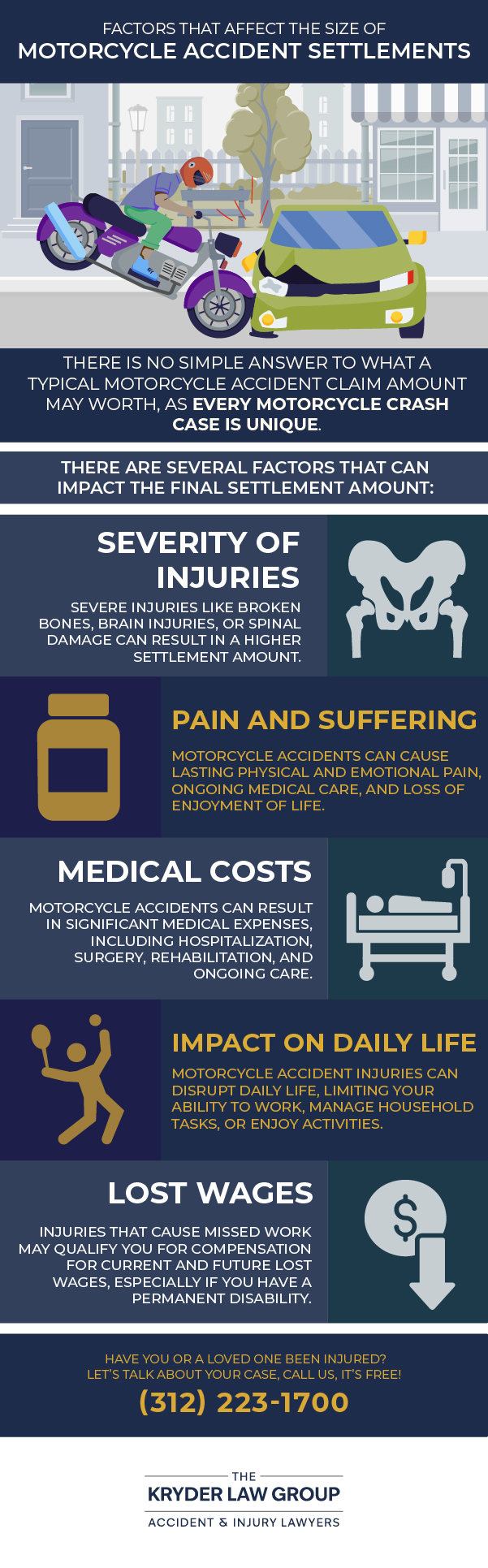
There are many factors that determine what the payout will be for a seriously injured rider.
Injury Severity
The more severe the injuries are, the higher the potential settlement. Broken bones, head injuries, and spinal damage require more treatment, longer recovery, and often cause permanent life changes—all of which increase claim value. Catastrophic injuries can result in the highest motorcycle crash settlements.
Pain and Suffering
Physical pain is compensable, as is emotional distress. Anxiety, depression, post-traumatic stress disorder (PTSD), and loss of enjoyment of life are all factored into settlement calculations, even without a bill attached.
Medical Costs
Hospital stays, surgeries, rehabilitation, and ongoing treatment are among the most direct drivers of settlement size. A settlement should cover both costs already incurred and projected future medical expenses.
Impact on Daily Life
If your injuries prevent you from working, completing household tasks, or doing activities you previously enjoyed, that lost quality of life has monetary value that courts and insurers account for.
Lost Wages
Missed work is compensable. If injuries affect your ability to work long-term or permanently, you may also recover damages for diminished future earning capacity.
Types of Damages You Could Recover
In most Midwestern states, motorcycle accident victims can pursue two categories of compensation:
Economic damages—tangible financial losses:
Medical bills and future healthcare expenses
Lost wages and reduced earning capacity
Property damage to your motorcycle and gear
Non-economic damages—real but less visible harms:
Physical pain and suffering
Emotional distress, including PTSD
Permanent disfigurement or disability
Loss of enjoyment of life
In cases involving a fatal injury, surviving family members may pursue wrongful death damages under state law. Filing deadlines for wrongful death claims vary by state, so speak with an experienced attorney as soon as possible.
Injuries That Typically Result in the Highest Settlements
Motorcyclists have far less physical protection than drivers of enclosed vehicles, which is why crash injuries tend to be serious. The injuries most commonly associated with larger settlements include:
TBIs are long-term cognitive, physical, and behavioral impairments. Lifetime medical costs for a severe TBI are estimated at $600,000 to $1.8 million per case.
Spinal cord injuries can result in partial or full paralysis, chronic pain, and permanent loss of sensation.
Neck and back injuries, including herniated discs, muscle strains, and spinal fractures, can be painful and debilitating for months or years.
Fractures like broken arms, legs, and other bones often require surgery and extensive rehabilitation.
Road rash or severe friction burns may require skin grafts and can leave permanent scarring.
Amputations can result in long-term care, prosthetics, and lost capacity, substantially increasing settlement value.
Internal organ damage is a life-threatening injury that often requires emergency surgery and extended hospitalization.
Soft tissue injuries like whiplash and related injuries may not appear on imaging but can cause significant pain and mobility limitations.
How Insurance Minimums Affect Your Settlement
Every state sets its own minimum liability insurance requirements. Across Illinois, Indiana, Iowa, Kentucky, Michigan, Minnesota, Missouri, Ohio, and Wisconsin, all require some combination of bodily injury and property damage coverage.
If the at-fault driver carries only minimum insurance policy limits and your damages exceed those amounts, recovering full compensation becomes more complicated—especially when injuries are severe.
What If the At-Fault Driver Is Uninsured?
You may still have options, including a personal injury lawsuit or a claim through your own uninsured motorist coverage. A personal injury lawyer can identify what’s available for injured riders in your state.
What If the Insurance Company Won’t Offer a Fair Settlement?
Insurance companies negotiate to protect their bottom line. If the initial offer falls short, a motorcycle accident attorney can build your case from evidence—medical records, accident reports, witness statements—and file a lawsuit if needed to pursue full compensation.
How Comparative Fault Rules Affect Your Recovery
Each state in our practice area follows its own comparative fault rules, but the core principle is consistent: if you were partially at fault, your compensation may be reduced (or eliminated) if your share of fault crosses a certain threshold.
Illinois follows modified comparative fault under 735 ILCS 5/2-1116. You can recover damages if you were less than 50% responsible; at 50% or more fault, recovery is barred. The other states we practice in follow similar frameworks, though specific thresholds vary.
Insurance adjusters sometimes try to assign higher fault to motorcyclists. Legal representation from an attorney who understands your state’s rules—and knows how to challenge unfair fault assignments—can make a meaningful difference in your final recovery.
How Long Do You Have to File?
Filing deadlines—statutes of limitations—vary by state. In most Midwestern states, personal injury victims generally have two years from the accident date to file a lawsuit. Miss the deadline, and motorcycle riders lose the right to pursue compensation in court.
Wrongful death claims carry separate deadlines. The clock typically starts from the date of death, not the accident, but the time frame depends on the state where the crash occurred.
Evidence fades, and witnesses move on. The sooner you act, the stronger your position.
How The Kryder Law Group Can Help
There’s no formula for predicting exactly what your case is worth—but the evidence matters, the details matter, and having someone in your corner who knows how to handle these cases matters.
The Kryder Law Group, LLC Accident and Injury Lawyers, practices across nine Midwestern states: Illinois, Indiana, Iowa, Kentucky, Michigan, Minnesota, Missouri, Ohio, and Wisconsin. We handle every case on a contingency fee basis; you pay nothing unless we win: no retainers, no hourly fees, and no upfront costs.
Wherever your accident happened in our nine-state region, we’re ready to review your case and help you understand your options. Call for a free consultation.
Frequently Asked Questions
Below are some questions our law firm is frequently asked regarding motorcycle accident settlements.
Is there a typical settlement amount for motorcycle accident cases in the Midwest?
No official average exists. Settlement values vary widely based on injury severity, out-of-pocket expenses for medical treatment (including physical therapy), future medical costs, lost income, and available coverage.
What is the most important factor in settlement value?
Injury severity is the most important factor. More serious injuries—TBIs, spinal cord damage, amputations—carry higher medical costs and greater long-term impact, which increases settlement value.
Can I recover compensation if the other driver was uninsured?
Potentially, yes. Options may include a personal injury lawsuit or a claim under your own uninsured motorist coverage. What’s available depends on your state.
How long does the accident claims process take?
Some personal injury claims resolve in months through negotiation. Others take longer when liability is disputed or injuries require extended treatment before fair value can be established. Filing a lawsuit extends the timeline further.
What if I was partially at fault?
Most states in our practice area use modified comparative negligence. You can generally still pursue fair compensation as long as you are not primarily at fault, though your recovery is reduced by your percentage of fault. An attorney can explain how the rules work in your state.
Do I need a lawyer?
You’re not legally required to hire one, but having an attorney significantly improves your chances of full and fair compensation. Insurance companies are experienced negotiators—you should be too.
Does The Kryder Law Group handle cases outside of Illinois?
Yes. We practice in nine states: Illinois, Indiana, Iowa, Kentucky, Michigan, Minnesota, Missouri, Ohio, and Wisconsin.
If you have suffered an injury in a motorcycle accident, you may be wondering what is the average motorcycle accident settlement for these types of cases.
Do I have a case?
Address
134 North LaSalle St., Suite 1515 Chicago, IL 60602 Get Directions
Settlements & Verdicts
$7.5M
$7.5 Million Recovered for a Construction Worker Injured on Site
$3M
$3 Million Recovered for the Family of a Person Struck by a Garbage Truck
$2.2M
$2.2 Million Recovered for a Salesperson Injured in an Automobile Collision
$2M
$2 Million Recovered for a Person Struck by a Speeding Vehicle While Waiting for the CTA Bus
$1.4M
$1.4 Million Recovered for a Computer Programmer Injured in a Slip and Fall
$1M
$1 Million Recovery in just 90 Days for the Family of a Man Killed While Helping a Stranded Motorist


 September 21st, 2026








 (312) 223-1700