Many drivers may wonder, “How much can you go over the speed limit?” Illinois law is clear: any amount—even just 5 mph over the posted speed limit—is illegal. Speeding is a leading cause of motor vehicle accidents across the country. If you or a loved one was seriously injured by a speeding motorist, an attorney from our personal injury law firm can help you understand your rights and seek the compensation you deserve.
In this Article
Illinois Has Laws Against Speeding
In Illinois, it is illegal to exceed the speed limit on any public road, including streets in a residential district, an urban district, and in the state highway system. Driving more than 26 miles per hour over the speed limit can lead to a Class B misdemeanor charge.
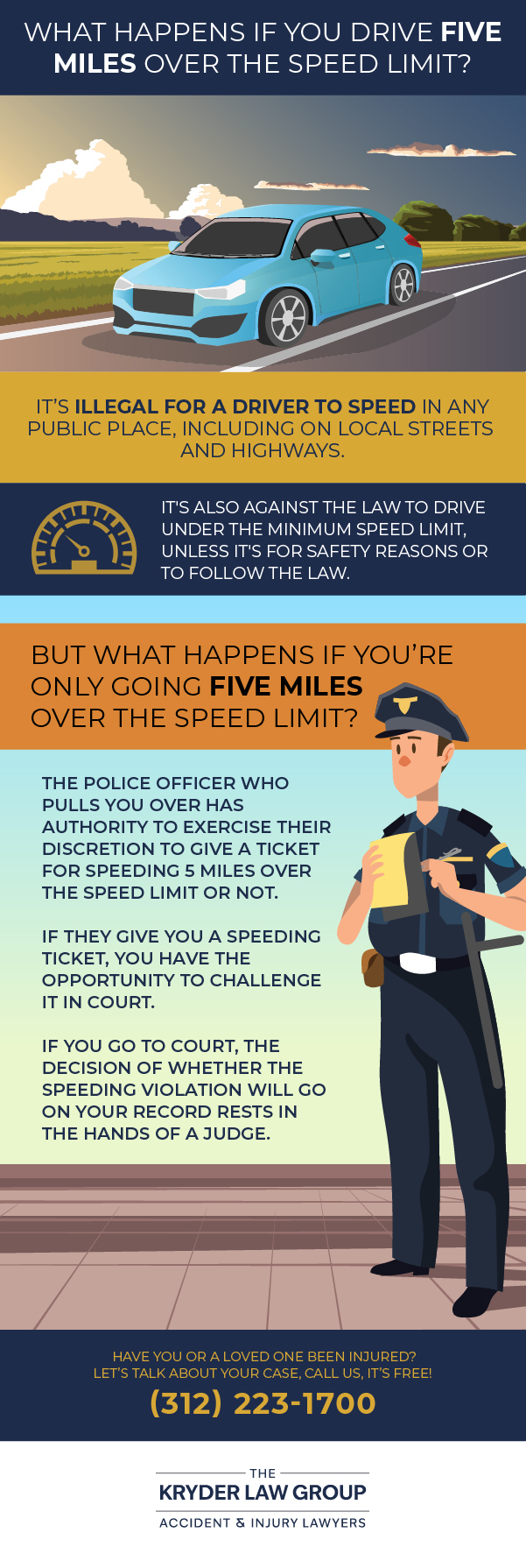
But What Happens If You’re Only Going Five Miles Over the Speed Limit?
In this scenario, the responding law enforcement officer has the authority to exercise their discretion in speed limit enforcement. They can choose to pull you over and issue a citation. If a police officer issues a speeding ticket, you always have the opportunity to challenge it in court. Ultimately, a judge will look at the facts and decide whether the speeding violation will stay on your driving record.
Is There a Minimum Speed Limit?
Yes, there is. By Illinois law (625 ILCS 5/), no person should drive so slowly that they block the normal and reasonable flow of traffic. The only exceptions are when driving slowly is necessary for safety reasons—such as in heavy traffic—or to comply with the law. There is a posted minimum speed limit on most major roads and highways. Drivers who choose to drive below this minimum speed limit may also be subject to traffic citations and financial fines.
Pay Attention to Local and Residential Speed Limits
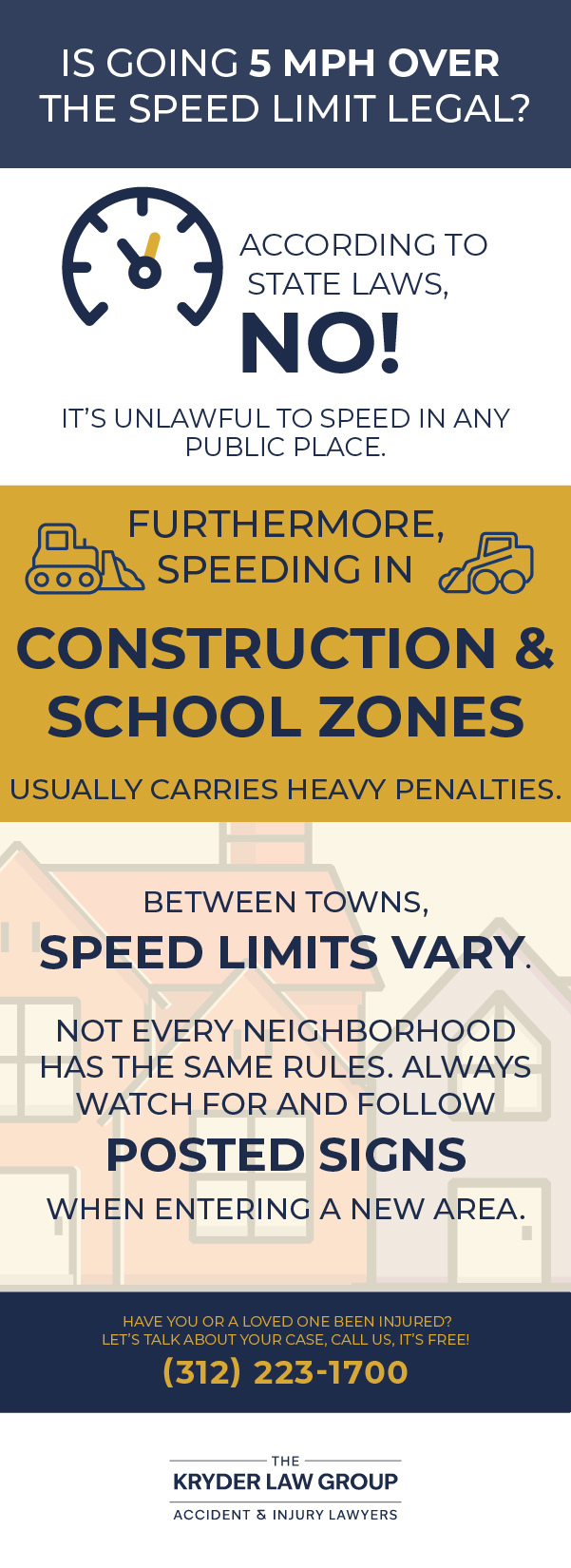
Different towns and villages often have residential speed limits different from those on their city streets. You cannot assume that every neighborhood has the same rules. Therefore, it is important to watch for lower speed limits and follow posted signs whenever you enter a new municipality.
For example, Skokie, IL, recently changed the maximum limit on its residential streets to 25 mph. Local governments often make these changes to protect pedestrians, bicyclists, and children playing near the street. Always stay alert and check the road signs in your local area.
Do the Police Monitor Some Places More Closely Than Others?
Yes. Police officers and speed cameras keep a much closer watch on specific locations where vulnerable people are present, and slower speeds are required. Exceeding the speed limit in these special areas can result in significantly higher fines and serious legal consequences.
Construction Zones
Drivers speeding in construction zones face a $375 fine (at the minimum) for their first offense. Repeat violations can quickly lead to higher fines and even a license suspension, according to the Illinois Department of Transportation (IDOT).
School Zones
Exceeding speed limits in school zones is considered reckless driving and a very serious offense. Illinois law (625 ILCS 5/11-605) clearly states that drivers cannot exceed 20 mph in school zones from 7 a.m. to 4 p.m. on days when children are present.
Do Some Situations Allow Speeding?
There are no specific laws in Illinois that permit speeding under any circumstances. Generally—according to the Illinois State Bar Association (ISBA)—in certain cases where a crime is charged, a judge may opt for an alternative approach by ordering court supervision instead of a guilty verdict.
How Does Illinois View Negligence?
The state of Illinois operates on a contributory negligence statute (735 ILCS 5/2-1116). If you primarily caused an accident, you could be responsible for any resulting damages. However, driving slightly higher than the maximum speed limit does not automatically make you entirely liable for an accident.
For instance, imagine you were going 5 miles per hour over the posted limit when your vehicle collided with another car. If the other driver was distracted by texting and completely failed to stop at a red light, the primary negligence could still be attributed to them.
What Are the Speeding Laws in Other Midwestern States?
If you frequently travel for work or leisure, you need to know the rules of the road in other locations outside of Illinois. Here is a brief look at the speeding laws in the other Midwestern states we serve:
Indiana
Indiana enforces two speeding laws: the basic speeding law and absolute limits. The basic law requires drivers to maintain a speed that is safe and reasonable based on current conditions and potential hazards. The absolute limits set specific maximum speeds, ranging from 15 mph to 70 mph, depending on the location.
Iowa
Iowa sets limits of 70 mph on rural interstates, 65 mph on divided multi-lane highways, and 55 mph on county highways. Urban areas typically have limits of 20–25 mph in business/residential districts and 45 mph in suburban areas. Speeding is a simple misdemeanor, with fines starting around $30–$100+, depending on the speed.
Kentucky
Kentucky enforces strict speeding laws with absolute limits. Penalties include fines ($1–$100+), court costs (approximately $143), and 3–6 points. Speeds greater than 25 mph over the speed limit (or speeds greater than 10 mph over the speed limit in work/school zones) may result in severe fines ($500+), license suspension, or reckless driving charges.
Michigan
Michigan speeding laws mandate a “careful and prudent” speed, allowing safe stopping within a clear distance based on conditions. Maximum limits are 70 mph on freeways and 55 mph on non-divided highways, with 3-point violations for exceeding limits by 11 mph or more.
Minnesota
Minnesota speeding laws set limits of 70 mph on rural interstates, 55–65 mph on urban interstates, and 30 mph in urban areas. Fines exceed $100 for driving 10 mph or more over the speed limit, and driving over 100 mph leads to a six-month license revocation. Automated speed cameras are allowed in select cities starting in 2025.
Missouri
Missouri speeding laws include absolute limits (up to 70 mph on rural interstates, 65 mph on rural expressways, and 60 mph on urban interstates) and a basic rule for safe speeds based on conditions. Violations less than or equal to 5 mph over the speed limit are infractions. Violations 6–20 mph over are Class C misdemeanors. And violations greater than 20 mph over are Class B misdemeanors.
Ohio
Ohio speeding laws require a “reasonable and proper” speed based on conditions. Fines range from $150–$300+ with 2–4 points. A proposed $200 penalty may apply for driving with excess speed. Penalties include 2 points for minor speeding and 4 points for major speeding. 12 points in 2 years result in a 6-month license suspension.
Wisconsin
Wisconsin speeding laws impose fines ($200–$800+), 3–6 demerit points, and possible license suspension for exceeding limits or driving at dangerous speeds. Key laws include § 346.57, addressing absolute and “reasonable and prudent” speeds. Driving 25 mph or more over the speed limit in 55+ mph zones results in a mandatory 15-day suspension.
Call the Attorneys at The Kryder Law Group, LLC Accident and Injury Lawyers, Today
If you or a loved one has been seriously injured by a speeding driver, contact us to explore your legal options and possible compensation.
We offer a free consultation to discuss speeding-related accidents. This is our chance to evaluate your situation, provide guidance, and answer your questions at no cost.
If you've been injured by a driver exceeding the speed limit, a Chicago car accident lawyer can help.
Do I have a case?
Address
134 North LaSalle St., Suite 1515 Chicago, IL 60602 Get Directions
Settlements & Verdicts
$7.5M
$7.5 Million Recovered for a Construction Worker Injured on Site
$3M
$3 Million Recovered for the Family of a Person Struck by a Garbage Truck
$2.2M
$2.2 Million Recovered for a Salesperson Injured in an Automobile Collision
$2M
$2 Million Recovered for a Person Struck by a Speeding Vehicle While Waiting for the CTA Bus
$1.4M
$1.4 Million Recovered for a Computer Programmer Injured in a Slip and Fall
$1M
$1 Million Recovery in just 90 Days for the Family of a Man Killed While Helping a Stranded Motorist


 April 10th, 2026







 (312) 223-1700