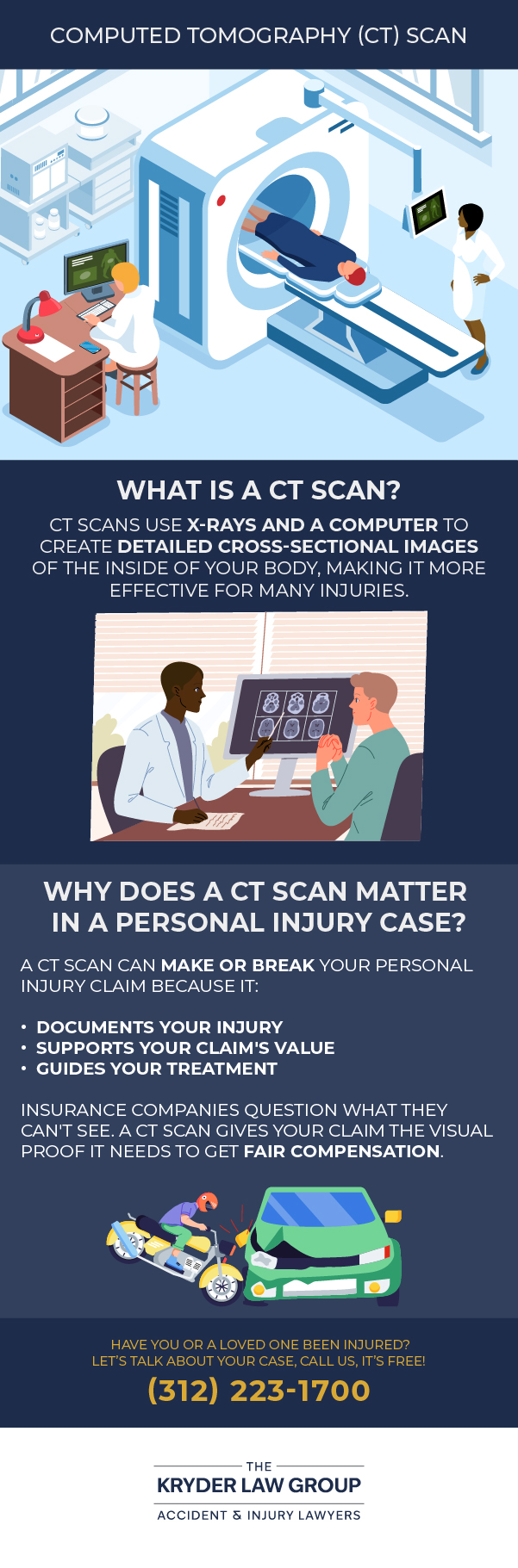
A computed tomography (CT) scan is an imaging procedure that combines multiple X-rays to create detailed, cross-sectional pictures of the body. In personal injury cases, CT scans help doctors diagnose fractures, internal bleeding, and organ damage—often after serious accidents.
Medical terms come up often in personal injury cases, and clients frequently ask what they mean. That’s why Andrew Kryder, Esq., founding partner of our personal injury law firm, explains them in clear terms as part of our legal glossary. Here we break down what a CT scan (computed tomography) is, what it diagnoses, and why it might matter for your injury claim.
En este artículo
What Is a CT Scan?
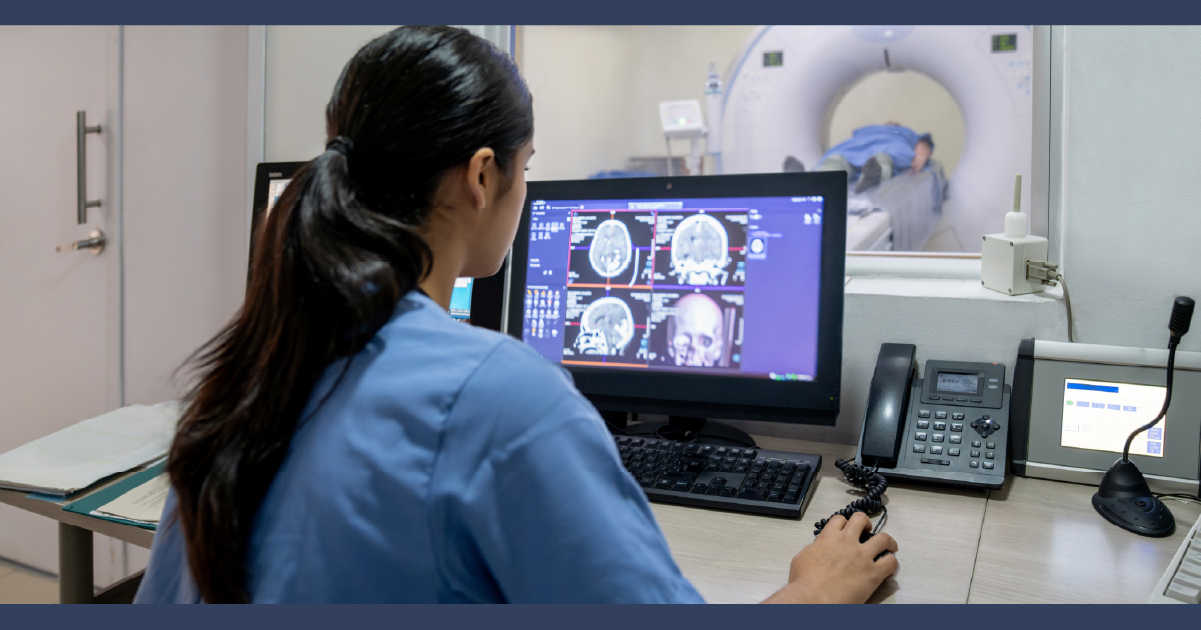
CT stands for computed tomography, and this scan is a medical imaging test that uses a rotating X-ray tube and a computer to create detailed images of the inside of your body. Contrast material enhances visibility of specific body areas in CT scans, making detailed structures stand out even more clearly. Unlike a standard X-ray, which shows a single flat image, a CT scan takes many pictures from different angles and combines them into cross-sectional images, or “slices.”
These slices give doctors a clearer, three-dimensional view of bones, blood vessels, internal organs, and soft tissue. CT scans provide high-resolution detail in a relatively short time frame. Because the scan is fast—often fewer than five minutes—it’s often the first choice for emergency situations where doctors need answers quickly.
What Injuries Does a CT Scan Diagnose?
CT scans are helpful for diagnosing internal bleeding and injuries after trauma. They are especially useful for identifying injuries that aren’t visible from the outside. Doctors commonly use them to diagnose:
Bone fractures, including complex breaks in the skull, spine, and pelvis
Internal bleeding in the chest, abdomen, or brain
Traumatic brain injuries (TBIs), such as bleeding, swelling, or bruising of the brain
Organ damage to the liver, kidneys, spleen, or lungs
Spinal injuries, including vertebrae fractures and disc damage
Because a CT scan reveals internal damage that a physical exam might miss, it can provide important evidence about the severity of an injury.
What Accidents Might Lead to Needing a CT Scan?
CT scans are frequently ordered after high-impact accidents where serious injury is possible. These include:
Car and truck crashes
Motorcycle wrecks
Slip and fall accidents (especially those involving head impact)
Construction accidents
Pedestrian and bicycle accidents
If you hit your head, experienced sudden trauma, or reported severe pain after an accident, a doctor may order a CT scan to rule out life-threatening injuries.
Why CT Scans Matter in a Personal Injury Case
A CT scan does more than guide medical treatment, planning, and monitoring. It also creates a documented record of your injuries. This record can connect your injuries directly to the accident, which is important when seeking fair compensation.
If you’ve been injured in an accident, the personal injury lawyers at The Kryder Law Group, LLC Accident and Injury Lawyers, can review your medical records and help you understand your options. Contact us today for a free consultation.
Preguntas frecuentes
Here are some questions our lawyers have been asked about CT scans.
What is the difference between a CT scan and an MRI?
A CT scanner rotates around the patient to capture images. It scans using X-rays to create images and is faster, making it ideal for emergencies and detecting fractures or bleeding. Magnetic resonance imaging (MRI) uses magnets and radio waves and is better for viewing soft tissue, such as ligaments, nerves, and the spinal cord.
Are CT scans safe?
CT scans are generally safe and widely used. Because CT scans expose patients to ionizing radiation from a rotating X-ray tube, doctors only order them when the benefit of a clear diagnosis outweighs the minimal risk. Children are particularly sensitive to radiation exposure. Additionally, while severe side effects are rare (in fewer than 0.01 to 0.04% of cases), contrast material can cause allergic reactions in some patients, but it flushes from the body within 24 hours. Finally, CT technology can be safely used for patients with certain implants.
Can CT scan results be used as evidence in my injury case?
Yes. CT images and reports can serve as objective medical evidence, helping to document the type and severity of your injuries and link them to the accident.
Who pays for a CT scan after an accident?
Payment can come from several sources, including auto insurance, health insurance, or a settlement. A personal injury lawyer can help you understand how your medical costs may be covered.
What is a CT scan and why does it matter in a personal injury case? Learn what injuries it diagnoses and how it can support your claim.
¿Tengo motivos para presentar una demanda?
Dirección
134 North LaSalle St., Suite 1515, , Chicago, IL 60602 Cómo llegar
Acuerdos y sentencias
$7.5M
Se han conseguido 7,5 millones de dólares para un trabajador de la construcción que sufrió un accidente en la obra
$3M
Se han recuperado 3 millones de dólares para la familia de una persona atropellada por un camión de basura
$2.2M
Se han recuperado 2,2 millones de dólares para un comercial que resultó herido en un accidente de tráfico
$2M
Se han conseguido 2 millones de dólares para una persona que fue atropellada por un vehículo que circulaba a exceso de velocidad mientras esperaba el autobús de la CTA
$1.4M
Se han recuperado 1,4 millones de dólares para un programador informático que resultó herido tras sufrir un resbalón y una caída
$1M
Indemnización de 1 millón de dólares en solo 90 días para la familia de un hombre que falleció mientras ayudaba a un conductor que se había quedado tirado


 September 29th, 2026








 (312) 223-1700