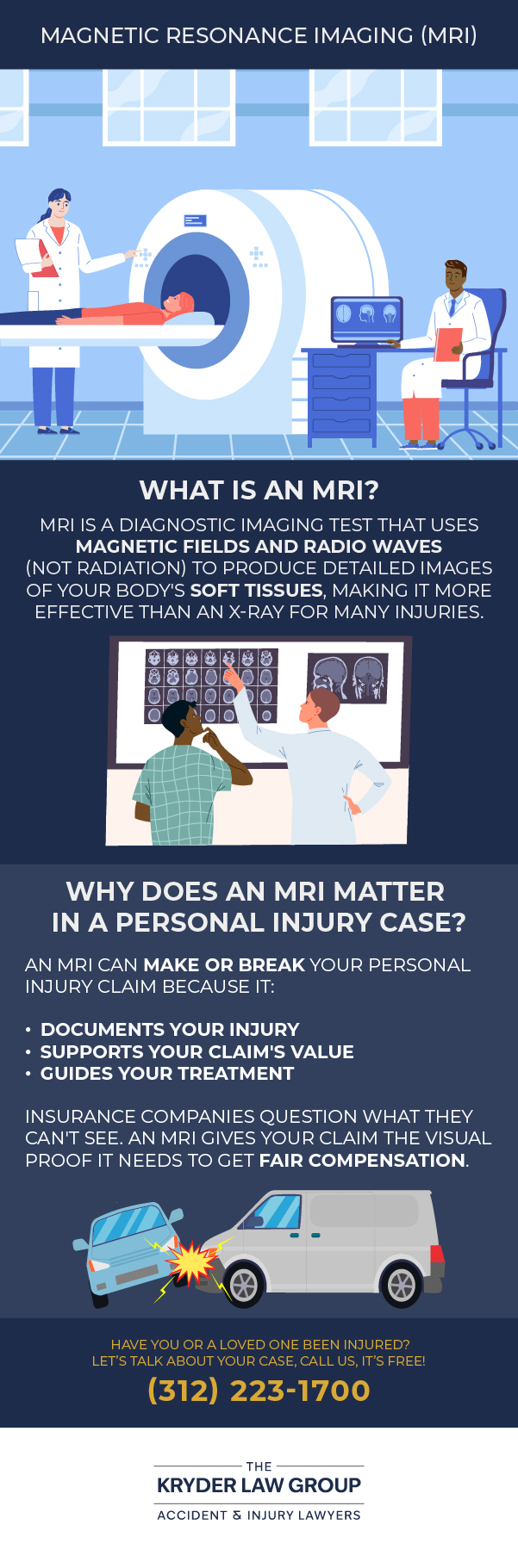
Magnetic resonance imaging (MRI) is a scan that uses powerful magnets and radio waves to create detailed pictures of the soft tissues inside your body like muscles, ligaments, nerves, and spinal discs. In personal injury cases, an MRI machine helps doctors find injuries that X-rays often miss, which can be key evidence for your claim.
Personal injury cases often come with medical terms that clients have never heard before. That can feel overwhelming when you’re already dealing with pain and paperwork. This post is part of our legal glossary series, where we break down the medical terms that show up most often in injury claims.
Andrew Kryder, Esq., is the founding partner of our personal injury law firm. Over the years, Andy has noticed that clients ask about the same medical terms again and again. MRI is one of the most common. So Andy is explaining it here in plain language, so you know what it means, why a doctor might order one, and how it fits into a personal injury case.
En este artículo
What Is an MRI?
MRI is a diagnostic imaging test that creates detailed images of the inside of your body. Unlike an X-ray, an MRI scanner uses a strong magnetic field and radio waves rather than radiation. This makes it especially good at showing soft tissues that X-rays cannot capture clearly.
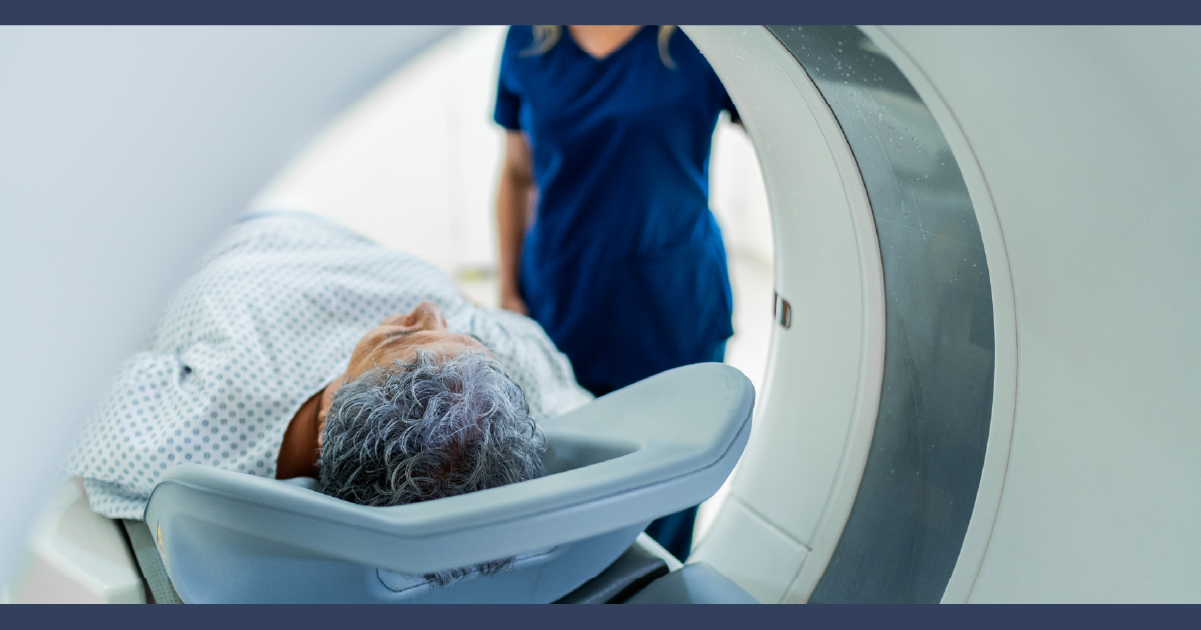
During the scan, you lie still on a table that slides into a large, tube-shaped machine. There are even open MRI machines that are designed for claustrophobic patients. The machine takes cross-section images from different angles. Doctors then review these images to spot damage, inflammation, tears, or other problems.
The biggest advantage of an MRI is detail. An X-ray is great for spotting broken bones, but it won’t show a torn ligament or a herniated disc. An MRI can. That level of detail matters when an injury involves muscles, nerves, or connective tissue.
What Are MRI Contrast Agents?
In some cases, a doctor or radiologist may order an MRI with contrast dye (a special dye, most commonly gadolinium) to enhance the visibility of internal structures and improve image clarity.
How it works: the contrast material is injected through an intravenous (IV) line prior to or during the scan, helping doctors distinguish between normal and abnormal tissue.
Safety: gadolinium-based contrast agents are widely used and rarely cause allergic reactions.
What Types of Injuries Do MRI Exams Diagnose?
An MRI is often used when a doctor suspects damage to soft tissue or the nervous system, including the brain and spinal cord. Because it captures such clear images, it can confirm injuries that might otherwise go undetected. Here are common injuries an MRI helps diagnose, organized by body part.
Spine and Back Injuries
The spine is one of the most common areas scanned after a motor vehicle accident or a slip and fall. An MRI can reveal:
Herniated or bulging discs, where the cushioning between vertebrae pushes out of place
Spinal cord injuries, which can affect movement and sensation
Nerve compression, often causing pain that radiates into the arms or legs
Neck Injuries
Neck injuries are frequent in car crashes, slip and falls, or construction site accidents. An MRI can identify:
Whiplash-related soft tissue damage in the muscles and ligaments
Cervical disc injuries in the upper spine
Nerve root injuries that lead to numbness or tingling
Brain and Head Injuries
Injuries to the head and brain are common in catastrophic accidents involving motorcycle riders or collisions involving semi-trucks and other commercial vehicles. An MRI helps to identify:
Traumatic brain injuries (TBIs) and brain trauma, including bleeding, swelling, or tissue bruising
Functional MRI (fMRI), which measures blood flow in the brain to assess how brain activity and function have been affected
Knee, Shoulder, and Joint Injuries
Joints contain ligaments, tendons, and cartilage that X-rays cannot show well. Accident victims involved in pedestrian or bicycle accidents are often treated for these types of injuries. An MRI can reveal:
Torn ligaments, such as an anterior cruciate ligament (ACL) tear in the knee
Rotator cuff tears in the shoulder
Meniscus damage (the cartilage that cushions the knee)
Tendon injuries throughout the body
Chest and Cardiac Injuries
Cardiac magnetic resonance imaging is a specialized scan used to assess heart structure and function following high-impact accidents that cause trauma to the chest. It detects serious soft tissue damage that standard X-rays or computed tomography (CT) scans often miss, including:
Myocardial contusion (bruising of the heart muscle)
Aortic damage or tears to major blood vessels
Pericardial effusion (fluid buildup around the heart)
Structural damage to the heart’s valves or chambers
Which Accidents Often Require an MRI?
Many personal injury cases involve the kind of forceful impact that can damage soft tissue and joints. A doctor may order an MRI after accidents such as:
Car crashes, which commonly cause whiplash, disc injuries, and joint damage
Truck and motorcycle accidents, where the force of impact can lead to severe spinal and brain injuries
Slip and fall accidents, which often result in torn ligaments, back injuries, and head trauma
Construction accidents involving falls, heavy objects, or machinery
Pedestrian and bicycle accidents, where the body absorbs significant force
If pain lingers or symptoms don’t match what an X-ray shows, a doctor may turn to an MRI for a clearer picture.
Why Does an MRI Matter in a Personal Injury Case?
An MRI procedure can play an important role in a personal injury claim for a few reasons.
It documents the injury. An MRI creates a clear medical record showing the type and extent of your injury. This helps connect your injury to the accident that caused it.
It supports the value of your claim. Soft tissue injuries are real, but they can be hard to prove without imaging. An MRI provides objective evidence that backs up your account of the pain and limitations you’re experiencing.
It guides treatment. The scan helps doctors plan the right care, whether that’s physical therapy, medication, or surgery. A documented treatment plan strengthens your case and reflects the true cost of your recovery.
Insurance companies often question injuries they cannot see. An MRI gives your claim solid, visual proof, which can make a real difference when it comes to getting fair compensation.
The Bottom Line on MRIs in Injury Cases
An MRI catches complex soft tissue and joint injuries that X-rays miss. If you need help understanding your scan or navigating your injury claim, The Kryder Law Group is here to help.
Preguntas frecuentes
Here are some answers to more frequently asked questions we hear from clients after an accident when the diagnostic includes an MRI.
What’s the difference between an MRI, an X-ray, and a CT scan?
An X-ray uses radiation to quickly view dense bone structures and fractures. A CT scan uses a rotating X-ray with computer processing to create detailed, 3D cross-sectional images of bones, internal organs, and severe trauma. An MRI uses powerful magnetic fields and radio waves (no radiation) to generate high-resolution images of soft tissues like ligaments, tendons, spinal discs, and brain tissue.
Does an MRI hurt?
No, an MRI is painless. You lie still while the machine scans your body for 30 to 60 minutes. The main discomfort for some people is staying still (claustrophobia may require sedation) and the loud noises the machine makes (up to 120 dBA). Ask your provider about options if enclosed spaces make you uneasy.
How soon after an accident should I get an MRI scan?
That depends on your symptoms and your doctor’s advice. Some injuries appear right away, while others develop over days or weeks. If pain continues or worsens, tell your doctor, since prompt documentation can also help protect your claim.
Will an MRI help prove my injury claim?
An MRI can provide objective evidence of an injury that supports your claim, especially for soft tissue and spinal damage. It documents the injury, connects it to the accident, and helps show the true extent of your harm.
Who pays for an MRI in a personal injury case?
Payment can depend on your insurance, the details of your case, and who was at fault. A personal injury attorney can explain your options and help you understand how medical costs may be handled as part of your claim.
Learn what an MRI is, the injuries it diagnoses, and why it matters in a personal injury case—explained in plain terms by attorney Andrew Kryder.
¿Tengo motivos para presentar una demanda?
Dirección
134 North LaSalle St., Suite 1515, , Chicago, IL 60602 Cómo llegar
Acuerdos y sentencias
$7.5M
Se han conseguido 7,5 millones de dólares para un trabajador de la construcción que sufrió un accidente en la obra
$3M
Se han recuperado 3 millones de dólares para la familia de una persona atropellada por un camión de basura
$2.2M
Se han recuperado 2,2 millones de dólares para un comercial que resultó herido en un accidente de tráfico
$2M
Se han conseguido 2 millones de dólares para una persona que fue atropellada por un vehículo que circulaba a exceso de velocidad mientras esperaba el autobús de la CTA
$1.4M
Se han recuperado 1,4 millones de dólares para un programador informático que resultó herido tras sufrir un resbalón y una caída
$1M
Indemnización de 1 millón de dólares en solo 90 días para la familia de un hombre que falleció mientras ayudaba a un conductor que se había quedado tirado


 September 29th, 2026








 (312) 223-1700