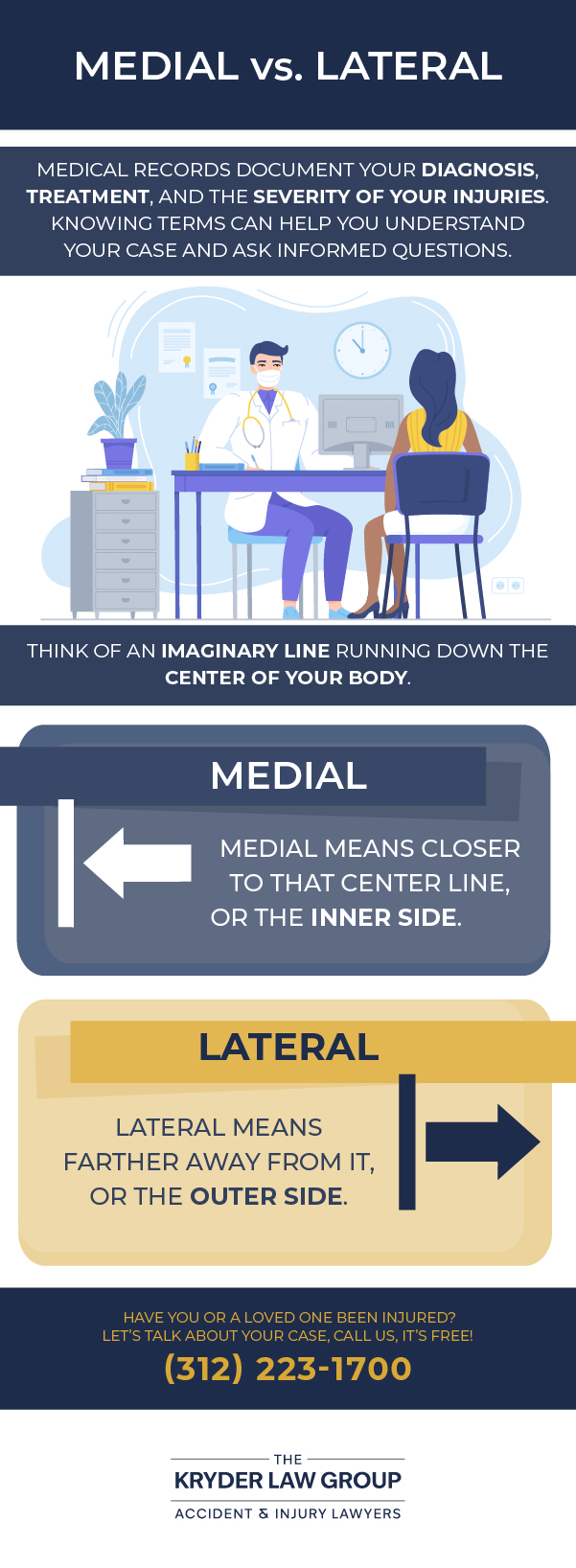
Medial means “toward the midline of the body,” and lateral means “toward the outer side.” These directional terms appear regularly in medical records and diagnostic reports tied to personal injury cases. Knowing what they mean helps you understand your injuries and how they’re described in your legal claim.
Medical terminology shows up constantly in personal injury cases. Terms that make perfect sense to a doctor can leave clients wondering what’s actually wrong and what it means for their case. Andrew Kryder, Esq., founding partner of our Midwestern personal injury law firm, put together this glossary because clients ask about these terms all the time. This entry covers two directional terms you’ll frequently encounter in medical records: medial vs. lateral.
En este artículo
What Do Medial and Lateral Mean?
While medial and lateral describe positions relative to the body’s midline, other anatomical terms like proximal (closer to the point of attachment) and distal (further away along a limb) are also used in medical records to provide a complete picture of an injury to body parts.
Medial means toward the midline of the body.
Lateral means away from the midline, toward the outer side.
When describing injuries on the same side of the body, these terms help clarify the exact point of injury across diagnostic imaging and surgical records.
Anatomical Examples and Joint Movement
Medial rotation moves a limb inward toward the center of the body, and body parts can be medial or lateral in relation to each other. For example, the big toe is medial to the little toe because it sits closer to the body’s midline. Conversely, the arms are lateral to the torso. Looking at the legs, the inner edge of the knee is considered medial, while the outer surface facing away from the body’s midline is lateral.
Where Are These Terms Used on the Body?
Medial and lateral apply across many areas of the body. In personal injury cases, they are often seen in injuries caused by slip and falls or motor vehicle accidents. The most common include:
Knee: The knee has both medial (inner) and lateral (outer) compartments, ligaments, and menisci. A medial collateral ligament (MCL) injury affects the inner side of the knee; a lateral collateral ligament (LCL) injury affects the outer side.
Ankle: Ankle sprains are frequently described as medial or lateral, depending on which side of the ankle is damaged. Lateral ankle sprains affecting the outer ligaments are among the most common injuries seen after slips and falls.
Elbow: Medial epicondylitis (golfer’s elbow) and lateral epicondylitis (tennis elbow) describe inflammation on opposite sides of the elbow joint. Both can result from repetitive strain or direct trauma.
Shoulder: Shoulder injuries may involve medial or lateral structures, depending on the mechanism of injury. Lateral clavicle fractures, for example, occur near the outer end of the collarbone.
Hip: Medial and lateral are used to describe the location of hip fractures, labral tears, and soft tissue damage. These are particularly relevant in fall-related injury cases.
Spinal and Nerve Structures
In spinal injury cases, which are often part of catastrophic injury cases, medial and lateral also describe the anatomical position of disc herniations and nerve compression:
A lateral disc herniation pushes outward toward the side of the spinal canal, often compressing a nerve root as it exits the spine.
A central or medial herniation affects the area closer to the midline of the spinal cord.
The medial and lateral branches of spinal nerves are also referenced in diagnostic nerve block procedures and pain management records.
Common Injuries Where Medial and Lateral Are Used
Here are common injuries where medial and lateral are used to describe the outcome of an accident caused by someone else’s negligence.
MCL Tear
The MCL runs along the inner side of the knee, connecting the thigh bone to the shin bone. MCL tears frequently result from side-impact collisions or falls that force the knee inward. These injuries range from mild sprains to complete tears requiring surgery.
Lateral Meniscus Tear
The lateral meniscus is a crescent-shaped piece of cartilage on the outer side of the knee joint. Tears to this structure are common in accident cases involving twisting forces or direct impact to the knee and can cause pain, swelling, and long-term joint instability.
Lateral Ankle Sprain
Lateral ankle sprains occur when the foot rolls inward, stretching or tearing the ligaments on the outer side of the ankle. These injuries frequently appear in slip and fall claims and can range from minor ligament stretching to complete ligament rupture.
Medial Epicondyle Fracture
The medial epicondyle is a bony prominence on the inner side of the elbow. Fractures to this area can occur in high-impact accidents or falls onto an outstretched arm. In children, these fractures are particularly significant because the growth plate may be involved.
Lateral Clavicle Fracture
A fracture of the outer (lateral) end of the collarbone is common in vehicle accidents and falls. Depending on the severity, these fractures may require surgical fixation and extended rehabilitation.
Why Do These Terms Matter in a Personal Injury Case?
Medical records are central to any personal injury claim, as they document your diagnosis, treatment, and injury severity relative to the body’s median plane. When a magnetic resonance imaging (MRI) notes a “lateral meniscus tear” or “MCL sprain,” these terms refer directly to the specific location of your trauma, which insurance adjusters and defense lawyers evaluate closely. Understanding this terminology helps you track your case progress and ask informed questions.
The distinction between medial and lateral directly impacts settlement value. Injuries on opposite sides of a joint carry different recovery timelines, surgical needs, and long-term prognosis. For instance, a lateral disc herniation compressing a spinal nerve root often causes severe radicular pain compared to a smaller medial herniation. This is a clinical difference that can significantly influence your overall damages.
If a term in your medical records is unclear, bring it up with your attorney. The details matter.
Preguntas frecuentes
Here are answers to the questions we often hear from clients when they are reviewing their medical records and see the terms “medial” and “lateral.”
What is the difference between medial and lateral in medical terms?
Medial refers to the inner side of the body, toward the midline. Lateral refers to the outer side, away from the midline. Doctors use both terms to precisely describe the location of an injury or anatomical structure.
Why does it matter whether an injury is medial or lateral?
The location of an injury affects diagnosis, treatment, and recovery. In a personal injury case, accurate injury descriptions in medical records support your claim by documenting exactly what was damaged and where—details that can directly influence your compensation.
What is a lateral meniscus tear, and is it serious?
A lateral meniscus tear is damage to the cartilage on the outer side of the knee joint. It can cause pain, swelling, locking of the knee, and long-term instability. These tears are commonly documented in accident cases and may require arthroscopic surgery and physical therapy.
What is an MCL tear, and how does it relate to medial anatomy?
The MCL runs along the inner side of the knee. An MCL tear is one of the most common medial injuries seen in personal injury cases, particularly those involving side-impact collisions. Depending on severity, recovery may involve bracing, physical therapy, or surgery.
How do I know if these terms appear in my medical records?
Your medical records, MRI reports, and physician notes will often use medial and lateral when describing your injury location. If you’re unsure what something means, your attorney can help you review and interpret your records.
Learn what medial vs. lateral means in personal injury medical records and why they matter.
¿Tengo motivos para presentar una demanda?
Dirección
134 North LaSalle St., Suite 1515, , Chicago, IL 60602 Cómo llegar
Acuerdos y sentencias
$7.5M
Se han conseguido 7,5 millones de dólares para un trabajador de la construcción que sufrió un accidente en la obra
$3M
Se han recuperado 3 millones de dólares para la familia de una persona atropellada por un camión de basura
$2.2M
Se han recuperado 2,2 millones de dólares para un comercial que resultó herido en un accidente de tráfico
$2M
Se han conseguido 2 millones de dólares para una persona que fue atropellada por un vehículo que circulaba a exceso de velocidad mientras esperaba el autobús de la CTA
$1.4M
Se han recuperado 1,4 millones de dólares para un programador informático que resultó herido tras sufrir un resbalón y una caída
$1M
Indemnización de 1 millón de dólares en solo 90 días para la familia de un hombre que falleció mientras ayudaba a un conductor que se había quedado tirado


 September 20th, 2026








 (312) 223-1700