La terminología jurídica puede resultar abrumadora cuando se trata de casos de daños personales. Para ayudar a aclarar las cosas, el abogado Andrew Kryder, socio fundador de nuestro bufete especializado en daños personales, ha elaborado este glosario como una guía sencilla de los términos jurídicos más habituales. En esta entrada, analizamos el concepto de «causa inmediata»: qué significa, por qué desempeña un papel fundamental en una demanda sólida por daños personales, cómo constituye un factor sustancial a la hora de determinar la culpa y cuáles son algunos ejemplos de la vida real.
En este artículo
¿Qué es la causa inmediata?
La causalidad inmediata —una norma fundamental del derecho de responsabilidad civil— es un concepto jurídico que se utiliza en los casos de daños personales para demostrar que la actuación negligente del demandado fue la causa directa y previsible de las lesiones sufridas por la víctima. No se trata solo de qué desencadenó una reacción en cadena, sino de si la lesión concreta fue un resultado previsible de las acciones del demandado.
Datos clave sobre la causa real y la causa inmediata
Comprender cómo la ley establece un vínculo entre una acción y un daño es fundamental en cualquier caso de daños personales. Hay dos conceptos que rigen este vínculo: la causa real y la causa inmediata. Juntos, ayudan a determinar quién es legalmente responsable cuando alguien resulta lesionado. A continuación, te ofrecemos una explicación clara de lo que significan estos términos y por qué son importantes.
El criterio de previsibilidad
Para que alguien sea considerado responsable legalmente de una lesión, dicha lesión debe ser una consecuencia natural y razonablemente previsible de sus actos. En otras palabras, el daño tiene que ser algo que una persona razonable hubiera podido prever.
Si una acción peligrosa da lugar directamente a una lesión previsible, normalmente se puede establecer la responsabilidad. Sin embargo, si el resultado fue tan inusual o improbable que nadie podría haberlo previsto razonablemente, es posible que la ley no considere responsable a la persona. Este criterio garantiza que la responsabilidad sea justa y se base en el sentido común.
Causa jurídica frente a causa real
Estos dos conceptos van de la mano, pero responden a preguntas diferentes.
La causa real se basa en el criterio del «si no fuera por». Plantea una pregunta sencilla: si no fuera por la conducta del demandado, ¿se habría producido el perjuicio? Si la respuesta es no, y el perjuicio no se habría producido sin la acción del demandado, queda demostrada la causa real.
La causa próxima, también denominada causa legal, va un paso más allá. Se pregunta si el daño fue una consecuencia razonablemente previsible de la conducta. Este concepto establece límites a la responsabilidad, de modo que una persona solo es responsable de los daños que fueran una consecuencia previsible de sus actos, y no de cualquier resultado remoto o improbable.
La cadena de acontecimientos
La causa y el efecto suelen desarrollarse como una cadena de acontecimientos relacionados entre sí. La causa inmediata depende de que esa cadena se mantenga intacta.
A veces, un hecho impredecible e independiente se interpone tras la acción inicial y provoca la lesión. Cuando esto ocurre, ese hecho intermedio puede romper la cadena de causalidad. Si la ruptura es lo suficientemente significativa, puede eximir de responsabilidad al autor inicial, ya que el daño ya no es una consecuencia previsible de su conducta.
Voto del jurado
La existencia de una causa inmediata suele considerarse una cuestión de hecho. Esto significa que, por lo general, la decide un jurado y no un juez.
Por qué es importante determinar la causa inmediata en los casos de daños personales
Sin una causa inmediata, una persona podría ser considerada legalmente responsable de una cadena infinita de acontecimientos adversos derivados de un único error. Esto protege a los demandados de accidentes fortuitos o de coincidencias extrañas e impredecibles. Para que una víctima lesionada obtenga una indemnización, su abogado debe demostrar que la negligencia concreta del demandado provocó directamente el daño específico sufrido.
Cómo funciona la causa inmediata
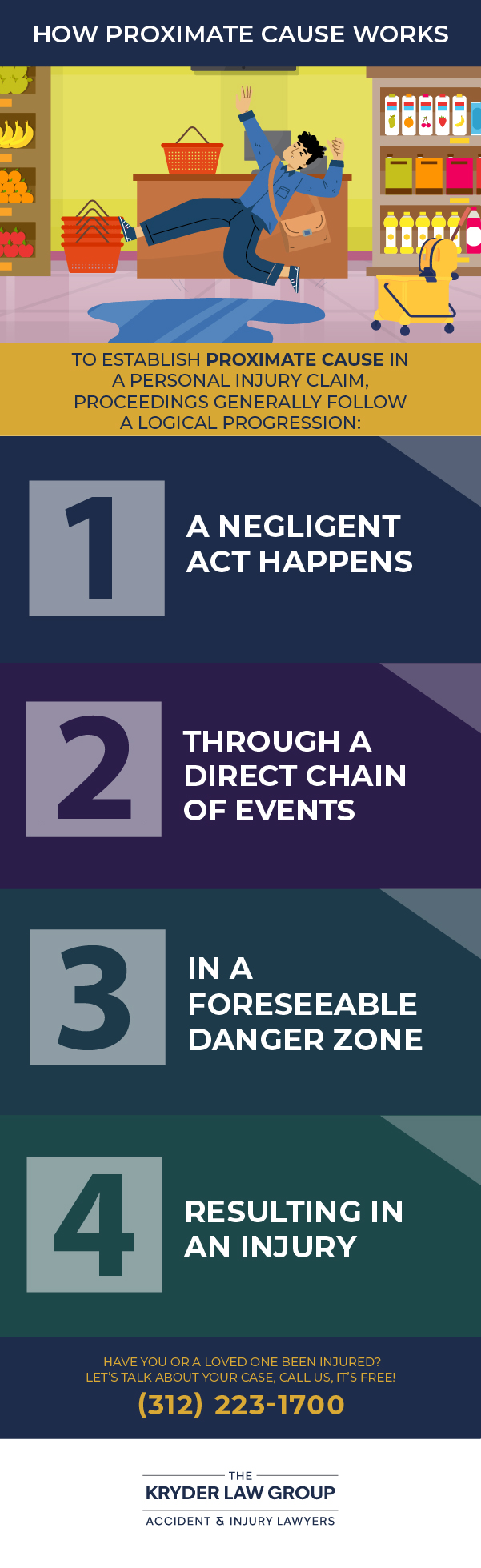
Para determinar la causa inmediata en una reclamación por daños personales, el procedimiento suele seguir una progresión lógica:
Demostrar la culpa. Demostrar que el demandado cometió un acto negligente o imprudente.
Aplica la prueba del «si no fuera por». «Si no fuerapor» la negligencia del demandado, ¿habrías resultado herido? Si la respuesta es no, entonces queda demostrada la causa de hecho.
Analiza la previsibilidad. Pregúntate si una persona razonable podría haber previsto que ese acto negligente causaría este tipo de daño.
Identifica los actos intermedios. Comprueba si alguna fuerza externa interrumpió la cadena de acontecimientos entre el error y la lesión.
Determinar la responsabilidad. Si la relación entre el error y la lesión es directa y previsible, se cumple el requisito de la causa inmediata.
Ejemplos de causa inmediata en casos de daños personales
Enviar mensajes de texto mientras se conduce: un conductor baja la vista hacia su móvil, se salta un semáforo en rojo y atropella a un peatón. Se cumple el requisito de causa inmediata, ya que atropellar a alguien es una consecuencia directa y previsible de conducir distraído.
La cadena rota (sin causa inmediata): Un conductor se salta un semáforo en rojo y provoca un pequeño choque. Mientras los conductores intercambian los datos del seguro en la acera, un rayo aislado cae sobre un árbol cercano, lo que provoca que se caiga una rama y se le rompa el brazo a la víctima. Saltarse el semáforo en rojo es la causa real del accidente, pero no es la causa inmediata de la fractura del brazo, ya que la caída de una rama de árbol a raíz de un rayo no es una consecuencia previsible de una infracción de tráfico.
Resbalón y caída: El encargado de un supermercado friega un pasillo, pero no coloca ninguna señal de advertencia. Un cliente resbala en el suelo mojado y se rompe la cadera. Se cumple el requisito de la causa inmediata, ya que la caída es una consecuencia altamente previsible de caminar sobre una superficie mojada que no se ve.
Descubre qué significa «causa inmediata», por qué desempeña un papel fundamental en una demanda sólida por daños personales, cómo constituye un factor sustancial a la hora de determinar la culpa y cuáles son algunos ejemplos reales.
¿Tengo motivos para presentar una demanda?
Dirección
134 North LaSalle St., Suite 1515, , Chicago, IL 60602 Cómo llegar
Acuerdos y sentencias
$7.5M
Se han conseguido 7,5 millones de dólares para un trabajador de la construcción que sufrió un accidente en la obra
$3M
Se han recuperado 3 millones de dólares para la familia de una persona atropellada por un camión de basura
$2.2M
Se han recuperado 2,2 millones de dólares para un comercial que resultó herido en un accidente de tráfico
$2M
Se han conseguido 2 millones de dólares para una persona que fue atropellada por un vehículo que circulaba a exceso de velocidad mientras esperaba el autobús de la CTA
$1.4M
Se han recuperado 1,4 millones de dólares para un programador informático que resultó herido tras sufrir un resbalón y una caída
$1M
Indemnización de 1 millón de dólares en solo 90 días para la familia de un hombre que falleció mientras ayudaba a un conductor que se había quedado tirado


 10 de julio de 2026









 (312) 223-1700