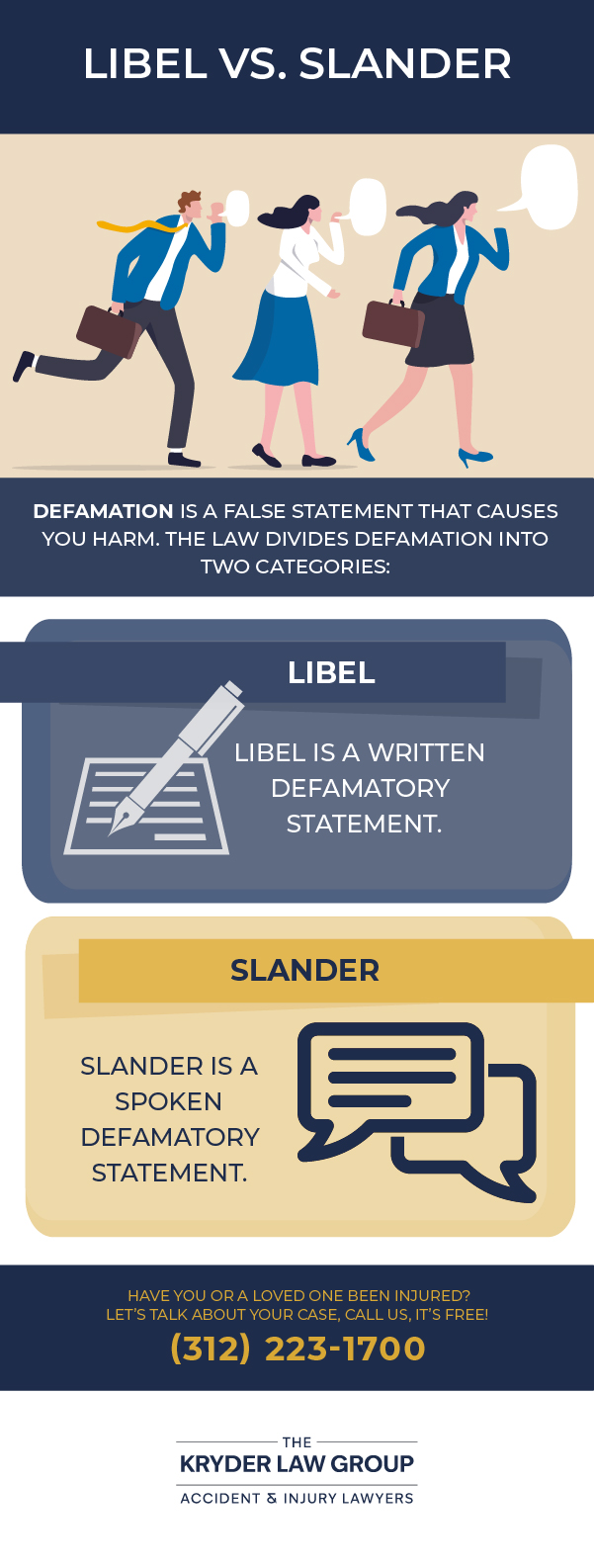
Understanding your rights after someone damages your reputation is critical. Our personal injury law firm compiled this legal glossary to help you understand the legal definition of these terms and how they fit into defamation laws. Defamation is a false statement that causes you harm. It falls under personal injury law because a ruined reputation destroys your career, livelihood, and mental well-being. The law divides defamation into two categories: libel vs. slander. In short, libel is a written defamatory statement while slander is spoken.
When defamation causes you to lose your job, destroys your business, or ruins your standing in the community, it is considered a civil wrong—a form of personal injury where you can seek financial compensation.
En este artículo
Libel vs. Slander: How Defamation Causes Personal Injury
Many people associate personal injury lawyers only with physical injuries from car accidents or slip and falls. However, a private person’s reputation and livelihood are valuable assets. When someone destroys those assets through lies, the resulting damage is a profound personal injury.
Defamation causes tangible harm. It can lead to severe emotional distress, anxiety, and isolation. It frequently causes direct financial ruin. If false statements destroy your career or business in Chicago or across the Midwest, the law provides a path to hold the wrongdoer accountable.
What Is Libel? Written Statements That Harm Your Reputation
Libel is written defamation; it is written, printed, or visually recorded. Because written words leave a permanent record, courts often view libel as inherently dangerous.
Untruthful statements written in workplace performance reviews or company-wide emails.
Visual media, such as signs, cartoons, or edited photos meant to deceive.
To win a libel case, you must prove the statement was written, false, shared with a third party, and caused you harm.
What Is Slander? Spoken Words That Damage Your Livelihood
Slander is oral defamation or spoken defamation. Unlike libel, slanderous statements are not a statement in writing; they are fleeting and temporary. Because spoken words disappear into the air, proving slander often requires witness testimony from people who heard the statements.
Common examples of slander include:
A competitor speaking false rumors to your clients to steal your business
A coworker falsely telling your boss that you stole company property
A speaker making false, damaging claims about you during a public meeting
Because spoken words leave no physical paper trail, you generally must prove the exact financial losses caused by the spoken words to win a lawsuit.
Digital Defamation: What Qualifies as an Online Personal Injury Case?
The internet has changed how reputation damage occurs. A single viral post can destroy a career overnight. In Illinois, digital defamation—often called “cyber-defamation”—occurs when someone publishes a false statement about you online.
However, not every mean or unfair online comment qualifies as a legal personal injury claim. To pursue a lawsuit, the digital statement must meet specific legal standards.
What Constitutes a Valid Online Personal Injury Case?
To file a successful lawsuit, the online content must cross the line from an annoyance into an actionable legal wrong. A strong personal injury case generally involves:
Statements of fact, not opinion: The poster must state something as an objective truth, not an opinion. Saying “John Smith stole $5,000 from our register” is an actionable statement of fact. Saying “I think John Smith is a terrible manager” is a protected opinion.
Measurable financial harm: The false post must cause you direct, quantifiable economic damage. Examples include being fired from your job, losing a lucrative contract, or suffering a massive drop in customers at your local business.
Falsely accusing you of a crime: Under Illinois law, the Slander and Libel Act(740 ILCS 145/), if someone falsely accuses you of a serious crime online (like theft or fraud), it is considered defamation per se. In these specific cases, the law presumes harm occurred, and you do not have to prove exact financial losses to file a lawsuit.
Unprofessional incompetence: Falsely attacking someone’s professional integrity or fitness for their trade online is also defamation per se. If a false review claims a licensed surgeon was drunk during surgery, this constitutes an automatic legal injury.
What DOES NOT Constitute an Online Personal Injury Case?
Many people contact personal injury firms frustrated by online behavior that, while hurtful, does not give rise to a lawsuit. The following scenarios generally do not qualify as legal defamation:
Hurt feelings and insults: Name-calling, general rudeness, and insults (e.g., calling someone “crazy,” “lazy,” or “a jerk”) are legally protected speech. They do not constitute a personal injury lawsuit.
The absolute truth: Truth is an absolute defense against defamation charges. If someone posts online that you filed for bankruptcy, and you actually did, you cannot sue them—even if the post severely damages your reputation.
Anonymous trolls you cannot identify: You cannot sue a website or platform (like Facebook, Yelp, or Google) for what its users post. Section 230 of the United States Communications Decency Act immunizes these companies; the United States Supreme Court has refused to narrow this act. You can only sue the individual writer. If the poster is completely anonymous and untraceable, a lawsuit cannot move forward.
Hyperbole and satire: Exaggerated language that no reasonable reader would take literally is protected. If a reviewer writes, “This restaurant’s pizza tasted like cardboard and gave me third-degree burns,” a court will likely view this as typical online hyperbole not a false statement.
How Often Are Defamation Cases Successful?
Defamation cases are difficult to win. Data from the Media Law Resource Center shows that defamation cases against the media rarely succeed at trial, with a media defendant prevailing in an estimated 70% to 75% of litigated court motions. Additionally, actual trials are nearly extinct and most successful plaintiff outcomes are achieved through out-of-court private settlements.
Suing a Private Individual
Private individuals almost never carry defamation insurance. That means even if you win a $100,000 judgment against a neighbor or coworker, you may walk away with nothing if that person has no savings, no property, and no assets to collect from.
This is why many attorneys will decline non-media defamation cases unless the defendant has clear, tangible assets or a business that can actually pay a damages award. Before moving forward, talk to a lawyer not just about whether you can win—but whether winning will actually put money in your pocket.
Understanding “Defamation Per Se” in Illinois and Midwest Law
In a standard defamation case, the plaintiff must prove exactly how much money they lost because of the lie. This is called “defamation per quod.” However, Illinois law recognizes that some lies are so malicious and toxic that harm is completely obvious. This is known as defamation per se.
In Illinois, there are five specific categories of statements that are considered defamation per se:
Accusing someone of committing a serious crime
Stating that someone has an infectious, loathsome disease
Accusing someone of unfitness or a lack of integrity in their job or profession
Stating that a person lacks ability or integrity in their trade
Accusing someone of adultery or fornication
If someone makes a statement that falls into these categories, you do not have to prove specific financial damages to move forward with a personal injury claim. The court automatically presumes you were damaged.
What Damages Can You Recover in a Defamation Lawsuit?
If you have been the victim of libel or slander, a personal injury lawsuit allows you to pursue compensation for the total impact the lie has had on your life. Damages in defamation cases can vary widely based on circumstances.
You can seek recovery for multiple types of damages:
Economic damages: compensation for lost wages, lost business revenue, loss of future earning capacity, and any out-of-pocket expenses you incurred trying to fix your reputation
Non-economic damages: compensation for emotional distress, anxiety, humiliation, and loss of enjoyment of life caused by the public shame
Punitive damages: in rare cases where the defendant acted with actual malice or pure spite, a court may award punitive damages, which are designed to punish the wrongdoer and deter others from acting similarly
When Does a False Statement Cross the Line Into a Legal Claim?
To determine if you have a viable personal injury claim, a lawyer will evaluate whether your situation meets the four strict pillars of defamation law.
Every successful defamation claim must prove:
Falsity: the statement must be entirely false; true statements, no matter how damaging or embarrassing, are not defamatory.
Publication: the statement must have been communicated to at least one person other than you.
Fault: the person who made the statement must have acted negligently or with actual malice (knowing it was false or recklessly disregarding the truth).
Injury: the statement must have caused demonstrable harm to your reputation, finances, or psychological well-being (unless it qualifies as defamation per se).
Understanding your rights after someone damages your reputation is critical. Learn how the law defines libel vs. slander.
¿Tengo motivos para presentar una demanda?
Dirección
134 North LaSalle St., Suite 1515, , Chicago, IL 60602 Cómo llegar
Acuerdos y sentencias
$7.5M
Se han conseguido 7,5 millones de dólares para un trabajador de la construcción que sufrió un accidente en la obra
$3M
Se han recuperado 3 millones de dólares para la familia de una persona atropellada por un camión de basura
$2.2M
Se han recuperado 2,2 millones de dólares para un comercial que resultó herido en un accidente de tráfico
$2M
Se han conseguido 2 millones de dólares para una persona que fue atropellada por un vehículo que circulaba a exceso de velocidad mientras esperaba el autobús de la CTA
$1.4M
Se han recuperado 1,4 millones de dólares para un programador informático que resultó herido tras sufrir un resbalón y una caída
$1M
Indemnización de 1 millón de dólares en solo 90 días para la familia de un hombre que falleció mientras ayudaba a un conductor que se había quedado tirado


 30 de julio de 2026








 (312) 223-1700