Losing a loved one is a profoundly painful experience. Discovering that their physical remains were mistreated or mishandled by a trusted institution compounds that grief into unmanageable trauma. Our personal injury law firm compiled this entry in our legal glossary to help families navigate the complex rules surrounding the Right of Sepulcher in Illinois.
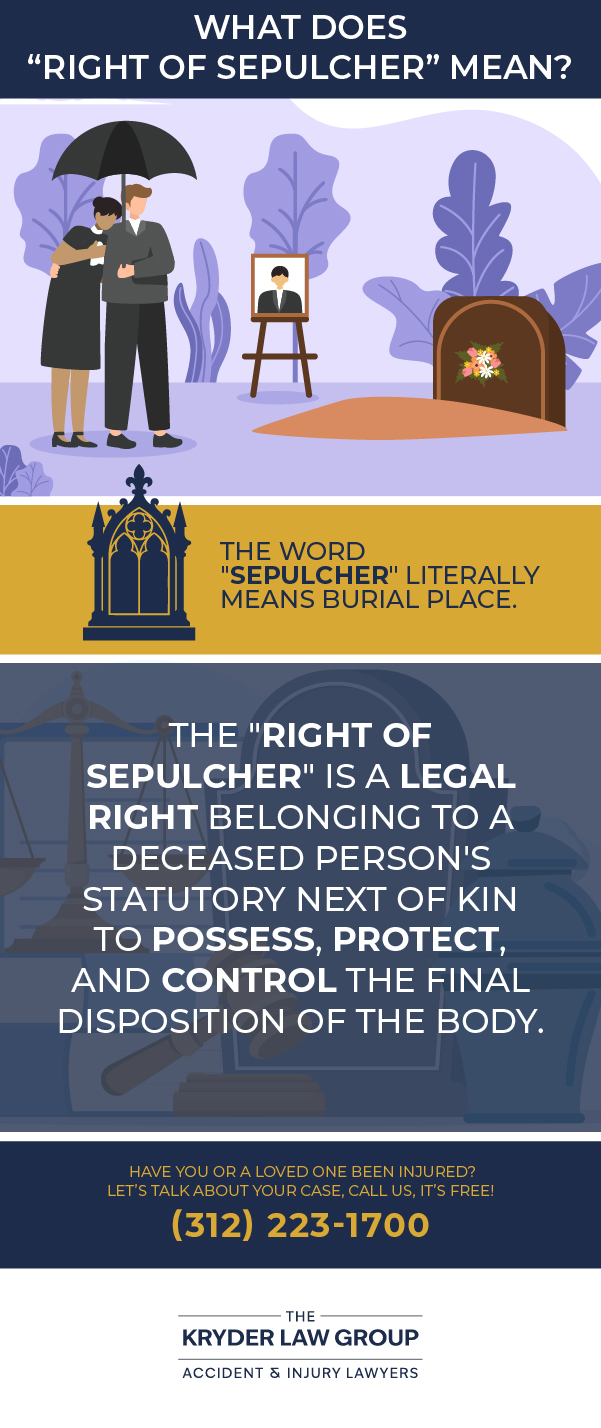
The “Right of Sepulcher” is a legal right belonging to a deceased person’s statutory next of kin to possess, protect, and control the final disposition of the body. The word “sepulcher” literally means a burial place. It is a common-law tort recognized in Illinois and carries a unique status under personal injury law, because—unlike most claims in Illinois—the disruption or desecration of a peaceful burial allows families to seek substantial financial compensation for severe emotional distress and mental anguish without requiring proof of a physical injury.
En este artículo
What Is the Right of Sepulcher Under Illinois Law?
Under Illinois law, the Right of Sepulcher guarantees that a grieving family has the absolute, exclusive right to take immediate possession of the physical remains of their deceased relative without interference. This right ensures that the next of kin can provide a prompt, dignified, and uninterrupted burial or cremation according to their cultural, religious, or personal wishes. Written instructions from the deceased take precedence over the default hierarchy for burial decisions in Illinois.
Because a deceased individual cannot suffer a new physical injury, the law protects the living relatives instead. This right establishes a strict legal duty of care for institutions entrusted with human remains. Any unauthorized interference, negligent delay, or intentional disruption of this process breaches that legal duty.
Who Has Standing to File a Right of Sepulcher Claim?
In the legal system, you must have the specific authority to bring a lawsuit to court. If you are wondering who has standing to file a Right of Sepulcher claim after a loved one’s remains are mistreated, Illinois follows a strict statutory hierarchy. Under the Illinois Disposition of Remains Act (755 ILCS 65/), the legal right—and the standing to sue for its violation—belongs to individuals in the following order:
Designated agent: a person explicitly named by the deceased in a legally binding written directive or affidavit
Executor/legal representative: the person named as the executor of the decedent’s will
Surviving spouse: the legally recognized husband or wife of the deceased individual
Adult children: the surviving adult sons or daughters of the deceased
Surviving parents: the biological or adoptive parents of the deceased
Adult siblings: the surviving adult brothers or sisters
Legal guardian: the court-appointed guardian of the deceased at the time of death
If multiple people share the same tier of kinship (such as three adult children), they must typically act together and are governed by majority rule. A distant relative or a friend does not have legal standing to file a claim if a closer relative is alive and available.
What Constitutes a Violation of Your Burial Rights?
A Right of Sepulcher claim arises when a professional entity behaves negligently or recklessly with a human decedent’s remains. Our funeral negligence lawyers investigate a wide variety of systemic failures and misconduct in Chicago and throughout the Midwest.
Actionable violations that give rise to a personal injury claim include:
Funeral home negligence: performing a cremation or burial without explicit authorization, mixing up remains, or losing a body
Cemetery desecration: commingling bodies in a single grave plot, damaging a casket during burial, or disturbing an established gravesite
Hospital or morgue mix-ups: releasing the wrong body to a funeral home or delaying the release of a body, causing the cancellation of a scheduled funeral
Unauthorized autopsies: performing an invasive autopsy or harvesting organs without the legally required consent of the next of kin
Mishandling and neglect: allowing a decedent’s body to decompose due to a lack of proper refrigeration or dignified care
Understanding the Right to Recovery for Mishandled Remains
When a family’s burial rights are violated, the legal system recognizes that the primary damage is psychological rather than physical. Your right to recovery allows you to pursue significant financial compensation for the severe emotional damage inflicted upon your family.
Through a personal injury lawsuit, surviving family members can recover compensation for:
Intentional or negligent infliction of emotional distress: compensation for the acute grief, severe anxiety, depression, insomnia, and trauma caused by knowing a loved one was mistreated
Medical and therapy expenses: coverage for the financial cost of psychological counseling, psychiatric care, or medications required to process the resulting trauma
Economic losses: reimbursement for ruined funeral costs, wasted burial plot fees, or missed work due to severe emotional shock
Punitive damages: rare cases where a cemetery or funeral home acted with gross negligence, pure greed, or deliberate malice and Chicago courts decide to award punitive financial penalties to punish the wrongdoer
Proving a Right of Sepulcher Claim in Chicago Courts
Filing a successful lawsuit in Cook County or the surrounding area requires proving specific legal elements. To establish liability, a personal injury lawyer must demonstrate three core facts to the court.
First, you must prove that you belong to the tier of kinship that holds legal standing. Second, you must prove that the defendant (such as a hospital, coroner, or funeral director) committed a distinct act of interference, neglect, or unauthorized modification of the body. Third, you must show a direct link between their misconduct and the severe emotional distress you are currently experiencing.
Losing a loved one is a painful experience. It's important for families to understand the complex rules regarding the Right of Sepulcher in Illinois.
¿Tengo motivos para presentar una demanda?
Dirección
134 North LaSalle St., Suite 1515, , Chicago, IL 60602 Cómo llegar
Acuerdos y sentencias
$7.5M
Se han conseguido 7,5 millones de dólares para un trabajador de la construcción que sufrió un accidente en la obra
$3M
Se han recuperado 3 millones de dólares para la familia de una persona atropellada por un camión de basura
$2.2M
Se han recuperado 2,2 millones de dólares para un comercial que resultó herido en un accidente de tráfico
$2M
Se han conseguido 2 millones de dólares para una persona que fue atropellada por un vehículo que circulaba a exceso de velocidad mientras esperaba el autobús de la CTA
$1.4M
Se han recuperado 1,4 millones de dólares para un programador informático que resultó herido tras sufrir un resbalón y una caída
$1M
Indemnización de 1 millón de dólares en solo 90 días para la familia de un hombre que falleció mientras ayudaba a un conductor que se había quedado tirado


 30 de julio de 2026









 (312) 223-1700