Because legal jargon can get confusing fast, Andrew Kryder, Esq., founding partner of our personal injury law firm, created this legal glossary to make complex legal terms easier to understand. This glossary entry explains what sovereign immunity means, why it matters in injury claims, and what it can mean when a government agency, public employee, or federal facility is involved.
En este artículo
What Is Sovereign Immunity?
Sovereign immunity is a core legal doctrine that broadly shields government entities from being sued unless they have explicitly waived sovereign immunity protection. This is different from qualified immunity, which protects individual government officials from personal liability in certain situations.
In the United States, the Eleventh Amendment Immunity in the federal constitution restricts federal courts from hearing lawsuits brought against a state by citizens of another U.S. state or a foreign state. The Supreme Court has interpreted this to mean that states have sovereign immunity from private lawsuits in their own courts.
In simple terms, you generally can’t sue a federal, state, or local government as you would a private citizen. Exceptions exist, but they have strict rules that can limit the entity you can sue and your compensation.
Key Facts About Sovereign Immunity
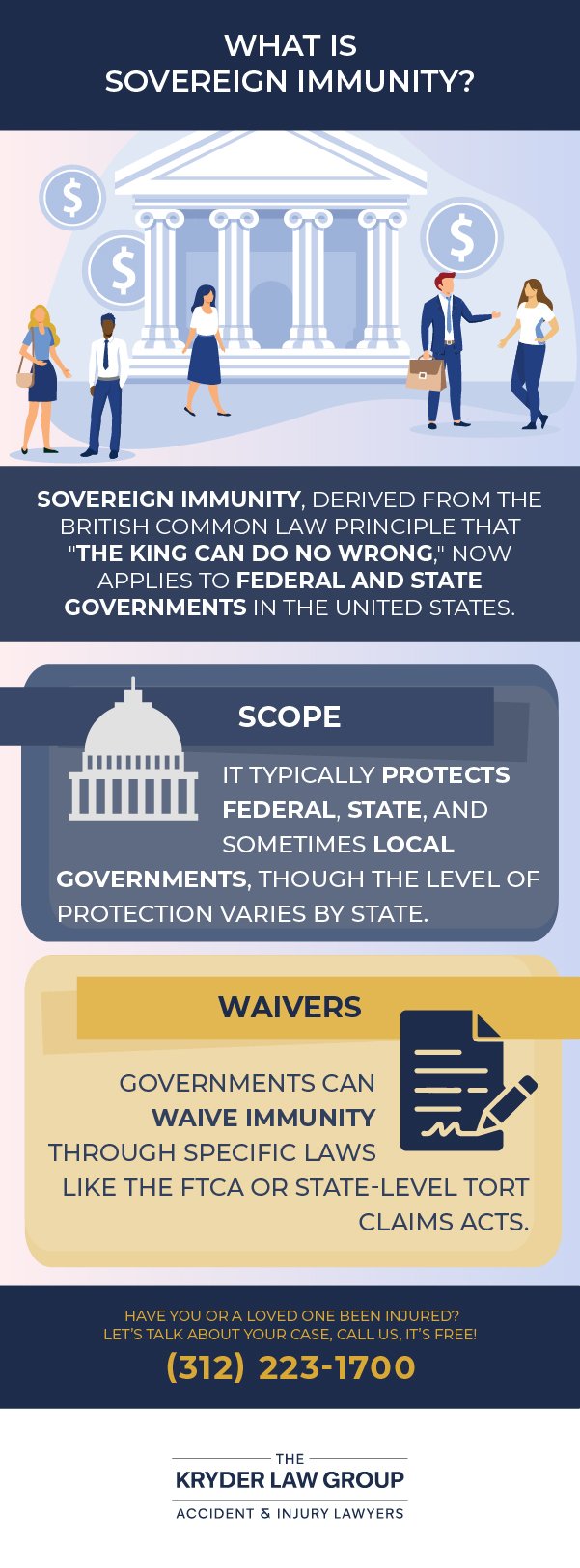
Origin: Derived from the British common law principle that “the King can do no wrong,” it now applies to federal and state governments in the United States.
Scope: It typically protects federal and state governments, and often local municipalities, though the level of protection for local entities can vary according to state law.
Waivers: Governments can waive immunity through specific laws like the Federal Tort Claims Act (FTCA) or various state-level tort claims acts.
What Are State-Level Tort Claims Acts in the Midwest?
Why Sovereign Immunity Matters in Personal Injury Cases
Sovereign immunity matters because many injury claims involve public property, government workers, or government vehicles.
If your injury involves a city bus, a county hospital, a state agency, or a federal employee, the claim process is different from a standard personal injury case. You might need to submit special notices, meet shorter deadlines, or follow unique procedures before a lawsuit can even begin.
These differences may affect:
Where and how to file your claim
Deadlines for taking action
What evidence or details you’ll need
Limits on what you can recover
Risk of dismissal if procedures aren’t followed
If a public agency might be involved in your injury, it’s important to identify this early.
How Sovereign Immunity Works
Sovereign immunity isn’t absolute. Governments sometimes allow lawsuits but only within narrow exceptions.
Claims Against State or Local Governments
Cities, counties, and agencies can sometimes be sued but only if your claim falls within a listed exception. There are often special protections for emergency services, discretionary decisions, and certain functions.
For injured people, this means details matter—a claim may succeed or fail based on who owned the property or employed the worker and what deadlines apply. An attorney can help you understand federal or state sovereign immunity in your case.
Claims Against the Federal Government
Claims against the federal government usually fall under the FTCA. This federal law allows some personal injury claims against the United States government when a federal employee’s negligence caused an injury while they were doing their job.
In short, federal sovereign immunity can be waived but only under strict, specific rules that determine when a federal court has the authority to hear a case.
Examples of Sovereign Immunity in Personal Injury Cases
Here are some ways governmental immunity may affect injury claims:
Car accident involving a government vehicle: a USPS truck runs a red light and causes a crash.
Unsafe conditions on public property: you slip and fall on damaged steps at a courthouse or on an icy sidewalk outside a government building.
Negligence at a federal facility: you are injured by substandard care at a Veterans Affairs (VA) hospital.
Learn what sovereign immunity means, why it matters, and what it can mean when a government agency, public employee, or federal facility is involved.
¿Tengo motivos para presentar una demanda?
Dirección
134 North LaSalle St., Suite 1515, , Chicago, IL 60602 Cómo llegar
Acuerdos y sentencias
$7.5M
Se han conseguido 7,5 millones de dólares para un trabajador de la construcción que sufrió un accidente en la obra
$3M
Se han recuperado 3 millones de dólares para la familia de una persona atropellada por un camión de basura
$2.2M
Se han recuperado 2,2 millones de dólares para un comercial que resultó herido en un accidente de tráfico
$2M
Se han conseguido 2 millones de dólares para una persona que fue atropellada por un vehículo que circulaba a exceso de velocidad mientras esperaba el autobús de la CTA
$1.4M
Se han recuperado 1,4 millones de dólares para un programador informático que resultó herido tras sufrir un resbalón y una caída
$1M
Indemnización de 1 millón de dólares en solo 90 días para la familia de un hombre que falleció mientras ayudaba a un conductor que se había quedado tirado


 25 de junio de 2026








 (312) 223-1700