“With contrast” and “without contrast” describe two ways of performing an imaging scan, such as a computed tomography (CT) scan or magnetic resonance imaging (MRI). Contrast is a special dye that highlights certain tissues, blood vessels, and organs so they show up more clearly. In personal injury cases, contrast helps doctors spot injuries that might otherwise be missed.
Medical terms come up often in personal injury cases, and clients frequently ask what they mean. That’s why our founding partner, Andrew Kryder, Esq., explains them in clear terms as part of our legal glossary. Here, we break down what with/without contrast means, what they help diagnose, and why they might matter for your injury claim.
In this Article
What Does “with Contrast” and “Without Contrast” Mean?
When a doctor orders an imaging scan, they choose whether to perform it with or without a CT or MRI contrast agent. Contrast is a dye, and it is often an iodine-based or gadolinium-based contrast agent. It temporarily highlights specific areas inside the body.
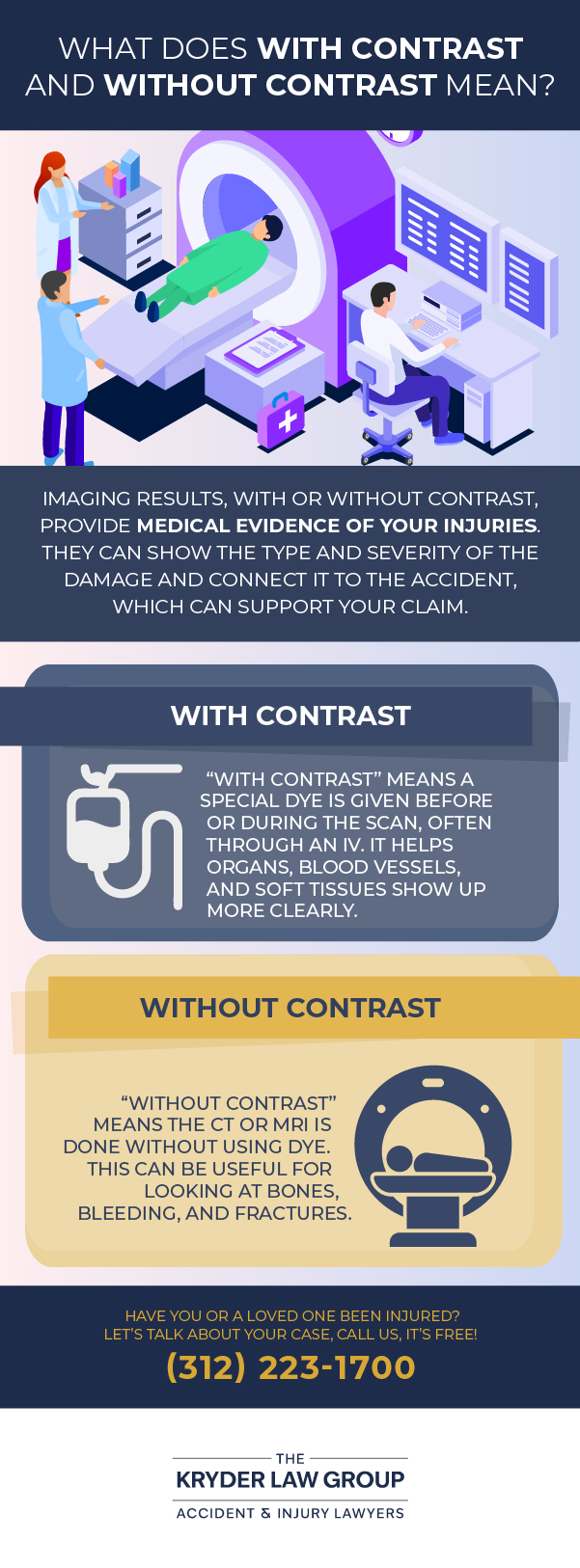
“Without contrast” means the CT or MRI scan is taken as is (with no dye). This approach works well for viewing bones, detecting bleeding, and spotting fractures.
“With contrast” means the dye is given before or during the scan, usually through an IV, by mouth, or by another route. The dye in the contrast MRI makes the body’s soft tissues, blood vessels, and organs stand out, helping doctors see problems that a plain scan can’t reveal.
Sometimes a healthcare provider orders both. A scan performed with and without contrast lets them compare the two CT or MRI images and pinpoint an injury more accurately.
What Injuries Does Contrast Help Diagnose?
Contrast is especially useful for viewing soft tissue, blood vessels, and organs—areas that don’t always show up clearly on a standard scan. Doctors commonly use contrast imaging to diagnose:
Internal bleeding and blood vessel damage
Organ injuries to the liver, spleen, kidneys, or other organs
Soft tissue damage, including torn muscles and ligaments
Herniated discs and spinal injuries
Tumors, infections, and inflammation
Blood clots and blocked or damaged arteries
Because contrast highlights areas that a plain scan may miss, it can create detailed images that reveal the full extent of an injury after an accident.
What Accidents Might Lead to Needing Imaging with or Without Contrast?
A doctor may order a scan with or without contrast when a person shows signs of internal injury, soft tissue damage, or organ trauma. These injuries frequently follow accidents such as:
Car and truck crashes
Motorcycle wrecks
Slip and fall accidents
Construction and workplace accidents
Pedestrian and bicycle accidents
If you’ve experienced pain, swelling, or symptoms of internal injury after an accident, a doctor may use contrast imaging to find the source and measure the damage.
Why Contrast Imaging Matters in a Personal Injury Case
Imaging with or without contrast material does more than guide treatment. It creates an objective record of your injuries that a physical exam alone can’t provide. That record helps connect your injuries directly to the accident, which matters when you’re seeking fair compensation.
Some injuries like internal bleeding or soft tissue tears are hard to prove without clear imaging. A scan with contrast offers detailed, measurable evidence, making it harder for an insurance company to dismiss your claim.
If you’ve been injured in an accident, the personal injury lawyers at The Kryder Law Group, LLC Accident and Injury Lawyers, can review your medical records and help you understand your options. Contact us today for a free consultation.
Frequently Asked Questions
Here are questions we often hear from clients when reading their medical records after an accident.
What is the difference between a scan with contrast and without contrast?
A scan without contrast is taken with no dye and works well for viewing bones and bleeding. A scan with contrast uses a dye to highlight blood vessels, soft tissues, and organs, helping doctors see problems a plain scan can’t reveal. Sometimes both are done for comparison.
Is contrast dye safe?
For most people, contrast dye is safe and leaves the body naturally within a day or two. Some people may feel a warm sensation or metallic taste during the scan. Contrast can create a risk of allergic reactions in some patients, but such reactions are rare, and patients with kidney problems or dye allergies should tell their doctor beforehand.
Can imaging results be used as evidence in my injury case?
Yes. Imaging results—whether taken with or without contrast—provide objective medical evidence of your injuries. They can document the type and severity of the damage and link it to the accident, which is valuable when pursuing a claim.
Who pays for imaging after an accident?
Payment can come from several sources, including auto insurance, health insurance, or a settlement. A personal injury lawyer can help you understand how your medical costs may be covered.
Learn what "with contrast" and "without contrast" mean, what injuries contrast imaging diagnoses, and why it matters in a personal injury claim.
Do I have a case?
Address
134 North LaSalle St., Suite 1515 Chicago, IL 60602 Get Directions
Settlements & Verdicts
$7.5M
$7.5 Million Recovered for a Construction Worker Injured on Site
$3M
$3 Million Recovered for the Family of a Person Struck by a Garbage Truck
$2.2M
$2.2 Million Recovered for a Salesperson Injured in an Automobile Collision
$2M
$2 Million Recovered for a Person Struck by a Speeding Vehicle While Waiting for the CTA Bus
$1.4M
$1.4 Million Recovered for a Computer Programmer Injured in a Slip and Fall
$1M
$1 Million Recovery in just 90 Days for the Family of a Man Killed While Helping a Stranded Motorist


 September 29th, 2026








 (312) 223-1700