If you were hurt at work, you probably have one big question on your mind: what will workers’ compensation actually cover? The good news is the system is built to support an injured employee while they recover, and understanding your options is the first step toward getting the help you deserve. Our workers’ compensation lawyers can answer your questions about a workers’ compensation claim.
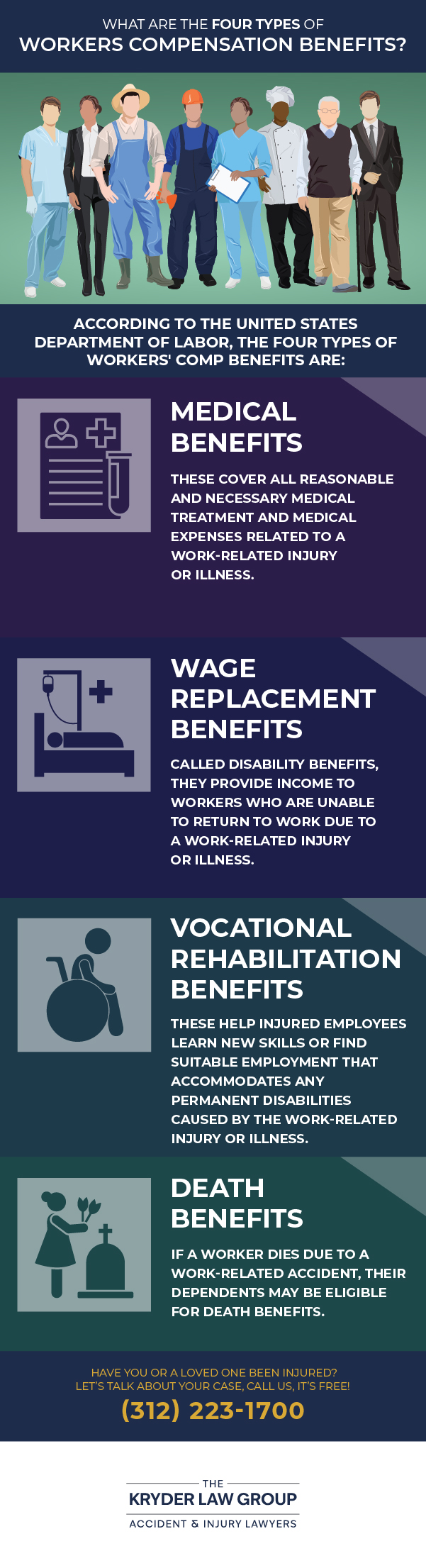
Workers’ compensation programs generally offer four types of workers’ compensation benefits: medical treatment, wage replacement (disability), vocational rehabilitation, and death benefits. Under federal guidance from the U.S. Department of Labor (USDOL), as well as state laws like the Illinois Workers’ Compensation Act, these categories outline the foundational support available to employees injured on the job. Workers’ compensation policies vary by state regulations.
Here’s what you’ll learn in this guide:
What each of the four benefit types covers
How Illinois law and the Illinois Workers’ Compensation Commission (IWCC) handle your claim
Answers to common questions about doctors, timelines, and costs
Let’s break it down.
In this Article
What Are Workers’ Compensation Benefits in Illinois?
In Illinois, most employers are required to carry workers’ compensation insurance to provide benefits for their injured employees; workers’ compensation operates as a no-fault system. This means if you suffer a work-related injury or illness, you may be entitled to receive benefits under the Illinois Workers’ Compensation Act (820 ILCS 305, et al.), regardless of fault.
If a workplace accident results in an employee’s death, certain surviving family members may be eligible to receive death benefits.
What Is the Illinois Workers’ Compensation Commission?
The IWCC is the state agency responsible for overseeing and enforcing workers’ compensation laws in Illinois. This generally includes helping ensure employers carry required insurance, resolving disputes between employees and employers, and administering benefits to injured workers.
Medical Benefits in Workers’ Comp Claims
Medical benefits are one of the most common types of workers’ compensation. They may cover the reasonable and necessary medical expenses tied to a work-related injury or illness, including:
Doctor visits
Hospital stays
Surgeries
Physical therapy
Medications
In Illinois, injured workers generally have the right to select their own medical providers under the statutory “two-doctor rule” (820 ILCS 305/8[a]). This rule permits an employee to choose up to two primary physicians and receive care within their direct chains of referral. Initial emergency treatment does not count against this limit. However, if an employer uses an approved Preferred Provider Program (PPP), the worker must select within that network or formally opt out in writing, which reduces their independent choice to a single provider chain.
Here’s the catch: these rules can get complicated quickly. If you have questions about your right to choose a physician for your medical care, our team can help clarify your options.
Wage Replacement Benefits
When a workplace injury keeps you from earning your full paycheck, wage replacement benefits help cover your lost wages. According to the IWCC Handbook, these benefits provide crucial financial support to workers who are temporarily or permanently unable to earn their regular income due to a job-related injury or illness.
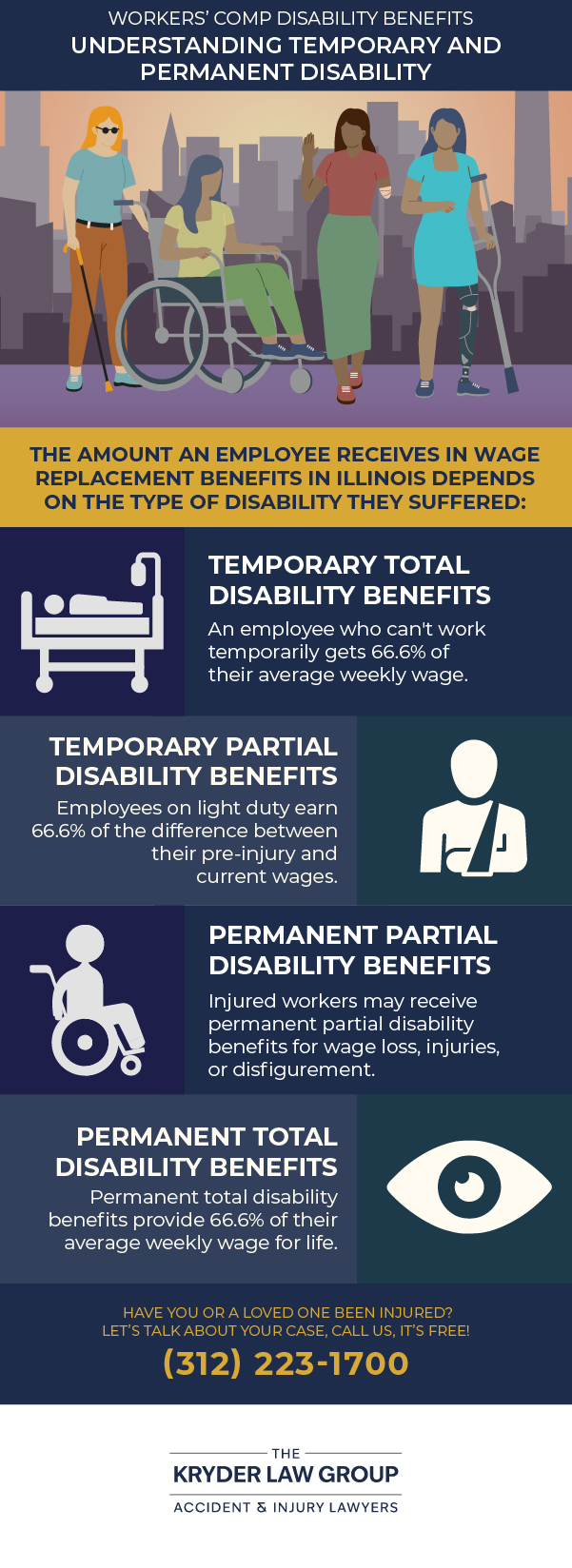
In Illinois, wage replacement is generally calculated at 66 2/3% of your average weekly wage, subject to statutory minimums and maximums. For severe injuries occurring between July 15, 2026, and January 14, 2027, weekly temporary total disability (TTD) payments are capped at a maximum of $2,045.63.
Workers’ compensation disability benefits are classified into four categories: temporary total, temporary partial, permanent total, and permanent partial disability (PPD).
Temporary Total Disability Benefits
TTD benefits apply when a work injury completely prevents you from working during recovery. Payments equal 66 2/3% of your average weekly wage, subject to statutory limits. Benefits begin on the fourth calendar day of lost time; if disability exceeds 14 days, the initial three-day waiting period is paid retroactively. TTD payments continue until your physician clears you to return to work or determines you have reached maximum medical improvement (MMI).
Temporary Partial Disability Benefits
Temporary partial disability (TPD) benefits may apply if you return to light-duty work at reduced pay. In Illinois, TPD pays 66 2/3% of the difference between your pre-injury average weekly wage and your current light-duty earnings, subject to statutory maximums.
Permanent Partial Disability Benefits
PPD benefits may be available if you suffer a lasting impairment but retain some ability to work. In Illinois, PPD is calculated using one of four categories: wage differential, scheduled loss of use, non-scheduled loss (person as a whole), or disfigurement.
Permanent Total Disability Benefits
Permanent total disability (PTD) benefits apply when a severe work-related injury or illness leaves you permanently unable to perform any gainful employment or results in the total loss of two major body parts (such as eyes, hands, or feet). Under Illinois law (820 ILCS 305/8[f]), PTD provides weekly payments equal to 66 2/3% of your average weekly wage, which can continue for life (provided you remain permanently disabled).
What Is Maximum Medical Improvement?
MMI occurs when a physician determines your work-related injury has stabilized and no further curative treatment will significantly improve your condition. Reaching MMI marks a major transition in your claim: TTD benefits end, and your case shifts to evaluating permanent disability benefits (such as PPD or PTD) or negotiating a claim settlement.
Vocational Rehabilitation Benefits
If a work-related injury or illness keeps you from returning to your old job, vocational rehabilitation benefits may help you get back on your feet. These benefits are designed to help you build new skills or find suitable employment and may include:
Vocational rehabilitation services
Counseling and supervised job searches
Job retraining
On-the-job training
Death Benefits
If a worker dies from a work-related accident or illness, their surviving dependents may be eligible for statutory death benefits under Illinois law. These benefits provide weekly wage replacement payments equal to 66 2/3% of the deceased employee’s average weekly wage (subject to state limits), as well as coverage for related prior medical bills and a statutory funeral and burial expense allowance of up to $10,000. If you lost a family member in a work accident, our team can help you understand who may file.
How to File a Workers’ Compensation Claim in Illinois
Report the injury immediately. Notify your supervisor as soon as possible. Under Illinois law, you must give notice within 45 days of the accident.
Seek medical treatment. See a doctor right away and inform them your injury is work-related.
Document the incident. Keep copies of medical records, receipts, witness information, and a written summary of how the injury occurred.
Ensure your employer files the claim. Your employer is responsible for notifying their insurance company to initiate benefits.
Frequently Asked Questions About Illinois Workers’ Comp Benefits
Here are questions our law firm commonly gets asked about workers’ compensation benefits.
How long do workers’ compensation benefits last in Illinois?
It depends on the type of benefit. Temporary benefits usually continue until you return to work or reach MMI. PTD benefits may, in some cases, continue for life. Medical benefits generally continue as long as treatment is reasonable and necessary for the work-related injury.
Can I choose my own doctor for a workers’ comp claim in Illinois?
Generally, yes. In Illinois, injured workers usually have some right to choose their own doctor, though specific rules and exceptions may apply. Some specialized treatments may still require approval from the employer’s insurance carrier.
How much does a workers’ compensation lawyer cost in Illinois?
At The Kryder Law Group, LLC Accident and Injury Lawyers, we handle cases on a contingency fee basis. This means clients pay no upfront legal fees, and we only get paid an attorney fee if we recover compensation for you. Case expenses and court costs are typically reimbursed from the recovery.
What should I do if my workers’ comp claim is denied?
If your claim is denied, you may have the right to dispute the decision through the appeals process with the IWCC. A workers’ compensation lawyer can review the denial, help gather supporting evidence, and represent you throughout the process.
Free Consultation
Understanding your workers’ compensation benefits can feel overwhelming, but you don’t have to navigate it alone. For over two decades, our firm has helped injured workers across Illinois and the Midwest secure the compensation they deserve.
Contact us by phone or online for a free consultation. We work on a contingency fee basis. This means clients pay no upfront legal fees (and no attorney fees) unless we recover compensation for you. Case expenses and court costs are reimbursed from your recovery.
If you suffered a work-related injury and need more explanation of the types of workers’ comp benefits, contact The Kryder Law Group, LLC.
Do I have a case?
Address
134 North LaSalle St., Suite 1515 Chicago, IL 60602 Get Directions
Settlements & Verdicts
$7.5M
$7.5 Million Recovered for a Construction Worker Injured on Site
$3M
$3 Million Recovered for the Family of a Person Struck by a Garbage Truck
$2.2M
$2.2 Million Recovered for a Salesperson Injured in an Automobile Collision
$2M
$2 Million Recovered for a Person Struck by a Speeding Vehicle While Waiting for the CTA Bus
$1.4M
$1.4 Million Recovered for a Computer Programmer Injured in a Slip and Fall
$1M
$1 Million Recovery in just 90 Days for the Family of a Man Killed While Helping a Stranded Motorist


 September 21st, 2026









 (312) 223-1700