Are you confused by legal jargon and wish a lawyer could just explain it in plain language? That’s exactly what we do in this legal glossary series. This time, our personal injury lawyers break down what a “bellwether trial” means—and why it could matter to your case.
In this Article
What Is a Bellwether Trial?
If you’ve been following a mass tort lawsuit, you may have come across the term “bellwether trial.” It sounds technical, but the concept is straightforward—and it matters a great deal if you’re one of many people with a similar legal claim.
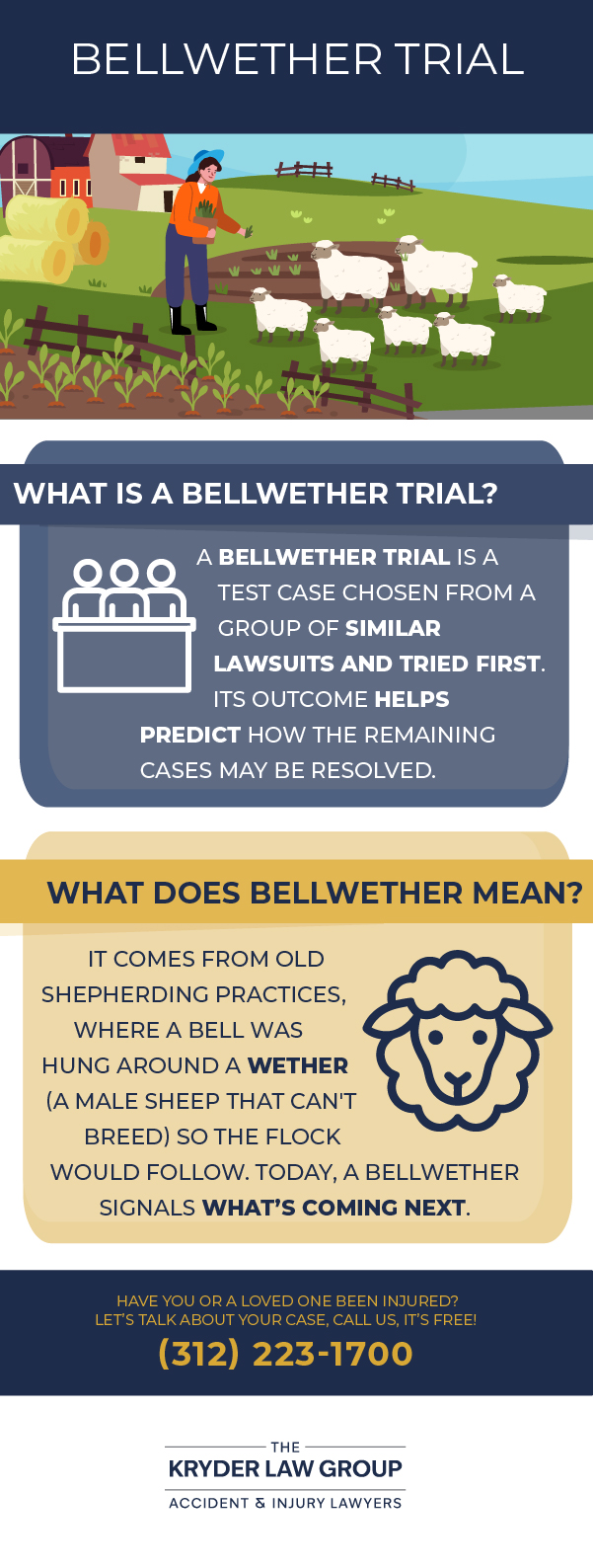
A bellwether trial is a test case selected from a large group of similar lawsuits and tried first. The outcome helps predict how remaining cases may be resolved, often encouraging settlements before every claim goes to trial.
When Is a Bellwether Trial Used?
Bellwether trials arise in multidistrict litigation (MDL)—a legal process that consolidates hundreds or thousands of similar lawsuits before a single federal judge. Full individual trials for every case would be impractical. Instead, the court selects a small number of representative cases to try first.
These early verdicts reveal how juries respond to the evidence, which arguments land, and what damages look like in practice. That information often drives both sides toward settlement negotiations for the remaining cases.
How Is a Multidistrict Litigation Different from a Class Action?
The main difference is that a class action combines thousands of claims into one single lawsuit, while an MDL keeps thousands of lawsuits separate but groups them together for pretrial management.
How Does a Bellwether Trial Work?
During pretrial proceedings, the judge appoints a Plaintiffs’ Steering Committee—a lead team of attorneys who pool resources to fight the defendant (often a large corporation). This committee does the heavy lifting, gathering corporate documents and expert testimony so individual victims do not have to fund these massive expenses alone.
While your individual case is safely paused, this committee and the defense select a handful of representative filed cases to go to court first. These early trials act as a test run, producing verdicts that show both sides how juries respond to the evidence. While “MDL” refers to federal courts, many state courts use identical processes under tort law.
What Is an Example of a Bellwether Trial?
The hair relaxer cancer litigation is a current example. Thousands of women allege that chemical hair relaxers caused uterine, ovarian, and other cancers in lawsuits consolidated before U.S. District Judge Mary M. Rowland in the Northern District of Illinois. After the court established the bellwether process in 2025, pretrial discovery and other proceedings pushed the first bellwether trials to 2027. Earlier, Judge Rowland denied the manufacturers’ motions to dismiss many of the core personal injury claims, allowing the litigation to proceed. If bellwether trials occur as scheduled, their outcomes are expected to influence settlement negotiations for many of the remaining claims and help predict outcomes for future cases.
Why Do Bellwether Trials Matter in Personal Injury Cases?
Holding bellwether trials is a high-stakes testing ground to see if trial teams for plaintiffs can successfully prove legal liability to a jury. Here’s why they matter:
They influence settlement discussions and claim values. A strong plaintiff verdict in a bellwether trial can push defendants to settle remaining claims for more.
They test legal theories. Both the defendant and plaintiffs’ counsel learn which legal arguments and key evidence are effective before more cases go to trial.
They move complex litigation forward. Without bellwether trials, mass tort cases could take decades to resolve.
Your individual case may not be selected as a bellwether trial case—most aren’t. But the results directly affect your claim’s outcome.
Frequently Asked Questions
What is the purpose of a bellwether trial?
A bellwether trial tests how a jury responds to a representative case within a large group of similar lawsuits. The verdict helps both sides gauge the strength of the claims and often encourages settlement of additional cases.
Does a bellwether trial verdict apply to every case?
No. A bellwether verdict does not legally bind other plaintiffs in an MDL case. However, it does influence how defendants value and negotiate the remaining claims, including yours.
How do they select bellwether cases?
In the initial phase, the court chooses a small mix of cases that match what most victims experienced. They look at your specific injury, how long you used the product, and your age—ensuring older and young users are represented.
What happens if defendants lose a bellwether trial?
If the defense loses, it shows they are at huge risk for the rest of the other cases, which speeds up a total settlement. If the defense wins, it lowers the payout value for similar claims.
What does bellwether mean?
The word comes from an old shepherding practice. A wether is a male sheep that cannot breed, and a bell was placed around its neck so the rest of the flock would follow it. Over time, bellwether came to mean someone or something that leads the way or signals what is coming next.
Learn from personal injury lawyers what a "bellwether trial" means—and why it could matter to your case.
Do I have a case?
Address
134 North LaSalle St., Suite 1515 Chicago, IL 60602 Get Directions
Settlements & Verdicts
$7.5M
$7.5 Million Recovered for a Construction Worker Injured on Site
$3M
$3 Million Recovered for the Family of a Person Struck by a Garbage Truck
$2.2M
$2.2 Million Recovered for a Salesperson Injured in an Automobile Collision
$2M
$2 Million Recovered for a Person Struck by a Speeding Vehicle While Waiting for the CTA Bus
$1.4M
$1.4 Million Recovered for a Computer Programmer Injured in a Slip and Fall
$1M
$1 Million Recovery in just 90 Days for the Family of a Man Killed While Helping a Stranded Motorist


 July 10th, 2026








 (312) 223-1700