Legal jargon can get confusing fast. That’s why Andrew Kryder, Esq., founding partner of our personal injury law firm, created this glossary to make complex legal terms easier to understand. This entry explains what a guardian ad litem (or GAL) is, why the role matters in personal injury claims, and how it works with real-world examples.
In this Article
What Is a Guardian Ad Litem?
In Latin, ad litem means “for the case” or “for the lawsuit,” so the phrase translated literally means “guardian for the lawsuit.” In practice, a guardian ad litem is a court-appointed representative who protects the legal interests of a vulnerable person during a specific lawsuit.
Key Facts About a Guardian Ad Litem
Temporary role: their authority ends once the legal case closes.
Objective party: they serve as an independent officer of the court, not a personal advocate.
Best interests: they focus solely on what benefits the protected individual.
Limited scope: they handle only the legal case at hand, not the person’s daily life.
Vulnerable clients: they represent a minor or dependent child, incapacitated adults, incompetent persons, or unborn heirs.
Why a Guardian Ad Litem Matters in Personal Injury Cases
Some people cannot legally sign binding contracts or settle a claim on their own. A guardian ad litem steps in to make sure no one takes advantage of a minor or an injured adult. They carefully review any proposed settlement to confirm the payout covers future medical needs and long-term care.
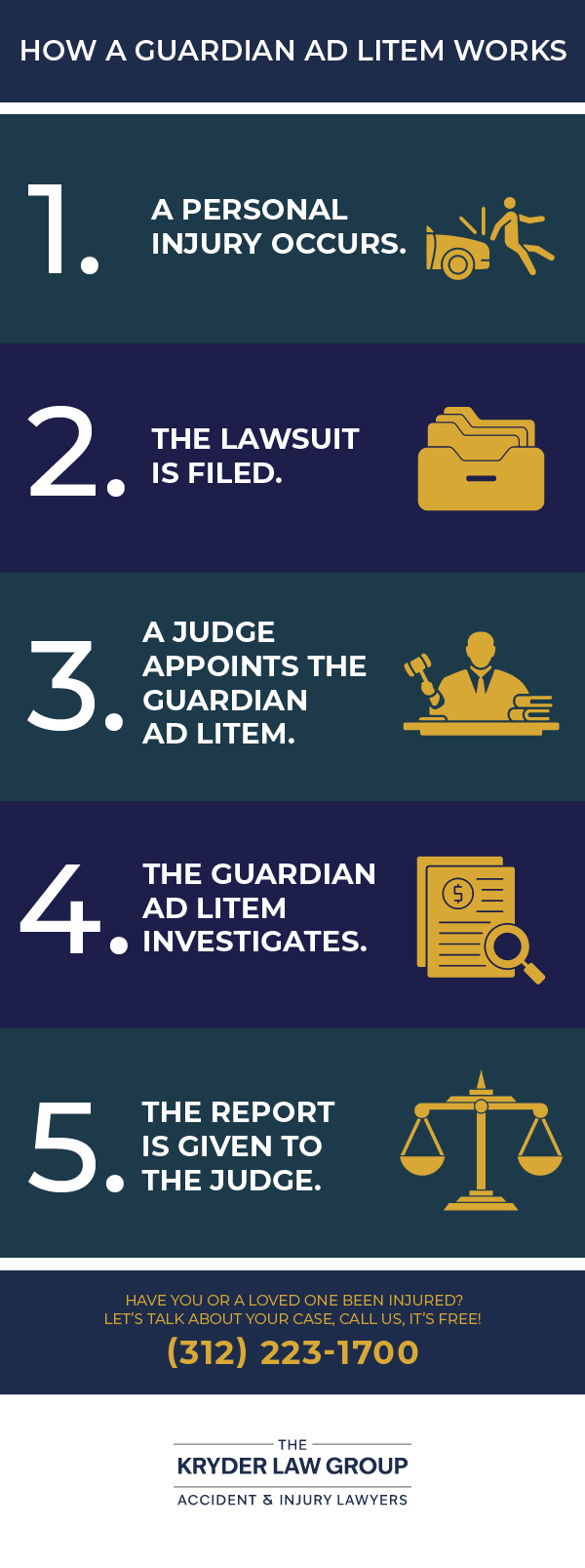
How a Guardian Ad Litem Works
Appointment: a judge selects the guardian at the start of the case.
Investigation: the guardian reviews medical records, financial needs, and accident reports.
Evaluation: they interview family members and legal counsel.
Recommendation: they submit an independent written report to the judge, explaining whether the settlement is fair.
Approval: the judge reviews that report before finalizing the case.
Who Pays for a Guardian Ad Litem in Personal Injury Cases?
The cost of a guardian ad litem is usually covered by settlement funds, but the exact process can vary. It’s best to consult with your attorney to understand how it applies to your case.
Examples of Guardians Ad Litem in Personal Injury Cases
Car accidents: a toddler is hurt in a crash, and the guardian ad litem makes sure the settlement funds go into a protected trust until the child turns 18.
Medical malpractice: a birth injury leaves a child with permanent brain damage, and the guardian ad litem appointed by the court reviews expert assessments of the cost of lifetime care and attends court hearings to represent the child’s best interests.
Traumatic brain injuries: an adult suffers severe cognitive loss in a workplace accident and can no longer communicate, so the guardian ad litem handles the lawsuit on their behalf.
Learn what a guardian ad litem (or GAL) is, why the role matters in personal injury claims, and how it works with real-world examples.
Do I have a case?
Address
134 North LaSalle St., Suite 1515 Chicago, IL 60602 Get Directions
Settlements & Verdicts
$7.5M
$7.5 Million Recovered for a Construction Worker Injured on Site
$3M
$3 Million Recovered for the Family of a Person Struck by a Garbage Truck
$2.2M
$2.2 Million Recovered for a Salesperson Injured in an Automobile Collision
$2M
$2 Million Recovered for a Person Struck by a Speeding Vehicle While Waiting for the CTA Bus
$1.4M
$1.4 Million Recovered for a Computer Programmer Injured in a Slip and Fall
$1M
$1 Million Recovery in just 90 Days for the Family of a Man Killed While Helping a Stranded Motorist


 July 10th, 2026









 (312) 223-1700