

Every year, students and student athletes across Columbus face hazing and bullying that leaves lasting damage—physically, emotionally, and financially. Whether it happened to new members on a football field in Hilliard, in a Greek organization at The Ohio State University, or in a residence hall on a college campus, the harm is real. And so are your legal options. This post breaks down what Ohio law says about hazing and bullying, what obligations schools and institutions have, and when a civil claim may be possible. If you or someone you love has been harassed, hazed, or bullied in Ohio, contact a Columbus hazing and bullying lawyer in our personal injury law firm for a free consultation. Here’s what you need to know before time runs out.
In this Article
How Can a Lawyer Help
Is Hazing Illegal in Ohio?
Yes. Hazing and bullying are serious legal issues in Ohio. Ohio has a specific statute that makes hazing a criminal offense, but over half of college students involved in campus organizations experience hazing. Hazing occurs in fraternities, sororities, athletic teams, honor societies, and student clubs in Ohio colleges and other educational institutions.
Ohio law criminalizes hazing under O.R.C. § 2903.31, and schools must maintain anti-bullying policies under O.R.C. § 3313.666. Victims may have grounds for civil claims against individuals, organizations, and institutions. Ohio’s personal injury statute of limitations is generally two years—so acting quickly matters.
Under Ohio Revised Code § 2903.31, hazing is defined as coercing or forcing someone into any act of initiation, affiliation, or membership that creates a substantial risk of mental or physical harm—such as forced alcohol consumption, extreme physical exercise, or sleep deprivation. This applies to both participants and organizers, as well as individual entities and organizations.
In October 2021, Ohio passed Senate Bill 126—known as Collin’s Law—significantly increasing criminal penalties for hazing:
- Misdemeanor hazing: standard hazing is a second-degree misdemeanor, no longer a fourth-degree misdemeanor.
- Felony hazing: hazing involving coerced consumption of alcohol or drugs that leads to serious physical harm is a third-degree felony.
- Felony involving death: recklessly permitting or participating in hazing that causes death elevates the charge to a second-degree felony.
- Elimination of consent: victims legally cannot “consent” to hazing as a defense for perpetrators.
- Mandatory action: this requires higher education institutions to enforce prevention policies and mandates reporting incidents to law enforcement.
For school bullying claims, obligations are outlined under Ohio Revised Code § 3313.666, while personal injury civil lawsuits must comply with the general two-year statute of limitations under Ohio Revised Code § 2305.10.
How Does Ohio Law Address Bullying?
Bullying is addressed separately from hazing and primarily governed through school policy and administrative law. Under federal law, civil rights claims can be pursued if bullying is based on a protected class; when bullying involves unwelcome sexual advances, coercion, or harassment based on sex, gender identity, national origin, or sexual orientation, it constitutes sexual harassment.
What Does Ohio’s Anti-Bullying Law Require of Schools?
Under Ohio Revised Code § 3313.666, every Ohio public school district—covering elementary, middle school, and high school environments across Columbus City, Worthington, Dublin, and Hilliard—must adopt a policy prohibiting harassment, intimidation, and bullying (HIB).
The statute defines HIB as any intentional written, verbal, electronic, or physical act exhibited toward another student more than once that:
- Causes mental or physical harm to the student
- Is sufficiently severe, persistent, or pervasive to create an intimidating, threatening, or abusive educational environment
Other examples include off-campus cyberbullying, social exclusion, physical threats, and athletic hazing. Schools must establish clear reporting, investigating, and parental notification procedures. A school district’s failure to enforce these mandated procedures can expose the district to civil liability.
What About Cyberbullying?
Ohio’s definition of bullying includes electronic acts—meaning cyberbullying is covered. Text messages, social media posts, and online threats that target a student fall within the law’s reach. If a school or its employees are aware of cyberbullying and fail to act, that inaction may support a civil claim.
Can You Sue for Hazing or Bullying in Ohio?
Yes, in many cases. Criminal charges against a bully or hazer don’t prevent a victim from pursuing a separate civil lawsuit for damages. In fact, a criminal conviction can actually strengthen a civil case.
Civil Liability for Hazing
If you or your child was hazed, potential defendants in a civil lawsuit may include:
- Individual perpetrators—those who directly participated in the hazing
- Organizations—fraternities, sororities, athletic teams, or clubs that allowed or organized the hazing
- Schools or universities—if they knew or should have known about hazing activity and failed to prevent it
- Coaches or school administrators—who directly supervised the group involved
Under Ohio law, you may be able to recover financial compensation for medical expenses, lost wages, mental and physical pain, emotional distress, and long-term psychological harm.
Civil Liability for Bullying in Schools
When a school district fails to enforce its anti-bullying policy under O.R.C. § 3313.666, the district may be liable for the harm suffered by a student. Key factors in these cases include:
- Whether school staff were aware of the bullying
- Whether the school took prompt and appropriate action
- Whether the bullying created a hostile educational environment
- Whether the victim suffered documented physical or psychological harm
Columbus-area families should keep records of every complaint filed, every meeting with school officials, and every report submitted. Documentation is critical in these cases.
Why Acting Quickly Matters in Ohio Hazing and Bullying Cases
Under Ohio Revised Code § 2305.10, most personal injury claims in Ohio must be filed within two years of the injury.
Two years can pass quickly, and delaying a claim can harm your case:
- Evidence is lost: digital records, text messages, and surveillance video are often deleted or overwritten.
- Witnesses fade: students graduate or move, and memories become unreliable.
- Investigations take time: educational institutions and internal boards require extensive review periods before formal claims are filed.
- Medical records delay progress: gathering physician statements, treatment histories, and psychological assessments takes months.
For minors, Ohio Revised Code § 2305.16 pauses (tolls) the two-year deadline until their 18th birthday. However, relying on exceptions is risky—contacting legal counsel early is critical to preserving evidence and proving liability.
What Should You Do After a Hazing or Bullying Incident in Columbus?
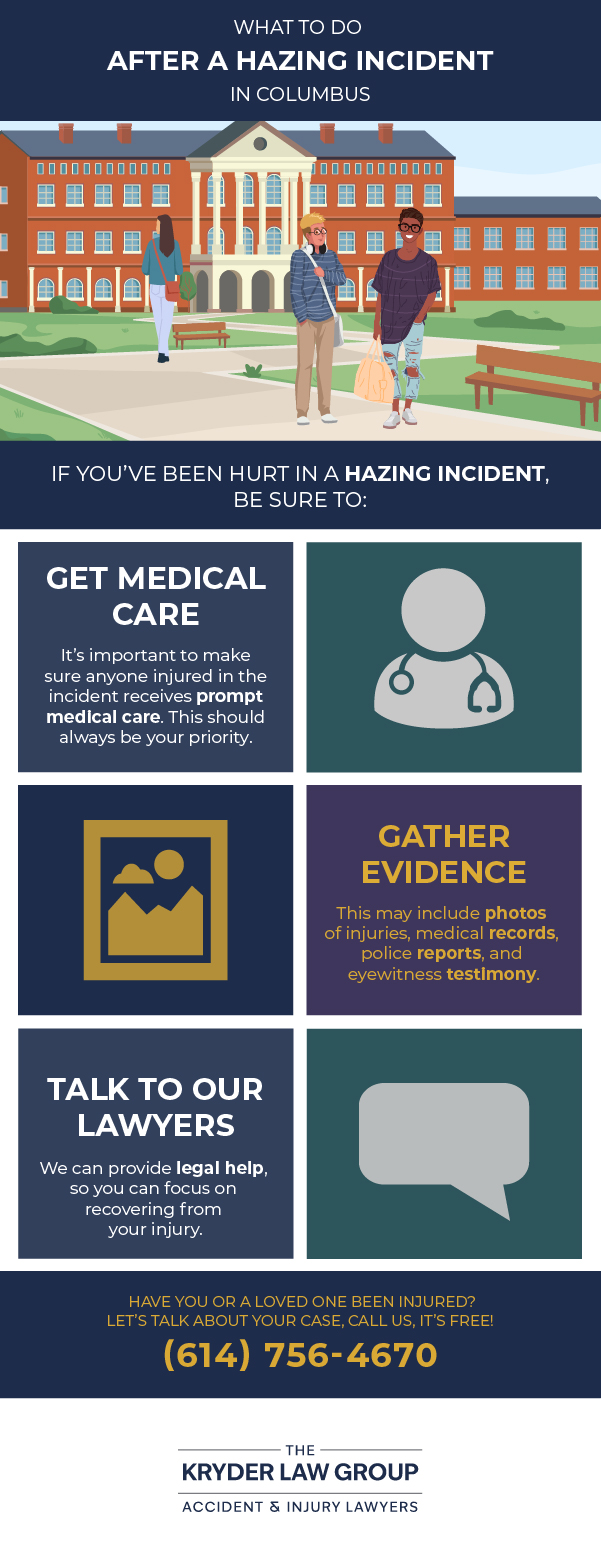
If you or your child experienced hazing or bullying in Columbus, Ohio, here are practical steps to take right away:
- Seek medical care. Even if injuries seem minor, document them with a healthcare provider.
- Report the incident. File a formal complaint with the school or university. Ask for written confirmation that the complaint was received.
- Preserve evidence. Save text messages, social media posts, photos, or videos. Write down dates, times, and names of anyone who witnessed the incident.
- Avoid settling quickly. Insurance companies and institutions may offer fast settlements. Don’t accept anything before speaking with a lawyer.
- Talk to an attorney. A hazing and bullying lawyer will guide you through the entire process, including gathering evidence, filing administrative complaints, and filing a civil lawsuit before time runs out.
What Resources Are Available for Ohio Families?
Families navigating hazing or bullying situations in Ohio don’t have to go through it alone. If your child’s life is in immediate danger, call 911.
Several resources are available:
- Columbus City Schools – Office of Equity and Employee Relations—handles formal bullying and harassment complaints for Columbus-area families
- Ohio Department of Education and Workforce—provides guidance on K-12 anti-bullying policies under O.R.C. § 3313.666
- Ohio Civil Rights Commission—handles discrimination-based harassment complaints at the school level
- The Ohio State University – Office of Student Life—a first point of contact for students experiencing hazing within campus organizations or Greek life
- HazingPrevention.org—national nonprofit offering resources for students, families, and educators
- StopBullying.gov—federal resource hub for bullying prevention and response
- Parental Responsibility and Bullying Laws Across the United States—an overview of how bullying laws and parental responsibility vary by state
- Columbus Police Department Non-Emergency Line—(614) 645-4545 for non-urgent incident reporting
Frequently Asked Questions About Ohio Hazing and Bullying Law
Here are answers to questions we often get asked by clients in Ohio about hazing and bullying.
Is hazing a felony in Ohio?
It can be. Under Collin’s Law (Senate Bill 248), hazing that causes serious physical harm is a third-degree felony in Ohio. Hazing that results in death is elevated to a second-degree felony. Standard hazing without serious injury is typically a misdemeanor, but criminal charges don’t prevent a bullied or hazing victim from also pursuing a civil lawsuit.
Can I sue a school in Columbus if my child was bullied?
Yes, in certain circumstances. If a Columbus-area school was aware of bullying and failed to take appropriate action under its anti-bullying policy (required by O.R.C. § 3313.666), the district may be civilly liable. The strength of your case depends on what the school knew, when it knew it, and how it responded.
Can a university or student organization be held liable for hazing in Ohio?
Yes. Under Ohio Revised Code § 2903.31 and Collin’s Law, universities and student organizations can face civil liability for hazing. If a school or organization knew about hazing activity—or created conditions that allowed it to occur—and failed to act, they may share responsibility for resulting harm. Individual perpetrators, fraternities or sororities, sports teams, and university administrators who supervised the group involved can all be named in a civil claim.
How long do I have to file a hazing or bullying lawsuit in Ohio?
Most personal injury claims in Ohio must be filed within two years of the incident under O.R.C. § 2305.10. If the victim is a minor, the two-year period may begin when they turn 18, but this isn’t guaranteed. Consulting an attorney as soon as possible is the safest approach.
What compensation can hazing or bullying victims recover in Ohio?
Victims may be eligible to recover compensation for medical bills, therapy costs, lost educational opportunities, pain and suffering, emotional distress, and (in some cases) punitive damages if the conduct was particularly egregious.
Does consent protect a hazer from liability in Ohio?
No. Under Collin’s Law, the defense that a victim “consented” to hazing was removed from Ohio law. A person cannot legally agree to be hazed in a way that eliminates the perpetrator’s criminal or civil liability.
You Have Rights—and a Deadline
Hazing and bullying cause real harm. They affect grades, careers, mental health, and in the worst cases, lives. Ohio law gives victims meaningful protections—but only if those rights are exercised before time runs out.
Our law firm works with hazing and bullying victims in Columbus and throughout Ohio. We review cases, explain options clearly, and fight for full and fair compensation. There’s no cost to get started, and you don’t pay anything unless we win.










 (312) 223-1700