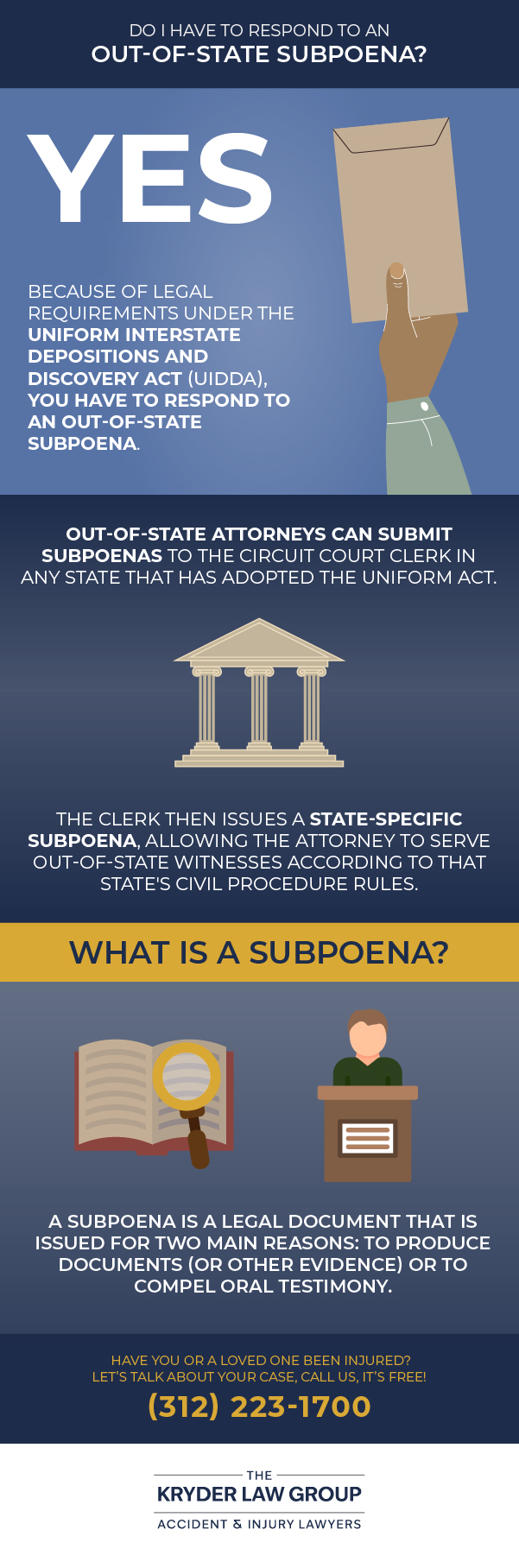
Yes, because of legal requirements under the Illinois Uniform Interstate Depositions and Discovery Act (UIDDA), you have to respond to an out-of-state subpoena. Our personal injury lawyers explain why.
In this Article
Out-of-State Subpoenas Explained by Andrew Kryder, Esq.
What Is a Subpoena?
A subpoena is a legal document that is issued for two main reasons: to produce documents or other evidence, or to compel oral testimony in either criminal or civil litigation.
If the subpoena is for documents, generally, no appearance is needed. If it’s for testimony, it could be for a deposition or appearance in front of a judge and jury. It is important to determine the type of subpoena to comply appropriately and on time.
What Is the Uniform Interstate Depositions and Discovery Act
Illinois has the Uniform Interstate Depositions and Discovery Act (735 ILCS 35/1et seq.), which is part of the legal landscape that streamlines the process for subpoenas and depositions across states. The law permits out-of-state attorneys to submit a subpoena to the court clerk of any Illinois circuit court. Upon receipt, the clerk issues an Illinois version of the subpoena, enabling the attorney to serve out-of-state witnesses, according to Illinois’s own rules of civil procedure.
What Is an Out-of-State (Foreign) Subpoena?
A subpoena is a formal written order from a court requiring you to do something. Usually, it asks you to provide documents, supply physical evidence, or appear in person to give testimony at a deposition or trial.
An out-of-state subpoena is issued when a witness or crucial evidence is located in a different state from where the case is being tried (a “foreign jurisdiction”). Because a state court’s authority is limited to its own borders, enforcing a subpoena in another state was once a very complicated process.
Understanding the UIDDA
To make the process of gathering evidence across state lines easier, the Uniform Law Commission created the Uniform Interstate Depositions and Discovery Act (UIDDA) in 2007.
The UIDDA simplifies the process for out-of-state subpoenas.
A lawyer can present a subpoena from the trial state to the court clerk in the state where the witness resides.
The local court clerk issues a new subpoena that matches the original request and follows the rules of the state where the witness lives.
What States Have Adopted the UIDDA?
According to the Uniform Law Commission, all states have adopted the Uniform Act except New Hampshire, Massachusetts, Missouri, and Puerto Rico—they all have introduced the bill in their legislatures.
Here is a look at the UIDDA adoption status for the Midwest states we frequently encounter:
Illinois: adopted
Indiana: adopted
Iowa: adopted
Kentucky: adopted
Michigan: adopted
Minnesota: adopted
Missouri: introduced
Ohio: adopted
Wisconsin: adopted
What If I Do Not Comply with Out-of-State or Local Subpoenas?
If your presence is required—even if you are an out-of-state witness—and you don’t appear, the judge may issue a rule to show cause or a warrant for your arrest. Attorneys and judges take subpoenas very seriously, so it’s in your best interest to comply.
If you have obligations on the subpoena date, you can retain local counsel or contact the office issuing it to agree on a suitable date.
Do I Have to Respond to a Subpoena Request from an Out-of-State Party?
Yes. The UIDDA allows for proper service of a subpoena in Illinois by an out-of-state attorney. Your obligation to respond is the same as if the subpoena came from Illinois.
Does the UIDDA Apply to a Federal Case?
Yes.
A federal case is a legal matter that falls under the jurisdiction of the United States federal courts, rather than state courts. These cases typically involve violations of federal laws or disputes between parties from different states.
If you receive an out-of-state subpoena from a local process server for a federal case, you must still respond to it—even if you are not located within the federal district where the case is being heard. The UIDDA applies to both the state and federal court proceedings.
How Do I Schedule a Deposition?
You’ll need to arrange a deposition with the issuer, either locally, by phone, or via video call.
Can I Issue Out-of-State Subpoenas for My Lawsuit?
If a settlement isn’t reached and a lawsuit is filed, years may pass between the date of the accident and when counsel conducts discovery. During this time, witnesses or doctors might relocate. Assuming the person you need isn’t in a state not participating in the UIDDA, your attorneys can use this law to support your injury claim.
Are There Filing Fees for Subpoenas?
Yes, there are filing fees associated with issuing out-of-state subpoenas. The clerk of the circuit court will charge a fee for issuing the subpoena and serving it to the recipient. Check with the specific county clerk’s office for their current fees.
How Can The Kryder Law Group, LLC Accident and Injury Lawyers, Help Me?
If you’ve been injured in the Midwest and have questions about subpoenas in your case, contact us. The UIDDA allows you to obtain local counsel who can advance cases across state lines by serving subpoenas where state laws or local ones don’t apply. Properly served subpoenas issued from a discovery state are enforceable by court order.
Learn about out of state subpoenas and if they apply to you.
Do I have a case?
Phone Number
Fax
Address
134 North LaSalle St., Suite 1515 Chicago, IL 60602 Get Directions
Settlements & Verdicts
$7.5M
$7.5 Million Recovered for a Construction Worker Injured on Site
$3M
$3 Million Recovered for the Family of a Person Struck by a Garbage Truck
$2.2M
$2.2 Million Recovered for a Salesperson Injured in an Automobile Collision
$2M
$2 Million Recovered for a Person Struck by a Speeding Vehicle While Waiting for the CTA Bus
$1.4M
$1.4 Million Recovered for a Computer Programmer Injured in a Slip and Fall
$1M
$1 Million Recovery in just 90 Days for the Family of a Man Killed While Helping a Stranded Motorist


 April 10th, 2026










 (312) 223-1700