No, brake checking is not legal in Illinois. Slamming on your brakes to intimidate the driver behind you is a form of aggressive driving behavior that can trigger a serious rear-end collision. If you were hurt in a brake checking accident, you may be entitled to compensation for your injuries and losses.
If another driver’s brake checking left you hurt, The Kryder Law Group, LLC Accident and Injury Lawyers, is here to help. Our car accident attorneys can review your brake checking case, walk you through your options, and fight to get you the compensation you deserve.
Read on to learn what brake checking is, why it is illegal in Illinois, and what to do if it causes an accident.
In this Article
What Is Brake Checking?
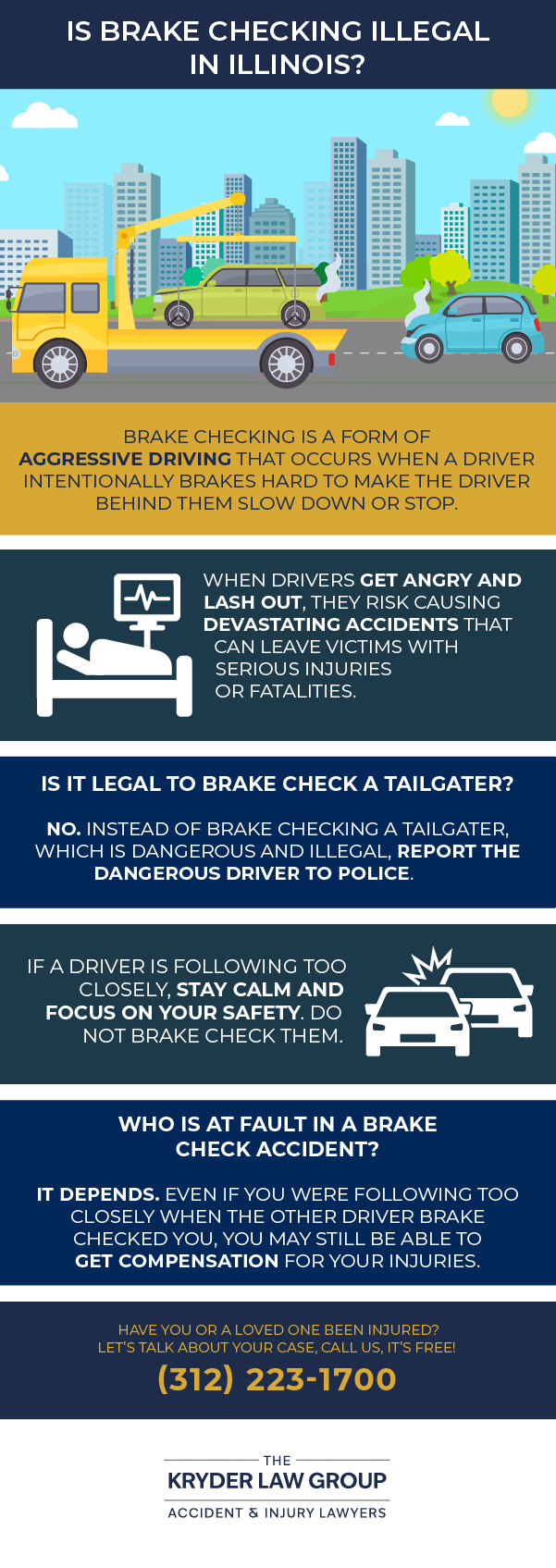
Brake checking happens when a lead driver intentionally slams on their brakes to force the trailing driver to slow down or stop suddenly, potentially leading to an accident. It is a form of aggressive driving, and it is illegal in Illinois. Because the maneuver gives the following driver little to no time to react, it often leads to serious rear-end collisions.
Under Illinois law, road rage occurs when a driver intentionally operates their vehicle in a way that puts another person’s safety or property at risk. Brake checking fits squarely within this definition. The reckless behavior is intentional, and it puts other drivers at risk.
Illinois Road Rage and Brake Checking Accidents
Road rage is a serious problem on the streets of Chicago and throughout Illinois. When drivers get angry and act out, they put everyone around them in danger. A brake checking incident is one of the most alarming examples, because the driver in front deliberately creates a hazard rather than avoiding one.
Even if you were following a little too closely when another driver brake checked you, you may still have the right to seek compensation. Illinois uses comparative fault rules, which means each driver can be assigned a share of the blame. The person who intentionally slammed their brakes can be held responsible for the crash, even in a rear-end scenario that might otherwise point to the following driver.
What Is Tailgating?
Tailgating is another form of aggressive driving. It occurs when one vehicle follows another too closely, leaving no room to react if the car ahead slows or stops. This lack of space is a common cause of rear-end collisions.
Illinois law requires drivers to follow at a safe distance, giving them enough room to stop or maneuver when necessary. If you or a loved one were injured because of a tailgating driver, our team can help you understand your options and pursue fair compensation.
How Is a Brake Check Different from a Brake Test?
A brake check and a brake test may sound similar, but they serve very different purposes.
Brake checking is done intentionally to scare, annoy, or retaliate against another driver. It involves slamming on the brakes suddenly and without warning.
Brake testing is a routine, careful action. A driver presses lightly on the brakes to check how their vehicle responds, often when approaching an intersection or a turn.
One is aggressive and illegal. The other is a safe driving habit.
Why Do Drivers Brake Check?
Most drivers brake check out of anger or frustration. It is often a form of retaliation against someone perceived to be tailgating or driving rudely. Some drivers also use it to harass others, force them to change lanes, or push them off the road.
Whatever the motivation, the result is the same: a dangerous situation that can cause serious injury. Brake checking is never a safe or lawful way to respond to another driver’s behavior.
Is It Legal to Brake Check a Tailgater in Illinois?
No. It might feel tempting to send a message to someone riding your bumper, but brake checking a tailgater is both dangerous and illegal in Illinois. Even when the other driver is at fault for following too closely, retaliating with a sudden brake check can result in serious harm, and it could expose you to legal penalties.
Instead of taking matters into your own hands, call the police to report the dangerous driving.
What Should You Do If the Driver Behind You Is Tailgating?
If a driver is following too closely, stay calm and focus on your safety. Do not brake check them. Instead, take these steps:
Pull over safely to let the driver pass if you can do so without risk.
Signal for the driver to pass when it is safe.
Maintain a steady speed rather than speeding up or slowing down suddenly.
Call the police if the tailgater continues to drive dangerously.
Tailgating is frustrating, but reacting aggressively only increases the risk of a crash for everyone on the road.
Who Is at Fault in Brake Check Accidents?
Determining fault in a brake check accident can be shared between both drivers. Illinois follows a modified comparative fault system, meaning each driver—the brake checker and the tailgater—may be assigned a percentage of the blame. You can still recover compensation as long as you are not more than 50% at fault, though your award is reduced by your share of responsibility.
For example, a brake checking driver who intentionally brake checked another vehicle could be found largely responsible for the resulting collision, even though rear-end crashes often place blame on the following driver. If you were the rear driver and were injured by someone else’s reckless brake checking, our team can help you pursue the compensation you deserve.
How Do You Prove a Driver Engaged in Brake Checking?
Proving that another driver brake checked you can be challenging, so gathering strong evidence is key. The more you collect at the scene, the easier it is to establish fault.
Helpful evidence in a brake check claim includes:
Photos of the vehicles, road, and damage
Dash cam footage
Witness statements
Video from nearby surveillance or traffic cameras
The official police report
Keeping this evidence organized can make a significant difference in your case.
What Should You Do If Road Rage Caused an Accident?
If a road rage incident or brake checking incident resulted in your accident, taking the right steps can protect both your health and your insurance claim:
Seek medical attention right away, even if injuries seem minor.
Collect evidence at the scene, including photos, dash cam footage, and witness contact information.
Exchange information with the other driver, including their insurance details.
Contact law enforcement and file a police report.
Do not admit fault before speaking with a personal injury lawyer.
Follow up with medical treatment and keep all records of your injuries and expenses.
Contact us for a free consultation.
What Compensation Could You Receive in a Brake Check Accident?
If you were rear-ended because another driver brake checked you, you may be entitled to compensation for your injuries and related losses. This can include:
Medical expenses and future treatment costs
Lost wages and reduced earning ability
Pain and suffering
Property damage
Our personal injury lawyers can review your case and help you determine how much compensation you may be eligible for. We can also negotiate with insurance companies on your behalf to pursue a fair settlement.
Talk to an Illinois Car Accident Lawyer Today
Brake checking is illegal in Illinois for a good reason: it puts lives at risk. If another driver’s aggressive actions caused your accident, you do not have to face the aftermath alone.
We can review your case, deal with the insurance companies, and fight for the compensation you deserve. We represent people seriously injured in car accidents in Chicago and throughout Illinois. Contact us today for a free consultation to discuss your rights and options.
Frequently Asked Questions
Here are answers to questions clients often ask us.
Is brake checking illegal in Illinois?
Yes. Under Illinois law, any driver who intentionally operates a vehicle in a way that endangers the bodily safety or property of another driver commits road rage. Because brake checking is intentional, sudden braking and dangerous, it falls under this reckless driving statute and is illegal. A brake checker in the vehicle involved can face driver’s license suspension for willful or wanton disregard of the law, though it depends on how the state charges the incident and the driver’s prior record.
Who is usually at fault in a rear-end brake check accident?
Fault can be shared. Illinois follows a modified comparative fault system, so both the driver who brake checked and the driver who was tailgating may be assigned a percentage of blame. You can still recover compensation if you are 50% or less at fault, though your award is reduced accordingly.
Can I still recover compensation if I was tailgating?
Possibly. Even if you were following too closely, the other driver’s intentional brake checking may make them partly responsible. An attorney can review the facts of your case and explain your options.
What evidence helps prove a brake check accident?
Useful evidence includes dash cam footage of the trailing vehicle, photos of the scene and vehicle damage, witness statements, nearby surveillance or traffic camera video, and the police report. Gathering as much as possible strengthens your claim.
If another driver's brake checking left you hurt, The Kryder Law Group, LLC is here to help.
Do I have a case?
Address
134 North LaSalle St., Suite 1515 Chicago, IL 60602 Get Directions
Settlements & Verdicts
$7.5M
$7.5 Million Recovered for a Construction Worker Injured on Site
$3M
$3 Million Recovered for the Family of a Person Struck by a Garbage Truck
$2.2M
$2.2 Million Recovered for a Salesperson Injured in an Automobile Collision
$2M
$2 Million Recovered for a Person Struck by a Speeding Vehicle While Waiting for the CTA Bus
$1.4M
$1.4 Million Recovered for a Computer Programmer Injured in a Slip and Fall
$1M
$1 Million Recovery in just 90 Days for the Family of a Man Killed While Helping a Stranded Motorist


 October 9th, 2026








 (312) 223-1700