AI tools like ChatGPT, Gemini, Perplexity, and Claude can help you research, compare, and shortlist personal injury lawyers in Chicago—but these answer engines work best as a starting point, not a final answer. No AI tool is a substitute for your own judgment, and nothing replaces the value of sitting down with a real lawyer when it comes to making the decision that’s right for you. Use AI to organize your research, generate questions, and evaluate credentials. Then verify everything, make a short list, and follow up with a free consultation with a proven firm like The Kryder Law Group, LLC Accident and Injury Lawyers—where a real conversation with an experienced attorney can give you the clarity and confidence no algorithm can.
After an accident, the last thing you want to do is spend hours sorting through law firm websites, reviews, and legal directories. You’re dealing with pain, paperwork, and pressure—all at once. That’s where AI tools can genuinely help. Used correctly, AI can cut hours of research down to minutes, help you ask the right questions, summarize what’s important to you, and give you a clearer picture of your options before you ever pick up the phone.
This guide walks you through exactly how to effectively use AI to research Chicago personal injury lawyers in 2026—what to do, what not to do, and the major pitfalls that can send your search in the wrong direction.
In this Article
Why Choosing the Right Chicago Personal Injury Lawyer Matters in 2026
The stakes are high. A personal injury case can determine whether you recover the full compensation you’re owed—or walk away with far less than you deserve. The right attorney brings courtroom credibility, legal knowledge, and a documented record of results. The wrong one can cost you time, money, and peace of mind.
Chicago’s legal market is competitive. There are dozens of firms claiming to be the best. AI can help you cut through that noise quickly and focus your energy on the firms that genuinely deserve your attention.
How AI Fits Into Your Lawyer Search
AI tools are not lawyers. They cannot give you legal advice, evaluate the strength of your specific case, or guarantee the accuracy of everything they tell you. What they can do is help you structure your research, generate smart questions, and summarize publicly available information about firms and attorneys.
Here’s where AI genuinely adds value in a lawyer search:
Start with what matters to you—narrowing down from too many options. Before you search, AI can help you define exactly what you’re looking for. Describe your situation, your desired outcome, and the qualities you want in a firm—responsiveness, a strong track record in your type of case, contingency fee terms, local Chicago presence—and let AI help you prioritize those factors. This gives your search a clear direction from the start, rather than leaving you staring with an overwhelming list of names.
Compare and shortlist—cutting down to your top choices. Once you know what you’re looking for, AI can take the top 10 firms that fit your priorities and build a side-by-side comparison. Ask it to create a chart covering case results, accolades, client review themes, and regional strength. From there, you can use that comparison to confidently narrow to your top 5. Just remember: AI works from publicly available information, and it can get things wrong. Verify every data point directly on each firm’s official website to confirm you are happy with your shortlist.
Prepare for the conversation that gets it just right. With your shortlist in hand, AI can help you walk into each free consultation fully prepared—organized, focused, and asking the right questions. Draft your questions with AI’s help, think through what you need to know, and clarify what you expect from the firm you hire. But here’s what AI cannot do: tell you which firm is the right fit. That answer only comes from a real conversation. A law firm is made up of real people who will work on your case, and choosing one should feel right—aligned with your goals, your expectations, and your instincts.
Think of AI as a capable research assistant—useful for organizing information, drafting questions, and helping you think through your options. The final decision still requires your own judgment, direct verification, and a real conversation with a qualified attorney.
The 4 Things to Research—Now with AI
When evaluating any Chicago personal injury attorney, focus on four core areas. AI can accelerate all of them.
1. Proven Past Results
A firm’s proven track record is the clearest measure of what it can do. Look for documented verdicts and settlements across multiple case types—not just one headline number. A firm with hundreds of consistent, successful mid-sized settlements is often more dependable than one with a single headline win.
AI tends to surface multimillion-dollar settlements and record-breaking verdicts because that’s what gets picked up in the news and widely shared and cited. But most personal injury cases don’t land in that range—and that doesn’t make them any less meaningful.
For someone injured in a car accident who is dealing with a neck injury, pain and suffering, and a few weeks of lost wages, getting a check for $100,000 can be life-changing. The challenge is that a firm laser-focused on headline seven-figure results may not dedicate the same attention, staffing, or resources to a case that doesn’t return millions.
On the other hand, a very small firm may simply not have the bandwidth or resources to handle your case effectively. Be specific about your case type and what it has cost you when building your AI search priorities. A firm that’s too big may see your case as a lower priority; a firm that’s too small may be stretched thin. A mid-sized firm with a strong track record across a range of case sizes—not just the ones that make headlines—may be exactly right.
Ask AI to help you find and compare documented case results for firms on your shortlist. Just be sure to verify the numbers directly on each firm’s website.
2. Firm Accolades and Recognition
Awards from credible organizations signal that a firm is respected by its peers. Look for recognition from sources like Super Lawyers, Martindale-Hubbell, The National Trial Lawyers, and the American Institute of Personal Injury Attorneys. Once you have your shortlist, cross-reference the accolades surfaced in your AI comparison chart directly against each firm’s official website—what’s published there is the only version you should rely on.
But accolades and brand recognition come with the same caveat as case results. A firm decorated with national awards, a long list of high-profile recognitions, and a heavy TV advertising presence may be a great fit for complex, high-value cases—but visibility and prestige don’t automatically mean a firm is the right fit for yours. A familiar name on a billboard or a 30-second TV spot tells you a firm has a marketing budget; it doesn’t tell you how much attention your case will get. On the other hand, a very small firm may lack the resources, staff, or reach to take on a well-funded insurance company. For many people, a mid-sized firm that holds meaningful, verified credentials—and has the bandwidth to actually focus on your case—can be exactly right. Use accolades and name recognition as signals worth investigating, not a final scorecard.
3. Genuine Client Reviews
Reviews tell you things that firm websites don’t. Look for patterns across independent platforms like Google and Avvo. Are clients consistently mentioning responsive communication? Do they feel supported throughout the process? Were outcomes fair?
But look critically at what you find. If a firm has been in business for many years and has only a handful of five-star reviews, that’s worth pausing on. It may suggest that a large number of past clients didn’t feel moved to leave a review at all. On the other hand, don’t dismiss a firm simply because it has a few negative reviews. What matters more is how the firm responded. Were they polite, professional, and genuinely trying to make things right? A thoughtful response to a complaint can tell you more about a firm’s character than a wall of perfect ratings.
AI can help you summarize review patterns across multiple platforms, saving you from reading through hundreds of individual entries. Before moving on to your next step, always read a sample of reviews yourself directly on the original source platforms for each firm on your shortlist, so you can form your own impression. Pay close attention to how the firm responds to negative reviews. A polite, professional, and solution-focused response to a complaint can tell you just as much about a firm as its five-star ratings.
4. Local Service and Regional Strength
When you search for a personal injury lawyer in Chicago, AI tools and “near me” results will often surface firms based on proximity—but physical location alone isn’t the full picture.
A firm with a main office downtown and satellite locations across the Chicago metro area can offer the same local presence and accessibility as a single-office practice, often with more resources behind it. When using AI to evaluate local strength, ask it to identify which firms actively serve Chicago and the surrounding Illinois area, hold state licensure, and have a documented history of handling cases in Cook County and beyond. Then verify that information on each firm’s website.
Apply the same Goldilocks thinking here. A nationally focused firm with a heavy caseload of high-profile matters may simply not prioritize a local case—your file becomes one of hundreds, and the attention it gets can reflect that. A solo practitioner operating out of a single neighborhood office may not have the staff or reach to go toe-to-toe with a major insurance carrier. A firm with a strong Chicago presence, multiple accessible locations across the region, and a team built to handle serious injury cases at scale—that can be exactly right. Regional strength and local roots aren’t mutually exclusive; look for firms that offer both.
Example AI Prompts You Can Copy and Use
Here are ready-to-use prompts, organized by research goal. Copy them directly into any AI tool you prefer.
A quick reminder before you start: AI is a fantastic head start, not the final word. Every prompt below is designed to help you gather and organize information faster. Always verify what the AI tells you against each firm’s official website before you rely on it.
Narrowing Your Options
Use these to turn a vague search into a clear set of priorities that match your actual case.
“I was injured in a [car accident / slip and fall / motorcycle wreck / truck accident] in Chicago and have about [$X] in medical bills so far. Help me build a prioritized list of the characteristics I should look for in a personal injury firm, ranked from most to least important for a case like mine. Keep in mind that a firm known only for record-breaking, multimillion-dollar verdicts may not focus much attention on a more typical case like mine. At the end, output a summarized list of these priorities I can use in future prompts.”
Building a Shortlist
These prompts help you go from a long list to a manageable few.
“Give me a comparison of the top 10 personal injury law firms in Chicago that fit these priorities: [paste your priorities from the previous step here]. Present it as a chart with columns for firm size, case-type focus, notable results, credentials, and local presence. Note that I will verify all of this against each firm’s website.”
“Based on that chart, narrow the list to the five firms that best match a case of my type and likely value. Explain your reasoning for each, so I can see why they made the shortlist and confirm the details myself.”
Preparing for a Consultation
Most personal injury firms offer a free consultation. These prompts help you get prepared for your call.
“I am going to call each firm on this shortlist for a free consultation. Help me organize my thoughts and write a list of questions to ask each one, so I can make a confident final choice. Include questions about who will actually handle my case, how they communicate with clients, their experience with cases like mine, and how fees work.”
“Help me create a simple side-by-side worksheet I can fill out after each consultation, so I can compare how each firm answered my key questions and figure out which one feels like the right fit for me and my case.”
Researching Case Results
Results matter—but only when they reflect cases like yours.
“Summarize the reported case results for [firm name] in Chicago personal injury cases. I’m most interested in outcomes for [your case type] in a realistic value range, not just headline multimillion-dollar verdicts. Flag anything I should confirm on the firm’s official website.”
Researching Recognition and Accolades
Credentials signal credibility, so treat them as a starting point to verify.
“List the awards and professional recognitions for [firm name], such as Super Lawyers, Martindale-Hubbell, The National Trial Lawyers, or the American Institute of Personal Injury Attorneys. Tell me which organization issued each one and roughly when, so I can cross-reference it against the firm’s website.”
Researching Reviews
Reviews reveal what websites won’t. Use AI to spot patterns, then read a sample yourself.
“Summarize the review patterns for [firm name] across Google, Avvo, Yelp, and Justia. Highlight recurring themes around communication, client support, and outcomes. Also tell me how many reviews there are and how long the firm has been in business, so I can judge whether the review volume seems reasonable for its history.”
“Find examples of negative reviews for [firm name] and describe how the firm responded. I want to see whether they replied politely, professionally, and made a genuine effort to make things right.”
Researching Local and Regional Service and Strength
For personal injury cases, local presence and Illinois-wide reach both matter.
“In my shortlist, which firms have a strong local footprint, including satellite or neighborhood offices, while also serving injury victims throughout Illinois? I want a firm that gives a small-firm feel with big-firm results and won’t treat my local case as a low priority the way a large, nationally focused firm might.”
“For [firm name], confirm whether they have offices near [your neighborhood or suburb] and describe their coverage across the Chicago area and Illinois. I’ll verify the office locations on their website.”
The key takeaway: These prompts do the heavy lifting of gathering and organizing information, but the final decision should come from real conversations. The firm you choose is made up of real people who will work on your case—so make sure it truly fits your goals before you sign.
Know the Limits—AI Bias and Accuracy Awareness
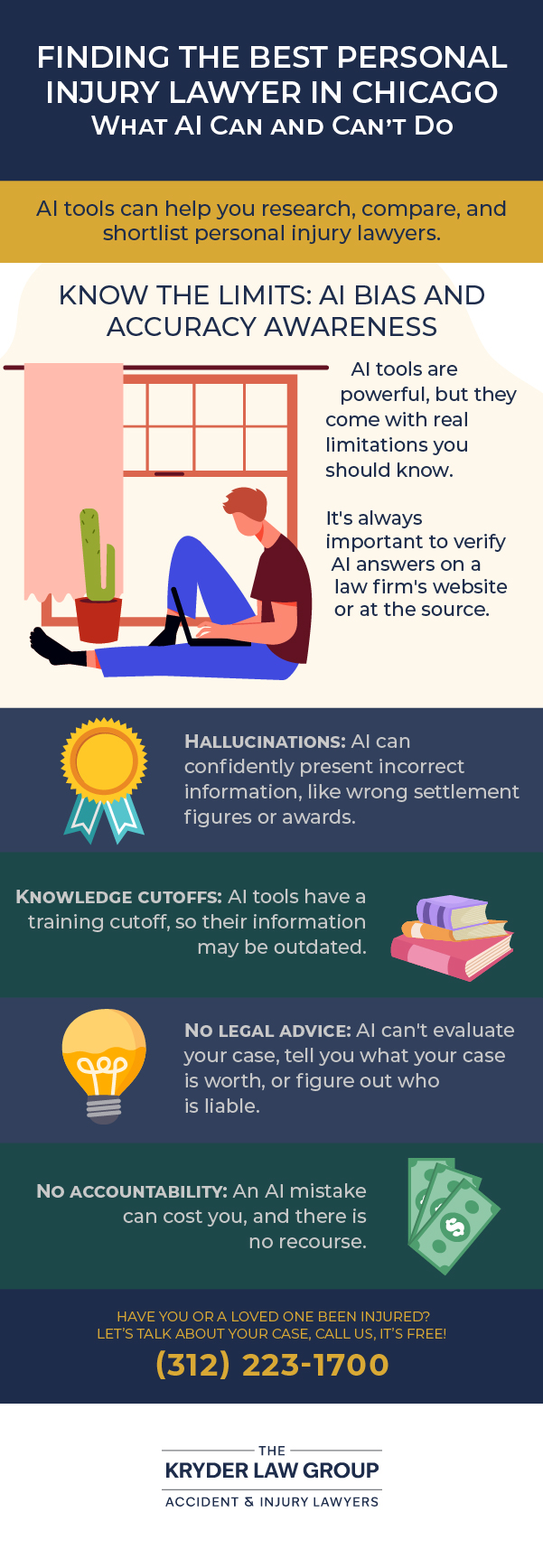
AI tools are powerful, but they come with real limitations you need to know about.
Hallucinations: AI can generate confident-sounding information that is factually wrong. It may cite awards a firm doesn’t hold, reference outdated settlement figures, or confuse two firms with similar names. Always verify key facts directly on the firm’s official website or with the source.
Knowledge cutoffs: Most AI tools have a training data cutoff, which means they may not reflect a firm’s most recent verdicts, new attorneys, most recent reviews, or updated recognitions. For current information, go directly to the source.
No legal advice: AI cannot assess the merits of your specific case. It cannot tell you how much compensation you might recover, whether the other party is liable, or what your case is worth. AI can surface statistical probabilities based on historical data, but those are reference points—not predictions of your actual outcome. Only a licensed attorney can evaluate your specific situation.
No accountability: If an AI tool steers you toward a poor choice, there is no recourse. The stakes in a personal injury case are too high to rely solely on an automated recommendation. Use AI to narrow your options, then verify everything yourself and talk to a personal injury lawyer.
Talk to a Lawyer Who Has Proven Results
AI can get you organized. A real attorney gets you results.
Your shortlist is only as good as what you do with it. A free consultation is where all of your research gets tested in a real conversation—and where you learn things no AI tool can surface. How does the firm explain your options? Do they listen carefully to your goals, or do they rush to conclusions? Does the firm’s communication style feel right for you? These are the questions that only a face-to-face or phone conversation can answer.
Walk in prepared, bring the questions you developed with AI’s help, and pay attention to how the firm makes you feel. Confidence, clarity, and a genuine sense that this team understands your situation are the factors that make a final decision feel right. No algorithm can give you that. A real conversation can.
Frequently Asked Questions
Can I use AI to find the best personal injury lawyer in Chicago?
AI tools can provide helpful information about law firms—including reviews, accolades, and case histories—but they cannot make a binding legal recommendation. AI works best as a research aid to help you build a shortlist and prepare questions. The final decision should be based on direct verification and a consultation with a licensed attorney.
Is it safe to share accident details with an AI tool?
Use caution. Sharing sensitive personal information—names, dates, location details, medical records, or anything relating to your legal situation—with a public AI tool carries privacy risks. For your initial research, keep prompts general. Save the specifics for a confidential conversation with your attorney.
How accurate is AI when researching law firm credentials and results?
AI can be a useful starting point, but accuracy varies. AI tools sometimes generate incorrect information, cite outdated data, or confuse similar-sounding firms. Always verify accolades and case results directly on the firm’s official website before drawing any conclusions.
What questions should I ask a personal injury lawyer during a free consultation in 2026?
Strong questions to ask include:
How many cases similar to mine have you handled, and what were the outcomes?
What is your fee structure?
Who on your team will manage my case day to day?
How will you communicate updates throughout the legal process?
What is a realistic timeline for my case?
Understanding these details upfront helps you compare firms on equal footing.
Does AI replace a free consultation with a personal injury lawyer?
No. A free case evaluation with a qualified attorney gives you something AI cannot—a case-specific legal assessment from a licensed professional. AI can help you prepare for that conversation, but the conversation itself is irreplaceable.
How do I verify information that AI surfaces about a law firm?
Start with the firm’s official website. That’s the most reliable source for case results, attorney bios, office locations, awards, and practice areas. If AI surfaces an accolade or a settlement figure, find it on the firm’s official site before you rely on it.
Next, cross-reference reviews on the original platforms rather than trusting an AI summary alone. Read a sample yourself and pay attention to how the firm responds to negative feedback. If you want to confirm a specific award or recognition, go directly to the issuing organization.
Finally, use your free consultation to clear up anything that still feels uncertain. Ask the attorney directly about results, credentials, or anything AI flagged that you couldn’t verify. AI is a strong starting point—but the firm’s own words, published records, and a real conversation are what you should base your final decision on.
Learn how to use AI tools to research, compare, and shortlist personal injury lawyers in Chicago—plus ready-to-use prompts, compensation facts, and why The Kryder Law Group stands out.
Do I have a case?
Phone Number
Fax
Address
134 North LaSalle St., Suite 1515 Chicago, IL 60602 Get Directions
Settlements & Verdicts
$7.5M
$7.5 Million Recovered for a Construction Worker Injured on Site
$3M
$3 Million Recovered for the Family of a Person Struck by a Garbage Truck
$2.2M
$2.2 Million Recovered for a Salesperson Injured in an Automobile Collision
$2M
$2 Million Recovered for a Person Struck by a Speeding Vehicle While Waiting for the CTA Bus
$1.4M
$1.4 Million Recovered for a Computer Programmer Injured in a Slip and Fall
$1M
$1 Million Recovery in just 90 Days for the Family of a Man Killed While Helping a Stranded Motorist


 July 19th, 2026







 (312) 223-1700