Ohio Aviation Accidents Report: 2016–2025
Aviation accidents are overwhelming. When you or a loved one is hurt, you want clear answers and strong support. Our plane crash lawyers reviewed the aviation accident data for Ohio airports over a 10-year period from 2016 to 2025 from the National Transportation Safety Board (NTSB) to help you understand where these incidents happen most often.
This report contrasts the accident rates at Ohio’s eight major commercial airports with the hundreds of smaller regional, municipal, and private airfields across the state.
Ohio’s Aviation Network
Ohio’s network of airports and aviation facilities connects communities and fuels economic growth throughout the state. There are 176 public-use airports and heliports, as well as 633 private airports and heliports. Ohio is also home to eight airports providing commercial services, according to the Ohio Department of Transportation:
- Akron-Canton Regional Airport (CAK)
- Cincinnati/Northern Kentucky International Airport (CVG)
- Cleveland Hopkins International Airport (CLE)
- Dayton International Airport (DAY)
- John Glenn Columbus International Airport (CMH)
- Rickenbacker International Airport (LCK)
- Toledo Express Airport (TOL)
- Youngstown-Warren Regional Airport (YNG)
Analysis of Ohio Aviation Accidents
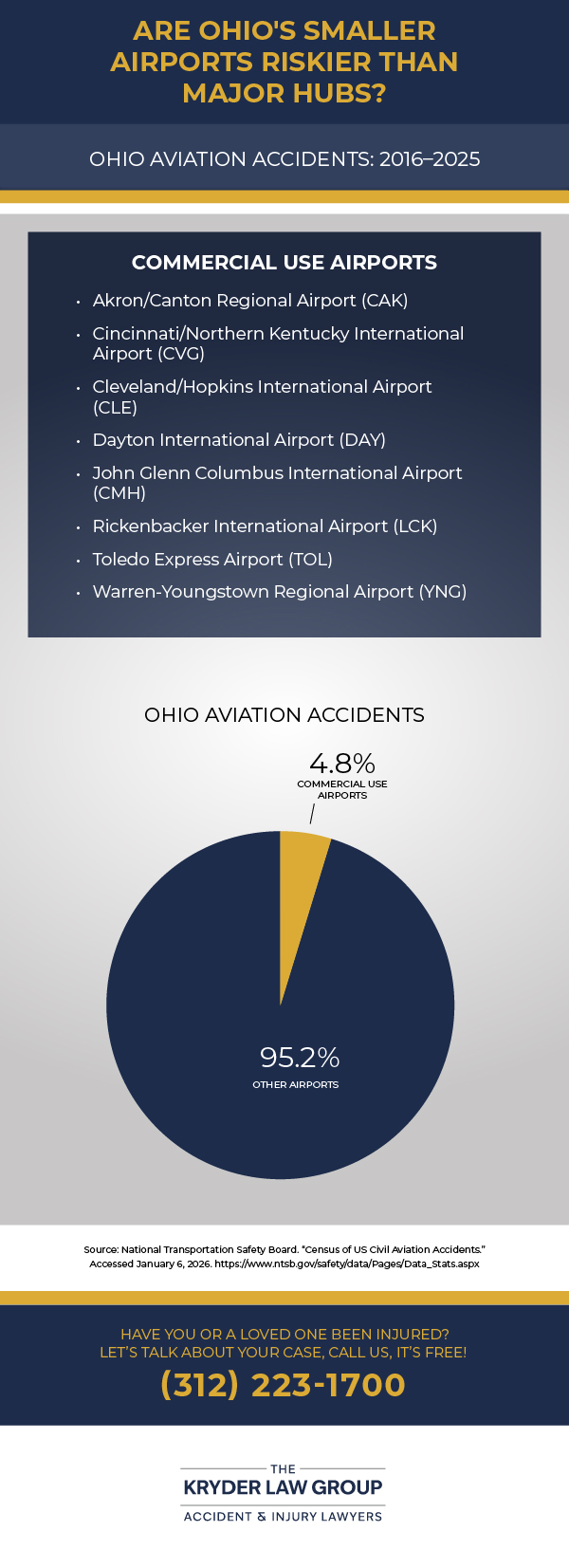
- 8 Commercial Use Airports: These airports, including major hubs like Cleveland Hopkins International Airport, John Glenn Columbus International Airport, and Dayton International Airport, account for 4.8% of all accidents in this 10-year period.
- Other State Airports: All other airports combined accounted for 177 accidents during the same period, making up roughly 95.2% of the total incidents.
| Type |
Accidents |
Percentage |
| Commercial Use Airports |
9 |
4.8% |
| Other Airports |
177 |
95.2% |
At first glance, it may seem surprising that the overwhelming majority of aviation accidents take place at smaller airports rather than at busy commercial hubs. Many assume that larger commercial airports, given their higher passenger volumes and complex operations, would naturally see more incidents. However, the data highlights that smaller regional and municipal airports, which tend to have a greater proportion of general aviation flights and fewer safety resources, are where most accidents occur.
Source: National Transportation Safety Board. “Census of US Civil Aviation Accidents.” Accessed January 6, 2026.
Accidents at Ohio Municipal Airfields
While a major commercial hub might see one or two accidents over a decade, some smaller municipal airfields see a higher frequency. For example, from 2016 to 2025:
- Fairfield County Airport: 7 accidents
- Wadsworth Municipal Airport: 6 accidents
- Andy Barnhart Memorial Airport: 5 accidents
- Clermont County Airport: 5 accidents
This data shows that while large commercial flight accidents often get the most media attention, private planes and smaller regional flights present a higher overall volume of accidents.
Understanding the Types of Flights: General Aviation vs. Commercial
It’s important to understand the key differences between general aviation and commercial flights when looking at accident data. General aviation covers a wide range of non-commercial activities, including private flying, flight training, agricultural aviation, and air ambulance services. These flights typically use smaller aircraft and often operate out of regional or municipal airports.
By contrast, commercial flights refer to scheduled passenger service, cargo transport, and charter operations run by certified airlines. These operations are usually found at Ohio’s eight commercial airports, where there are more stringent regulations, robust safety procedures, and greater oversight.
Accident statistics show that general aviation accounts for most incidents, which mirrors national trends—smaller aircraft, varied experience levels among pilots, and less infrastructure all play a role. If you’re interested in a more in-depth comparison of accident rates between general aviation and commercial operations across the United States, read our detailed analysis here.
Life After a Plane Crash
Experiencing a plane crash at one of Ohio’s hubs or smaller regional airports can change your life in an instant. Survivors and families are often left coping with physical injuries, emotional distress, and unexpected financial burdens, especially when these incidents happen closer to home—in community airports rather than major commercial hubs.
The aftermath of a plane crash can feel isolating, but you don’t have to go through it alone. Accessing reliable legal guidance can help restore stability, clarify your rights, and provide the reassurance needed to move forward. We are here to help you understand your options and navigate the complexities of your case.


 March 19th, 2026










 (312) 223-1700