When we think of dangerous travel, we often picture busy highways filled with semi-trucks. However, recent data suggests a different story unfolding in the skies above the Midwest. This report by our aviation accident lawyers compares the requirements for private pilot training against those for commercial driver’s license (CDL) holders in Midwestern states.
Our analysis reveals a significant disparity. While CDL drivers undergo rigorous, structured training to handle their vehicles safely, private pilots often take to the skies with comparatively minimal experience. This gap in training is a major factor contributing to the high accident rate in general aviation. By examining these differences, we aim to shed light on how better training standards could save lives.
Understanding the Safety Divide
Safety is always our top priority, whether on the road or in the air. The purpose of this report is to look closely at the connection between training standards and safety outcomes. We often assume that pilots, given the complexity of flying, receive the most extensive training possible. But is that assumption correct?
Are Accidents Related to Inexperience?
According to a recent report by The Kryder Law Group, LLC on civil aviation accidents, general aviation—which includes private pleasure flying—carries significant risks. Our hypothesis is straightforward: the high number of accidents in private aviation is strongly linked to pilot inexperience. This becomes startlingly clear when we compare the requirements for a private pilot license to the much more stringent demands placed on commercial truck drivers.
We focused our scope on Midwestern states, including Illinois, Indiana, Iowa, Kentucky, Michigan, Minnesota, Missouri, Ohio, Tennessee, and Wisconsin, gathering data from Federal Aviation Administration (FAA) regulations and state transportation guidelines.
The Dangers of General Aviation
General aviation is a broad category that covers most civilian flying, excluding scheduled airline service. While commercial airlines have achieved an incredible safety record, the same cannot be said for private planes.
Pilot Error
Findings from civil aviation accident reports establish general aviation as a high-risk activity. The statistics are concerning. A vast majority of aviation accidents fall into this category, and pilot error is frequently cited as a primary cause. These aren’t just numbers; they represent real people and families affected by tragic loss.
The economic and human consequences of these accidents are profound. When we look for the root causes, we consistently find that many pilots involved in accidents lacked the depth of experience necessary to handle unexpected situations. This leads us to question the adequacy of their initial training.
Private Pilot Certification Requirements
To understand why inexperience is such an issue, we must look at how someone becomes a private pilot. The FAA sets the minimum standards for a private pilot license (PPL).
Surprisingly, the barrier to entry is lower than many expect. Federal regulations require a minimum of just 40 hours of flight time for a student pilot to obtain a private pilot certificate. This includes at least 20 hours of flight training with a certified flight instructor and 10 hours of solo flight training. Specific requirements cover cross-country flights and night flying, but the total time commitment is relatively brief—especially when compared to the FAA requirements for a commercial pilot license of 250+ hours.
Across the Midwest, state-specific requirements generally mirror these federal minimums without adding significant additional training hours. This means a new pilot can legally carry passengers after spending just one standard work week’s worth of time in the air.
Commercial Driver’s License (CDL) Requirements
In contrast, let’s look at the requirements for obtaining a CDL to drive a semi-truck. Similar to becoming a commercial airline pilot, the path to becoming a professional truck driver is far more structured and demanding.
Federal and state regulations in the Midwest mandate comprehensive training programs. These aren’t just about logging hours; they involve extensive classroom instruction covering safety regulations, vehicle systems, and defensive driving. Following this, students must complete mandated behind-the-wheel hours on both ranges and public roads.
CDL training is designed to produce a professional operator. It acknowledges the immense responsibility of driving a heavy vehicle. The training hours required often exceed 160 hours of combined classroom and practical instruction, significantly overshadowing the requirements for private pilots.
Comparative Analysis: A Disparity in Standards
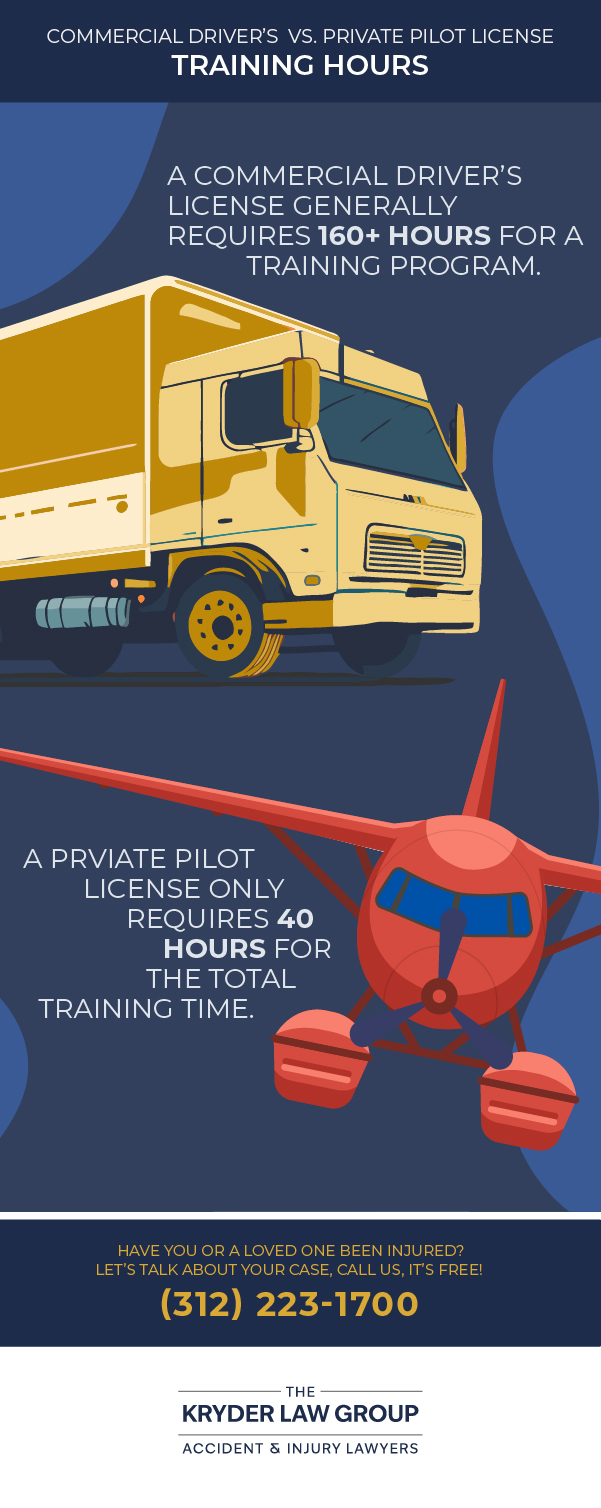
For additional perspective, an analysis of training requirements for teen drivers across the Midwest reveals that requirements are generally more stringent for teens learning to operate a motor vehicle than for adults learning to fly an aircraft. When we place these standards side by side, the difference is stark.
- Private pilot: approximately 40 flight hours minimum total training time
- CDL driver: approximately 160+ hours typically for training program
- New teen driver: 50 hours or more in most Midwestern states
Flight Training Programs: Professional vs. Hobbyist
The CDL process treats the student as a future professional, requiring deep immersion in safety protocols and practical handling. The private pilot licensing process at flight school, while technical, often treats the student more like a hobbyist.
This disparity in rigor directly correlates to safety outcomes. CDL drivers operate in a highly regulated environment with extensive preparation. Conversely, private pilots are allowed to operate complex machinery in three-dimensional space with a fraction of that preparation. It is no surprise that pilot inexperience is a leading cause of aviation mishaps when the training floor is set so low.
Midwestern State-by-State Training Requirements Comparison
The table below offers a closer look at how training standards vary—or remain consistent—across Midwestern states for private pilots, CDL holders, and new teen drivers. While federal guidelines for PPLs and CDLs provide a baseline, each state has the ability to introduce additional requirements.
|
State
|
Private Pilot (PPL) Total Hours
|
Notable PPL Components
|
CDL Total Training Hours
|
CDL Notable Components
|
Teen Driver Training Requirements
|
|
Illinois
|
40 (FAA minimum)
|
Cross-country, night flight
|
160+ (typical)
|
40 hours of classroom and 120+ behind-the-wheel training
|
Minimum 50 hours of driving practice
|
|
Indiana
|
40 (FAA minimum)
|
Cross-country, night flight
|
160+
|
17-credit-hour certificate; Classroom and behind-the-wheel training
|
Minimum 50 hours of driving practice
|
|
Iowa
|
40 (FAA minimum)
|
Cross-country, night flight
|
160+
|
Classroom and behind-the-wheel training
|
50 training hours: 30 hours of classroom instruction; 20 hours of behind-the-wheel instruction
|
|
Kentucky
|
40 (FAA minimum)
|
Cross-country, night flight
|
160+
|
Classroom and behind-the-wheel training
|
60 hours of driving practice
|
|
Michigan
|
40 (FAA minimum)
|
Cross-country, night flight
|
160+
|
Classroom and behind-the-wheel training
|
Minimum 50 hours of driving practice
|
|
Minnesota
|
40 (FAA minimum)
|
Cross-country, night flight
|
160+
|
Classroom and behind-the-wheel training
|
Minimum 50 hours of driving practice (Minimum is reduced to 40 hours if a parent/guardian takes a parent awareness class)
|
|
Missouri
|
40 (FAA minimum)
|
Cross-country, night flight
|
160+
|
Classroom and behind-the-wheel training
|
Minimum 40 hours of driving practice
|
|
Ohio
|
40 (FAA minimum)
|
Cross-country, night flight
|
160+
|
Classroom and behind-the-wheel training
|
Minimum 50 hours of driving practice
|
|
Tennessee
|
40 (FAA minimum)
|
Cross-country, night flight
|
160+
|
Classroom and behind-the-wheel training
|
Minimum 50 hours of driving practice
|
|
Wisconsin
|
40 (FAA minimum)
|
Cross-country, night flight
|
160-222+
|
Classroom and behind-the-wheel training
|
Minimum 50 hours of driving practice
|
Lessons from the Skies and Roads
Our analysis strongly suggests that the high rate of general aviation accidents is linked to insufficient pilot experience. This conclusion is undeniable when viewed against the backdrop of the rigorous training our truck drivers receive.
Flying is a privilege that comes with serious risks. By raising our standards, we can help ensure that every flight ends safely. If you have questions about aviation safety or have been affected by an accident, we are here to listen and help you understand your options.


 February 18th, 2026








 (312) 223-1700