An Analysis of Accident Distribution Across Illinois Airports 2015–2024
When an accident occurs, understanding the circumstances is crucial. This report from our Chicago plane crash lawyers provides an analysis of aviation accident data at Illinois airports from the National Transportation Safety Board (NTSB) over the ten-year period from 2015 to 2024.
Understanding where accidents happen can provide valuable insights for improving safety measures across the entire aviation system. This report will explore the provided accident distribution data and discuss its potential implications for travelers and aviation professionals in Illinois.
IL Accident Distribution: Busiest Hubs vs. Regional Airports
An interesting pattern emerges when looking at accident statistics from 2015 to 2024. According to NTSB data, there is a significant disparity in where accidents occur.
- Top 10 Busiest Airports: These airports, which include major hubs like Chicago O’Hare and Midway, account for 34.7% of all accidents in the last decade.
- Other State Airports: The remaining airports throughout Illinois, which are generally smaller and see less traffic, account for the majority of accidents, at 65.3%.
|
Type
|
Accidents
|
Percentage
|
|
Top 10 Busiest Airports
|
61
|
34.7%
|
|
Other Airports
|
115
|
65.3%
|
This finding may seem counterintuitive. One might assume that busier airports with a higher volume of aircraft takeoffs and landings would have a proportionally higher number of airliner accidents. However, the data indicates that more than two-thirds of incidents happen at less congested, regional airfields.
Source: National Transportation Safety Board. “Census of US Civil Aviation Accidents.” Accessed December 18, 2025.
Top 10 Busiest Airports in Illinois
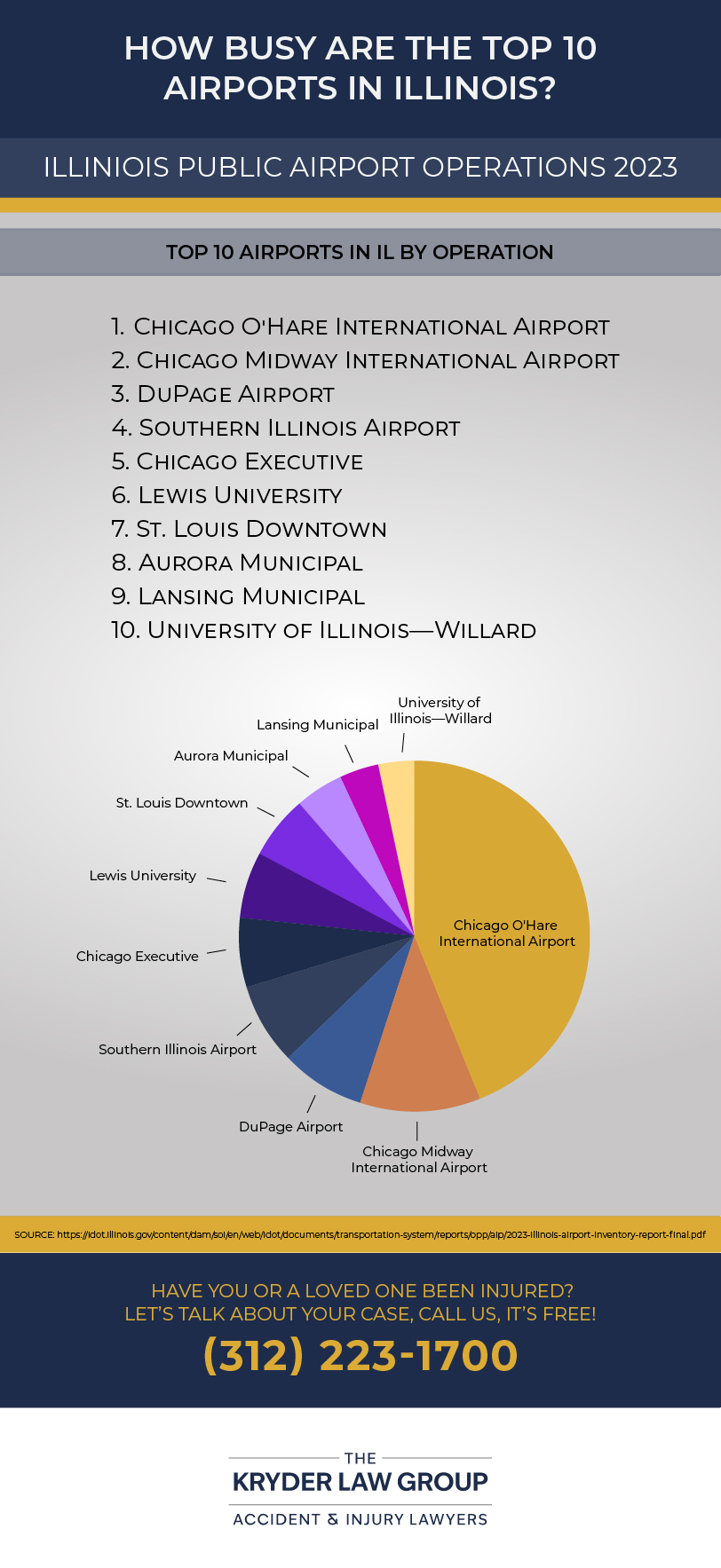
Understanding the busiest airports in the state helps provide context for the distribution of aviation activity and incidents. According to the Illinois Department of Transportation, these are the top 10 busiest airports in Illinois, based on operations data:
- Chicago O’Hare International Airport
- Chicago Midway International Airport
- DuPage Airport
- Southern Illinois Airport
- Chicago Executive
- Lewis University
- St. Louis Downtown
- Aurora Municipal
- Lansing Municipal
- University of Illinois—Willard
These airports represent the primary commercial and passenger travel hubs across Illinois.
Source: Illinois Department of Transportation. “2023 Illinois Public Use and Publicly Owned Airport Inventory Report.” Accessed December 18, 2025.
Potential Insights and Implications
The fact that a majority of accidents occur at smaller airports suggests several potential factors may be at play.
Resource and Infrastructure Differences
Major airports, like those in the top 10 busiest list, often have more extensive resources. This includes advanced air traffic control systems, longer and wider runways, and comprehensive emergency response services. Smaller airports, while safe, may operate with less sophisticated infrastructure.
Types of Flights
The top 10 airports primarily serve commercial airlines, which adhere to strict operational and maintenance protocols set by the Federal Aviation Administration. Smaller airports often cater to general aviation, including private pilots, flight training, and recreational flying. These types of general operations can present different risk profiles compared to commercial flights.
For a deeper look at national trends and accident data in civil aviation, you can refer to this U.S. Civil Aviation Accident and Fatality Report.
Pilot Experience
General aviation encompasses a wide range of pilot experience levels, from students to seasoned aviators. This contrasts with commercial airline pilots, who undergo rigorous and continuous training.
The higher percentage of accidents at smaller airfields does not mean they are unsafe. Instead, it highlights that different operational environments face unique challenges. The data suggests that efforts to enhance aviation safety should be tailored to the specific needs of all airports, not just the major hubs.
Moving Forward After a Plane Crash
Navigating the aftermath of an aviation incident can be a difficult and confusing process. The information in this report underscores the importance of understanding the distinct environments of different airports. Whether you are a pilot, passenger, or part of the aviation industry, recognizing these trends is a step toward fostering a safer flying experience for everyone in Illinois.
If you have been affected by an aviation accident, getting clear and direct guidance is essential. Our firm can help you understand your options and navigate the complexities of your case. We are here to provide the support you need.


 January 7th, 2026









 (312) 223-1700