

If you suspect a funeral home was negligent in handling the remains of your deceased loved one, an Indianapolis funeral home negligence lawyer can provide legal support. Our personal injury attorneys work to pursue justice for surviving family members, help you recover damages, and provide emotional support during this difficult time. Call us for your free confidential consultation.
In this Article
What Laws Apply to Indiana Funeral Homes?
In Indiana, the funeral industry—funeral homes and practitioners—is regulated by Indiana Code Title 25, Article 15 and the Indiana State Board of Funeral and Cemetery Service (see: Funeral & Cemetery Home), which is responsible for taking disciplinary action. These laws, along with federal rules, set strict ethical standards for consumer protection and public health.
Key regulations include:
- Licensing requirements: Funeral homes need a “funeral home license,” and practitioners need a “funeral director license.” Each facility must have a licensed funeral director as an “affidavit manager.” Licenses are renewed every two years and require 10 hours of continuing education.
- Consumer protection: Following the Federal Trade Commission (FTC) Funeral Rule, homes must provide an itemized general price list (GPL). For preneed contracts, 100% of funds must be placed in a trust or escrow, and only authorized agents of a licensed funeral home can sell them.
- Health and cremation: State law has a “48-hour rule” for holding or cremating human remains. Meticulous documentation is required for all cremations.
- Right of disposition: Indiana residents can legally appoint an “authorizing agent” through a Funeral Planning Declaration. Funeral homes are protected from liability if they follow the instructions of this designated agent.
Federal GPL
The FTC Funeral Rule: this federal law ensures consumer protection by requiring funeral homes to provide an itemized price list, allowing you to choose only the goods and services you want.
How Do I Avoid Negligence in Funeral and Burial Services?
State regulators suggest asking funeral directors detailed questions when you are making arrangements. An ethical director should be able to give clear answers:
1. Does the Funeral Director Have a License?
In Indiana, it is illegal to practice mortuary science or operate a mortuary facility without the proper credentials. Both the individual funeral director and the physical funeral home must hold separate, distinct licenses issued by the state.
2. Is the Funeral Director’s License Active?
To check if a license is active in Indiana, use the Indiana Professional Licensing Agency (PLA) license search portal. Indiana individual and facility licenses operate on a biennial cycle and must be renewed by December 31st of even-numbered years.
3. Which Funeral Company Will Provide the Services?
Under Indiana law, funeral services must be carried out by a licensed practitioner operating from a state-licensed funeral establishment. A funeral director needs clear permission from the legal next of kin or designated authorizing agent before removing or embalming a body, unless the county coroner takes legal jurisdiction in cases of sudden, violent, or suspicious death.
4. Are the Funeral Costs in Writing?
Under the FTC Funeral Rule and Indiana state law, a funeral home has a legal obligation to provide you with an itemized GPL before you discuss any specific funeral arrangements. Once selections are made, the director must provide a written, signed statement of goods and services selected, detailing all final costs, cash advance items, and payment terms before the services take place.
What Is Funeral Home Negligence?
Funeral home negligence occurs when any action or inaction by funeral home staff results in the mishandling, mistreatment, or disrespect of the body of a deceased person. It can also include failing to deliver services according to the family’s explicit wishes. These actions can have a profound impact on the grieving process for surviving family members.
Examples of Funeral Home Negligence
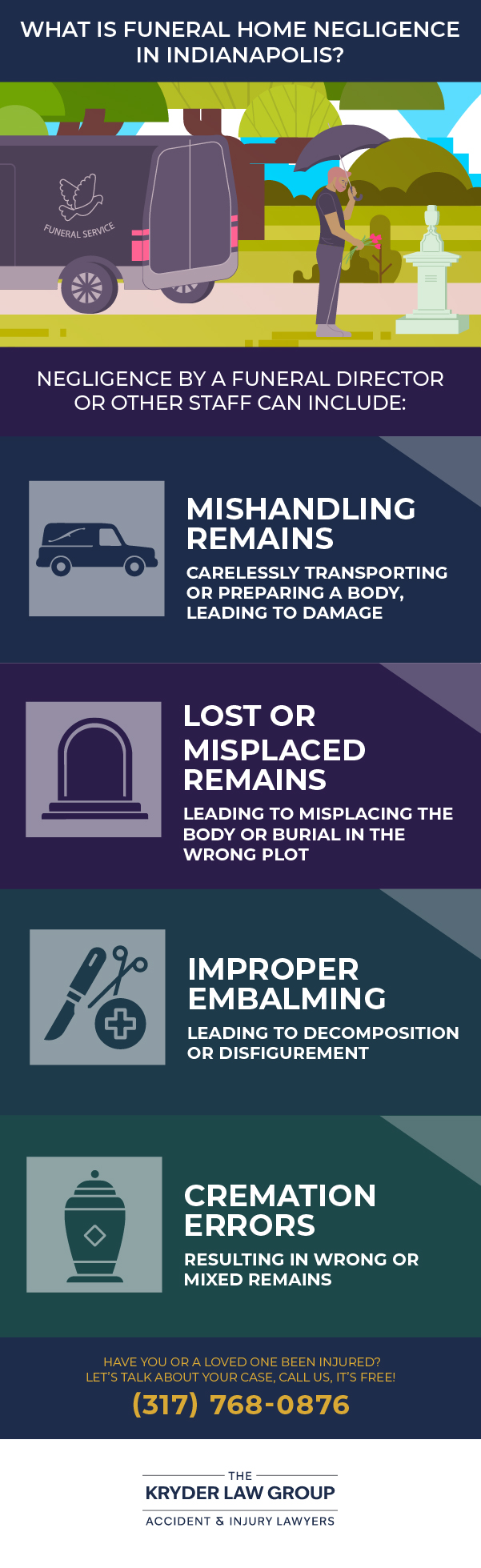
Examples of negligent funeral homes include:
- Improper storage or carelessly transporting or preparing the body
- Lost, misplaced, or wrongful burial of remains
- Improper embalming
- Cremation errors resulting in cremating the wrong body or mixing multiple bodies’ remains
- Failure to get explicit family consent
How Do I Report Funeral Director Negligence in Indiana?
To report a negligent funeral director or establishment in Indiana, you must file a complaint with the correct state or federal enforcement agency.
For Professional Misconduct, Mishandling, or Licensing Violations
- The investigative agency: for severe issues like the physical mishandling of remains, unauthorized embalming, cremation errors, or general misconduct, you must file an official complaint with the Office of the Indiana Attorney General Consumer Protection Division.
- How to file: you can complete the official electronic Indiana Licensing Enforcement and HPU Complaint Form; alternatively, you can download a hard copy of the Indiana Attorney General Licensing Enforcement Form and mail it to their Indianapolis office.
For a Prepaid, Preneed Contract and Financial Fraud
- The investigative agency: if a funeral home mismanaged preneed trust accounts, added hidden costs to an active escrow plan, or committed financial fraud, it falls under consumer deception.
- How to file: file a specialized consumer complaint through the primary Indiana Attorney General consumer complaint portal.
For Pricing Violations or Failure to Provide a GPL
Report the funeral home to the FTC at ReportFraud.ftc.gov.
Who Can File a Funeral Home Negligence Lawsuit in Indiana?
In Indiana, only specific individuals can file a funeral home misconduct lawsuit.
- The person who signed the contract with the funeral home can sue for breach of contract and financial losses.
- The person with the right of disposition (like a surviving spouse, adult child, or parent) can sue for emotional distress caused by the mishandling of remains.
- The personal representative of the estate can sue if the funeral home’s actions caused financial harm to the estate, such as mismanaging prepaid funds.
Can a Medical Malpractice or Wrongful Death Case Be Filed Against a Funeral Home in Indiana?
No. In Indiana, wrongful death and medical malpractice laws do not apply to post-mortem negligence by a funeral home.
- Wrongful death: A wrongful death claim requires proving that the defendant’s actions caused the person’s death. Since funeral homes only receive the body after death, they cannot be the legal cause of it.
- Medical malpractice: Indiana’s Medical Malpractice Act applies only to the care of living patients by licensed healthcare providers. Funeral directors are regulated as mortuary professionals not medical providers.
If a funeral home mishandles a body, the appropriate legal action is a civil lawsuit with a personal injury lawyer, such as for breach of contract or negligent infliction of emotional distress, not wrongful death or medical malpractice.
How Does an Attorney Prove a Funeral Service Provider Was Negligent?
To prove a funeral service provider was negligent in Indiana, a plaintiff must show:
- The funeral home owed a legal duty of care to the deceased.
- The funeral home failed that duty when their actions fell below the accepted standard.
- That specific failure directly caused the plaintiff harm.
- That harm caused economic damages and non-economic damages.
The resulting damages can include emotional distress and financial losses (not just physical injury).
What Financial Compensation Can Be Recovered in Funeral Home Negligence Cases?
If your family suspects funeral home negligence in Indiana, you are entitled to seek compensation for both the emotional and financial damages you suffered.
Compensatory Damages
You can seek compensation for the severe emotional distress caused by the mishandling of a loved one’s remains, even without physical injury. This can cover medical bills for therapy, lost wages from time off work, and corrective expenses such as secondary reburial expenses or secondary cremation.
Punitive Damages
Punitive damages are strictly capped in Indiana, and you must prove that the defendant acted with willful, reckless disregard or malice (gross negligence alone is not enough).
How Can an Indianapolis Funeral Home Negligence Lawyer Help?
If you suspect negligence in a funeral home’s actions, seek legal counsel from an experienced Indianapolis funeral home negligence attorney. We guide grieving families through complex legal issues and help them seek fair compensation for their financial losses and emotional suffering. With a thorough investigation (interviewing witnesses and gathering expert testimony), we gather and preserve evidence (like coroner’s reports and the contract to provide agreed-upon services), identify responsible parties, and handle settlement negotiations with insurance companies for a fair settlement.
Indiana enforces a strict two-year statute of limitations for personal injury, emotional distress, and professional liability claims; act before this time limit to protect your right to pursue legal action for your specific circumstances.
We work on a contingency fee basis, eliminating upfront costs for legal services provided. You won’t have to pay any legal fees unless we successfully recover compensation for you.
Free Case Evaluation for Funeral Negligence Cases
Call our law firm today for a free consultation to discuss how to recover compensation. An experienced attorney will explain the legal process in Indiana and outline your legal options to seek justice your family deserves.










 (312) 223-1700