

Kentucky law gives hazing and bullying victims real legal options. Schools, student organizations, and individuals can all face civil liability. If you or someone you love was harmed in Louisville, Kentucky’s personal injury statute of limitations gives you one year to file a claim—so taking legal action quickly matters.
Hazing and bullying leave lasting damage—physically, emotionally, and financially. Whether it happened at a Louisville high school, the University of Louisville, a fraternity, or a sports team, the harm is real. And so are your legal rights.
Kentucky has laws that address hazing directly, and schools across Jefferson County are required to have anti-bullying policies in place. But knowing the law exists and knowing how to use it are two very different things. Victims and their families have real legal recourse when institutions or individuals fail to keep students safe. This guide breaks down what Kentucky law actually says, who can be held liable, and what steps to take if you’ve been targeted.
If you’re ready to talk to a Louisville hazing and bullying lawyer, our personal injury law firm offers a free consultation.
In this Article
How Can a Lawyer Help in Cases of Bullying and Hazing in Louisville?
What Is Hazing Under Kentucky Law?
Kentucky’s hazing statute is found at KRS § 164.375. Under this law, hazing is defined as any intentional or reckless act directed against a student for the purpose of initiation into, affiliation with, or membership in any organization operating at a school or college.
The statute makes hazing a Class B misdemeanor when the act creates a risk of physical or mental harm—and a Class A misdemeanor when physical injury actually occurs. Importantly, the law states that consent is not a defense. A student who “agreed” to be hazed cannot be used as a shield by the person or group that caused the harm.
Criminal charges are handled separately from civil claims. Even if no criminal case is filed—or if charges are dropped—a hazing victim in Louisville, KY, can still pursue a civil lawsuit for damages.
What Activities Count as Hazing in Kentucky?
Hazing can take many forms. Courts and schools typically recognize activities such as physical abuse, forced consumption, humiliation, and other forms of coercion or peer mistreatment:
- Physical abuse: striking, paddling, forced exercise, sleep deprivation
- Forced consumption: alcohol, substances, or food in dangerous quantities
- Humiliation: public degradation, offensive tasks, or psychological abuse
- Isolation or exclusion: cutting someone off from resources or support
- Coercion: forcing participation in illegal or degrading acts under threat of exclusion
The setting doesn’t always matter. Hazing that happens off-campus—at a house party, during a team trip, or at a private event—can still fall under Kentucky law if it’s connected to a school-affiliated organization.
Kentucky School Anti-Bullying Requirements
Under KRS § 158.148, every public school in Kentucky—including Louisville’s Jefferson County Public Schools (JCPS)—must adopt a written policy prohibiting bullying. Kentucky’s Department of Education recognizes “bullying/hazing” within its student discipline guidelines. Severe bullying can involve criminal offenses, as defined in Kentucky Revised Statutes. The law defines bullying as any unwanted, repeated written, verbal, or physical act against a student that creates a hostile environment or substantially disrupts the school.
When bullying involves sexual harassment or misconduct based on gender, sex, race, color, or national origin, it crosses from school policy violations into federal civil rights matters. Under federal law—specifically Title IX and Title VI—educational institutions receiving public funds must promptly investigate and address systemic peer abuse.
Schools are required to:
- Investigate and gather evidence of reported incidents of bullying in a timely manner
- Document complaints and outcomes
- Notify parents of both the victim and the alleged aggressor
- Report (mandatory) knowledge of felony hazing incidents
- Take corrective action to stop the behavior and prevent retaliation
- Train staff on identifying and responding to bullying
When a Louisville school fails to follow these requirements—ignoring complaints, dismissing reports, or retaliating against a student who came forward—that failure can become part of a civil claim against the school or district.
Cyberbullying in Kentucky
Kentucky’s bullying law covers cyberbullying as well. Electronic harassment, threatening messages, and social media abuse that target a student can all trigger school obligations under KRS § 158.148—even when the conduct happens outside school hours. If the bullying substantially disrupts the learning environment or targets a student based on protected characteristics, the school is obligated to act.
Who Can Be Held Liable for Hazing and Bullying in Louisville?
Civil liability for hazing and bullying doesn’t stop with the person who threw the punch or sent the message. Multiple parties can be held liable, depending on the circumstances.
Individual Perpetrators
The person who committed the hazing or bullying act is the most direct target of a civil claim. Claims may include assault and battery, intentional infliction of emotional distress (IIED), or negligence. If the conduct was intentional and malicious, punitive damages may also be available under Kentucky law.
Student Organizations, Fraternities, and Sororities
Organizations that permit, encourage, or fail to prevent hazing can be held liable as institutions. This is particularly relevant for Greek-letter organizations at the University of Louisville or Bellarmine University. If leadership knew about hazing practices and did nothing, the organization’s governing body—and potentially its national chapter—can be brought into a civil lawsuit.
Schools and School Districts
Teachers, coaches, administrators, and staff owe a duty of care to the students under their supervision. When employees fail to report or actively tolerate hazing and severe peer abuse, their failure to act during the scope of their employment can form the basis of a negligence claim against both the individual employee and the school district.
Coaches and School Staff
Individual employees can face personal liability when they witness hazing or bullying and do nothing. A coach who watches teammates haze a new player, or a teacher who dismisses a bullying complaint without investigation, may be personally named in a civil claim alongside the school.
Statute of Limitations for Hazing and Bullying Claims in Kentucky
Time matters. In Kentucky, the general statute of limitations for personal injury claims is one year from the date of the injury, under KRS § 413.140. This applies to most hazing and bullying civil claims, including assault, battery, and IIED.
There are important exceptions:
- Minors: the statute of limitations may be tolled (paused) until the victim turns 18, giving them one year from their 18th birthday to file.
- Discovery rule: in some cases, where injuries weren’t immediately apparent—particularly psychological harm—the clock may start when the victim discovered (or reasonably should have discovered) the injury.
- Federal civil rights claims: claims under Title IX or Title VI may have different timelines, depending on the underlying facts.
Missing the filing deadline almost always means losing the right to sue. If you’re unsure where you stand, the safest move is to speak with a Louisville lawyer as soon as possible.
What to Do After a Hazing or Bullying Incident in Louisville
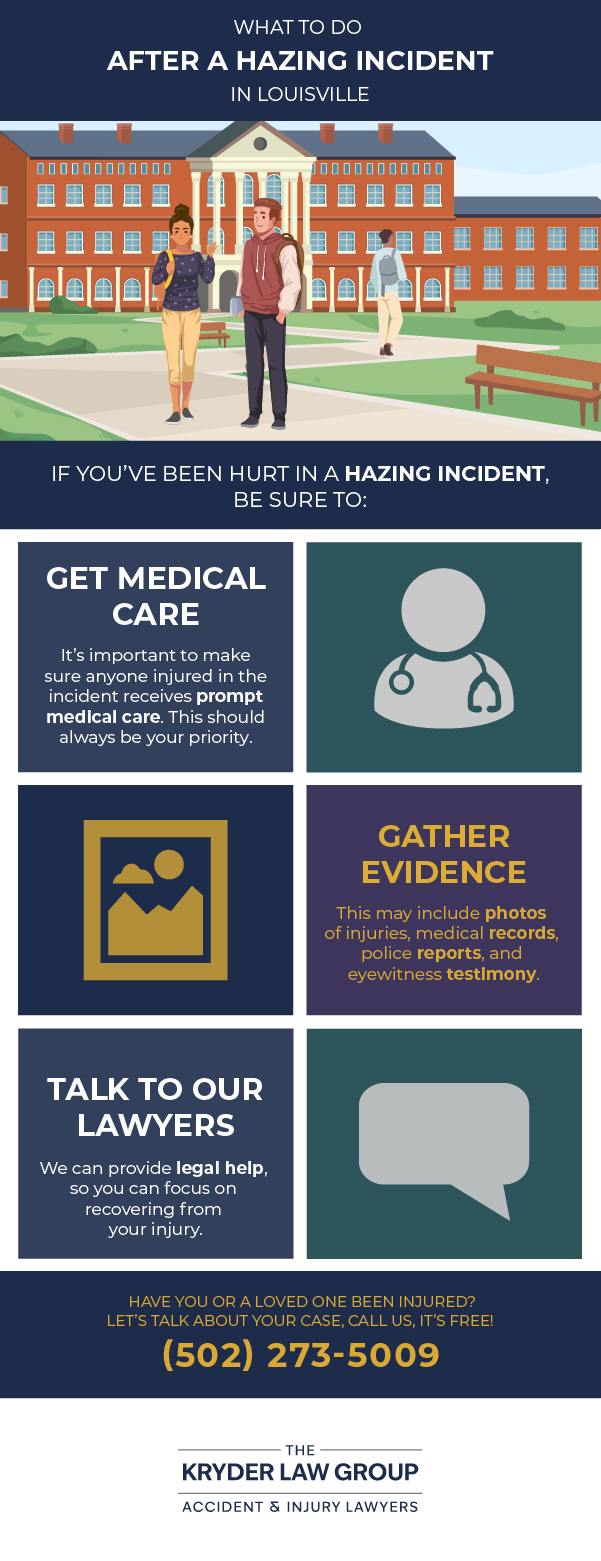
Navigating university administration, school board policies, and insurance adjusters on behalf of a victim is overwhelming. You do not have to deal with school officials or defense lawyers on your own while recovering from trauma.
Here’s what to prioritize:
- Seek medical attention. Document physical injuries right away. Even if injuries seem minor, a medical record creates a contemporaneous account of the harm.
- Report the incident. File a formal complaint with the school, university, or relevant organization. Put it in writing. Keep a copy.
- Preserve evidence. Save text messages, social media posts, emails, videos, and any other documentation of the bullying or hazing. Take screenshots before anything gets deleted.
- Write down what happened. Create a detailed, dated account of every incident—what was said, who was present, and what followed. Memory fades; documentation doesn’t.
- Identify witnesses. Anyone who saw or heard what happened may be able to support your claim.
- Avoid posting about the incident. Social media activity can complicate legal claims. Discuss this with a lawyer before posting anything publicly.
- Talk to a Louisville hazing and bullying lawyer. Many civil claims have a one-year window in Kentucky. Getting legal guidance early in the process protects your options.
The Real Cost of Hazing and Bullying
Victims often underestimate the full scope of what they’ve lost. A civil claim in Louisville can seek compensation for:
- Medical expenses: emergency care, therapy, ongoing treatment
- Lost educational opportunities: missed classes, dropped courses, or delayed graduation
- Pain and suffering: physical and emotional harm
- Emotional distress: anxiety, depression, post-traumatic stress disorder (PTSD), and related conditions
- Reputational harm: damage to academic standing or campus life
- Punitive damages: in cases of especially egregious conduct, Kentucky courts may award additional damages designed to punish the wrongdoer
The value of a case depends on the severity of the conduct, the evidence available, the number of parties involved, and the damages suffered. A Louisville attorney can help you assess what your claim may be worth.
Resources for Families
- JCPS Compliance & Investigations—handles formal bullying, harassment, and discrimination complaints for Louisville-area K-12 families
- University of Louisville Office of Student Affairs—a first point of contact for students experiencing hazing or bullying within campus organizations or Greek life
- Bellarmine University Division of Student Affairs—manages student welfare, anti-hazing, and anti-bullying matters for Bellarmine students
- Kentucky Department of Education: Safe Schools—provides guidance on K-12 anti-bullying policies under KRS § 158.148
- HazingPrevention.org—national nonprofit offering resources for students, families, and educators
- StopBullying.gov—federal resource hub for bullying prevention and response
- Navigating Parental Responsibility: Bullying Laws Across the United States—an overview of how bullying laws and parental responsibility vary by state
- Louisville Metro Police Department Non-Emergency Line—(502) 574-7111 for reporting non-urgent incidents
You Don’t Have to Figure This Out Alone
Hazing and bullying cases are emotionally hard and legally complex. Schools and organizations often have legal teams protecting their interests from the start. You deserve an advocate to fight for justice.
We can review your situation, identify liable parties, and explain your options clearly. There’s no obligation after a consultation—but there is a real cost to waiting.
If someone you love has been harmed, reach out today. Everything you share is confidential.
Frequently Asked Questions
Here are answers to questions we are often asked by Louisville clients about hazing and bullying.
Is hazing illegal in Kentucky?
Yes. Under KRS § 164.375, hazing is a criminal offense in Kentucky. It is classified as a Class B misdemeanor when it creates a risk of harm and a Class A misdemeanor when it results in physical injury. Consent is not a legal defense. Victims can also pursue civil claims independently of any criminal case.
Can I sue a school in Louisville for not stopping bullying?
Yes, in certain circumstances. If a Louisville school or JCPS failed to investigate a bullying complaint, ignored known misconduct, or didn’t follow Kentucky’s anti-bullying requirements under KRS § 158.148, that failure may support a negligence claim. Federal claims under Title IX or Title VI may also apply when the bullying was based on sex, race, or another protected characteristic.
How long do I have to file a hazing or bullying lawsuit in Kentucky?
Kentucky’s personal injury statute of limitations is generally one year from the date of injury under KRS § 413.140. Minors may have additional time—typically until one year after they turn 18. Given how quickly this window can close, consulting a lawyer promptly is strongly advised.
What if the hazing happened off-campus or at a private event?
Location doesn’t automatically determine legal liability. If the hazing was connected to a school-affiliated organization, team, or club, Kentucky law and school obligations may still apply. Off-campus hazing that causes injury can still support civil claims against individuals and organizations.
What if the organization denies that hazing happened?
Denial is common. It doesn’t end the case. Evidence—text messages, witness statements, medical records, photographs, and internal communications—can establish what happened even when organizations dispute it. Civil cases use a “preponderance of the evidence” standard, which is lower than the criminal “beyond a reasonable doubt” threshold.
Does it cost anything to speak with a Louisville hazing and bullying lawyer?
Our personal injury attorneys in Louisville offer free initial consultations for our potential clients, and we represent clients on a contingency fee basis, meaning you don’t pay attorney’s fees unless your case results in a recovery.










 (312) 223-1700